Detecting AD Credential Attacks
Third room in the Active Directory for SOC module, after Monitoring Active Directory and Detecting AD Initial Access. Those two covered what normal looks like and how an attacker gets through the front door. This one covers the five techniques that bridge the gap between attacker has a foothold and attacker owns the domain: Kerberoasting, AS-REP roasting, LSASS dumping, DCSync, and NTDS.dit extraction.
The framing is a real intrusion. In August 2024 a DFIR Report case documented BlackSuit ransomware operators using Rubeus to Kerberoast service accounts, AS-REP roasting an account with preauthentication disabled, and dumping credentials from LSASS memory, all in a single intrusion. A separate BlackSuit case investigated by ReliaQuest that same year saw over 20 accounts compromised through Kerberoasting alone, including a domain administrator. None of it was exotic.
Eight tasks, eighteen graded answers, and a nice structural touch: each task has its own Splunk index (task2 through task7), so the datasets never contaminate each other. All solved 100%.

As with the previous rooms I ran the SPL through Splunk’s REST API and re-ran the interesting searches in the browser for the screenshots. And again: set the time picker to All time, the data is timestamped March 2026.
Task 2: Kerberoasting
Kerberoasting works because any domain user can request a service ticket for any account with an SPN, and the ticket is encrypted with the service account’s password hash. Request it, take it offline, crack it. The room’s explanation of how accounts end up roastable is the honest one: an admin needs to run SQL Server, uses their own DA account as the service identity because it is quick, sets a memorable password, and moves on. Repeat over several years.
The detection signal is the encryption type. Modern AD issues AES-256 (0x12); attackers deliberately request RC4 (0x17) because it cracks far faster. So one query separates the attack from the noise:
index=task2 EventCode=4769
| stats count by Ticket_Encryption_Type, Account_Name, Service_Name, Client_Address
| sort - Ticket_Encryption_Type
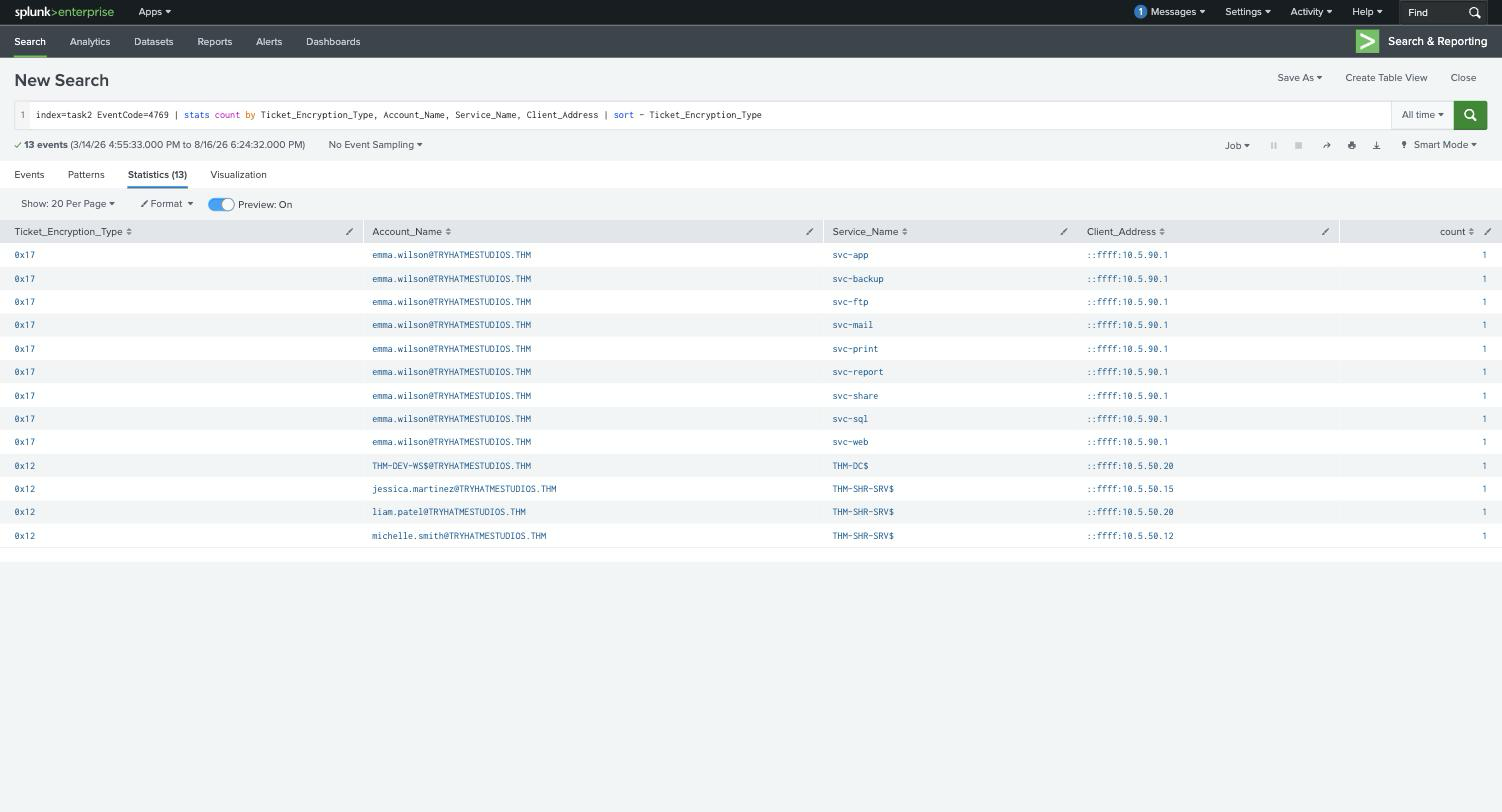
The shape is unmistakable. Nine 0x17 rows, all from emma.wilson, all from 10.5.90.1, each hitting a different service account, svc-app, svc-backup, svc-ftp, svc-mail, svc-print, svc-report, svc-share, svc-sql, svc-web. Below them sit the four legitimate 0x12 requests from real workstations to THM-DC$ and THM-SHR-SRV$.
So: 9 service accounts targeted, by emma.wilson, from 10.5.90.1. One user enumerating every SPN in the domain within a few seconds is not a person doing their job.
Task 3: AS-REP roasting
Same offline-cracking goal, different weakness. AS-REP roasting targets accounts with preauthentication disabled, and unlike Kerberoasting it does not need valid domain credentials at all, the DC simply hands over encrypted material to anyone who asks.
Normal Kerberos requires the user to prove knowledge of their password first by encrypting a timestamp, which the DC logs as Event 4768 with Pre_Authentication_Type=2. When preauth is off, that value is 0:
index=task3 EventCode=4768
| stats count by Pre_Authentication_Type, Account_Name, Ticket_Encryption_Type, Client_Address
#   0   alex.reed         0x17   ::ffff:10.5.90.1    2
#   2   jessica.martinez  0x12   ::ffff:10.5.50.15   1
#   2   liam.patel        0x12   ::ffff:10.5.50.20   1
alex.reed is the account with preauthentication disabled, and note it lines up on both axes: Pre-Auth Type 0 and RC4 and the same 10.5.90.1 attacker host from Task 2. Everyone else is Type 2 with AES from their own workstation.
Task 4: LSASS credential dumping
Roasting gets you hashes to crack. Dumping LSASS gets you credentials directly out of memory, no cracking required. The detection source shifts from Security events to Sysmon Event ID 10 (ProcessAccess), which records one process opening a handle to another.
index=task4 EventCode=10 TargetImage="*lsass.exe"
| stats count by SourceImage, GrantedAccess | sort -count
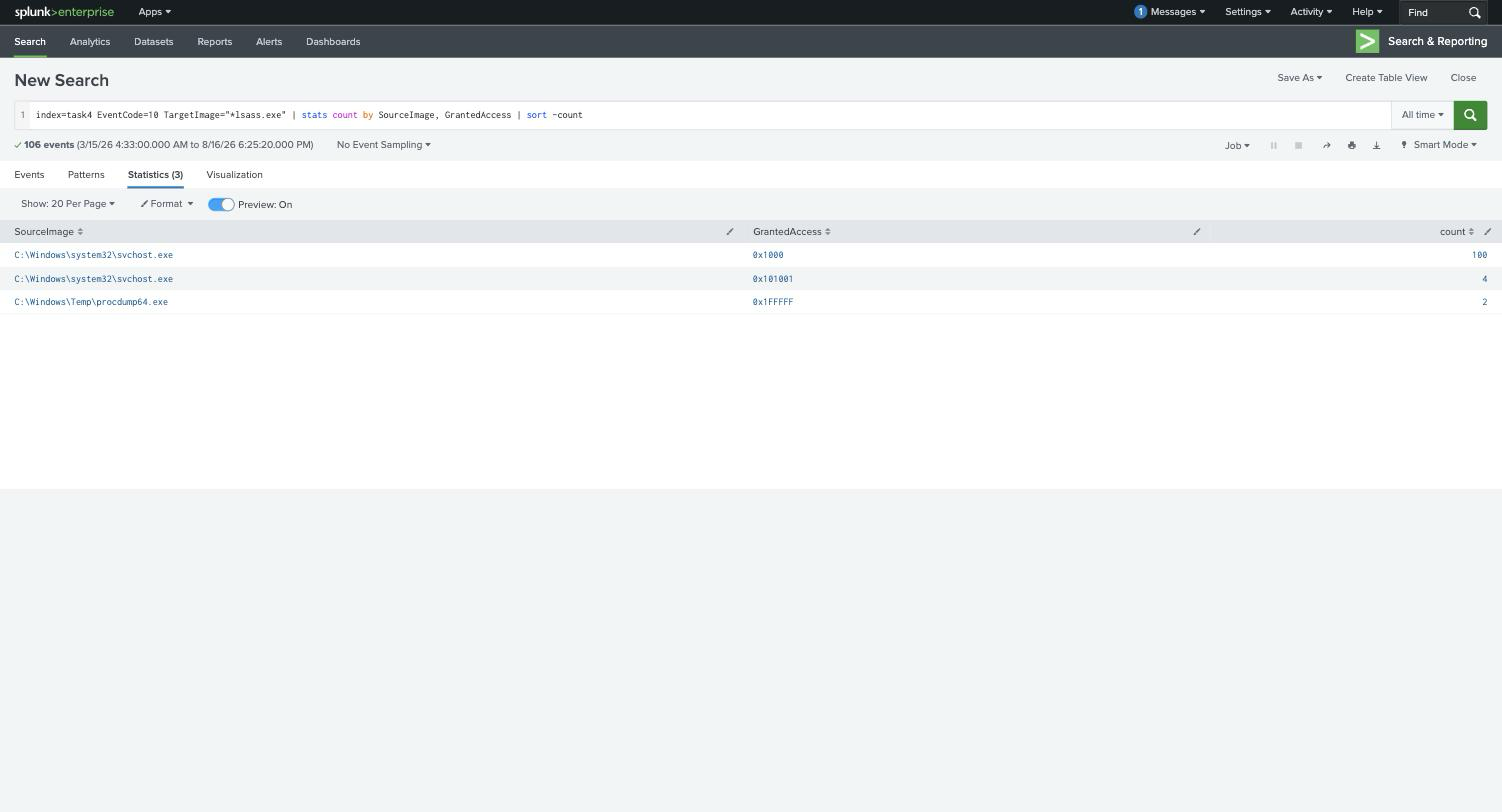
Three rows, and the third is the intrusion. svchost.exe touching LSASS 100 times with 0x1000 is routine Windows behaviour, this is exactly why “alert on any LSASS access” produces unusable noise. The outlier is C:\Windows\Temp\procdump64.exe with 0x1FFFFF, which is PROCESS_ALL_ACCESS. Two signals stack here: the access mask is far broader than anything legitimate needs, and a signed Sysinternals binary is running out of C:\Windows\Temp.
The third question is the interesting one, because it asks how the dump was taken. The answer is in the CallTrace:
index=task4 EventCode=10 TargetImage="*lsass.exe" SourceImage="*procdump64.exe"
| table _time, GrantedAccess, CallTrace
#   ...KERNEL32.DLL+2364e | dbgcore.DLL+aeef | dbgcore.DLL+1ac05 | dbgcore.DLL+13cf0 ...
dbgcore.dll, the library exporting MiniDumpWriteDump. Its presence in the call stack is what proves memory was actually written to a dump file rather than merely read, and it is the signature that survives renaming the executable.
Task 5: DCSync
DCSync is the point where an attacker stops stealing individual credentials and asks the domain controller to hand over every password hash in the directory, by impersonating a DC and invoking replication. There is no malware and no process to catch, from AD’s point of view it is a legitimate operation, just performed by the wrong principal.
The evidence is Event 4662, object access on the domain object with Control Access rights:
index=task5 EventCode=4662 Properties="*Control Access*"
| stats count by Account_Name, Logon_ID, Object_Type | sort -count
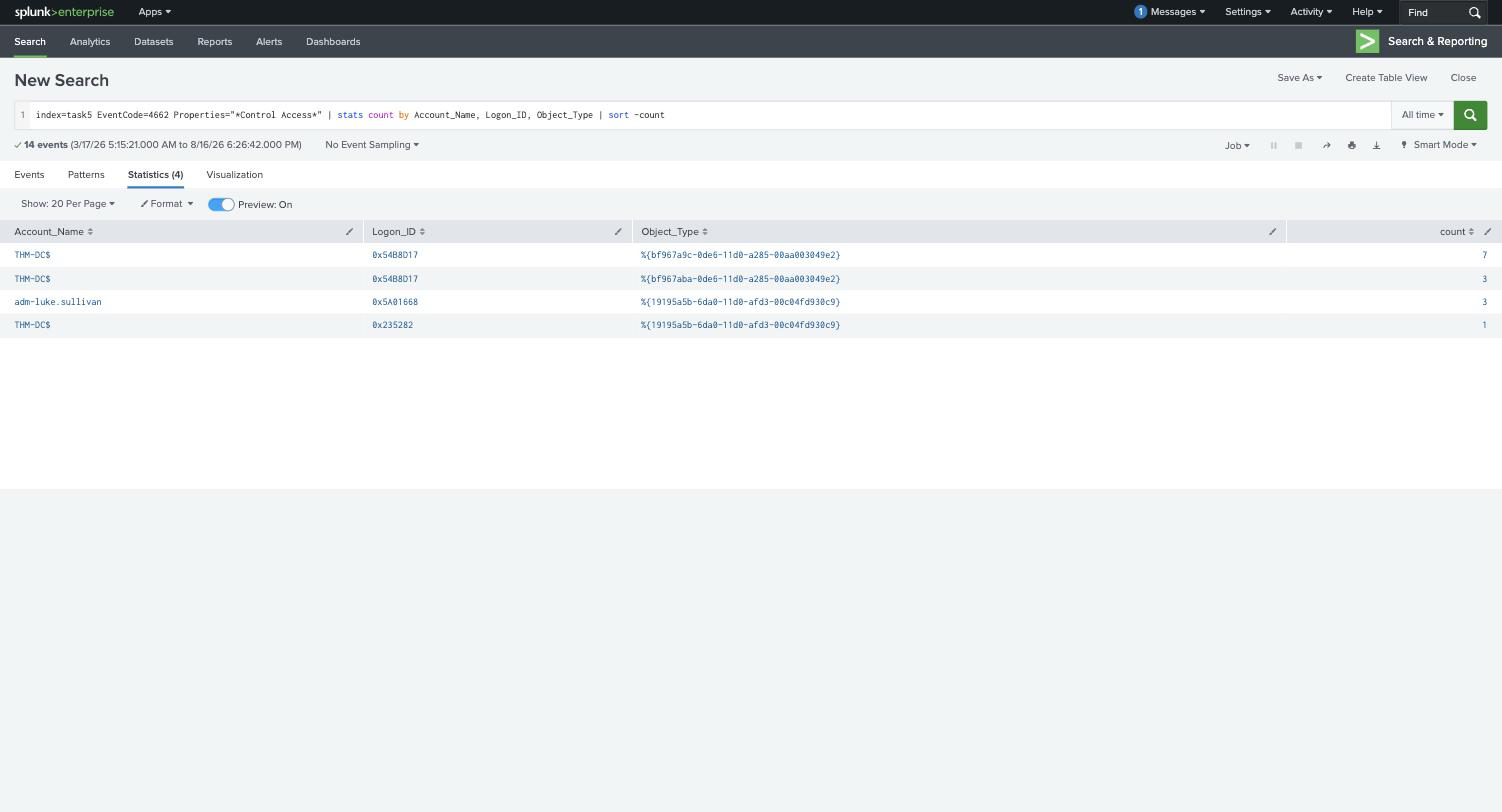
The trick is knowing what to ignore. Domain controllers replicate with each other constantly, so THM-DC$ generating 4662 is expected, machine accounts should be there. What should never appear is a user account performing replication against the domain object 19195a5b-6da0-11d0-afd3-00c04fd930c9. That is adm-luke.sullivan, on Logon ID 0x5A01668.
The Logon ID is the pivot that makes this actionable. It ties the directory operation back to the session that performed it:
index=task5 EventCode=4624 Logon_ID=0x5A01668
| table _time, Account_Name, Logon_Type, Source_Network_Address
#   2026-03-17 05:30:47   adm-luke.sullivan   Type 3   10.5.90.1
10.5.90.1 again, the same host that ran the Kerberoasting and the AS-REP roasting. Four techniques, one operator.
Task 6: NTDS.dit extraction
The last resort when DCSync is not available: copy the AD database off the disk. ntds.dit is locked while the DC is running, so the attacker needs either a volume shadow copy or the built-in IFM export. This dataset has both, which makes the command timeline the cleanest artefact in the room:
index=task6 EventCode=1 (CommandLine="*ntds*" OR CommandLine="*vssadmin*" OR CommandLine="*ShadowCopy*")
| table _time, CommandLine | sort _time
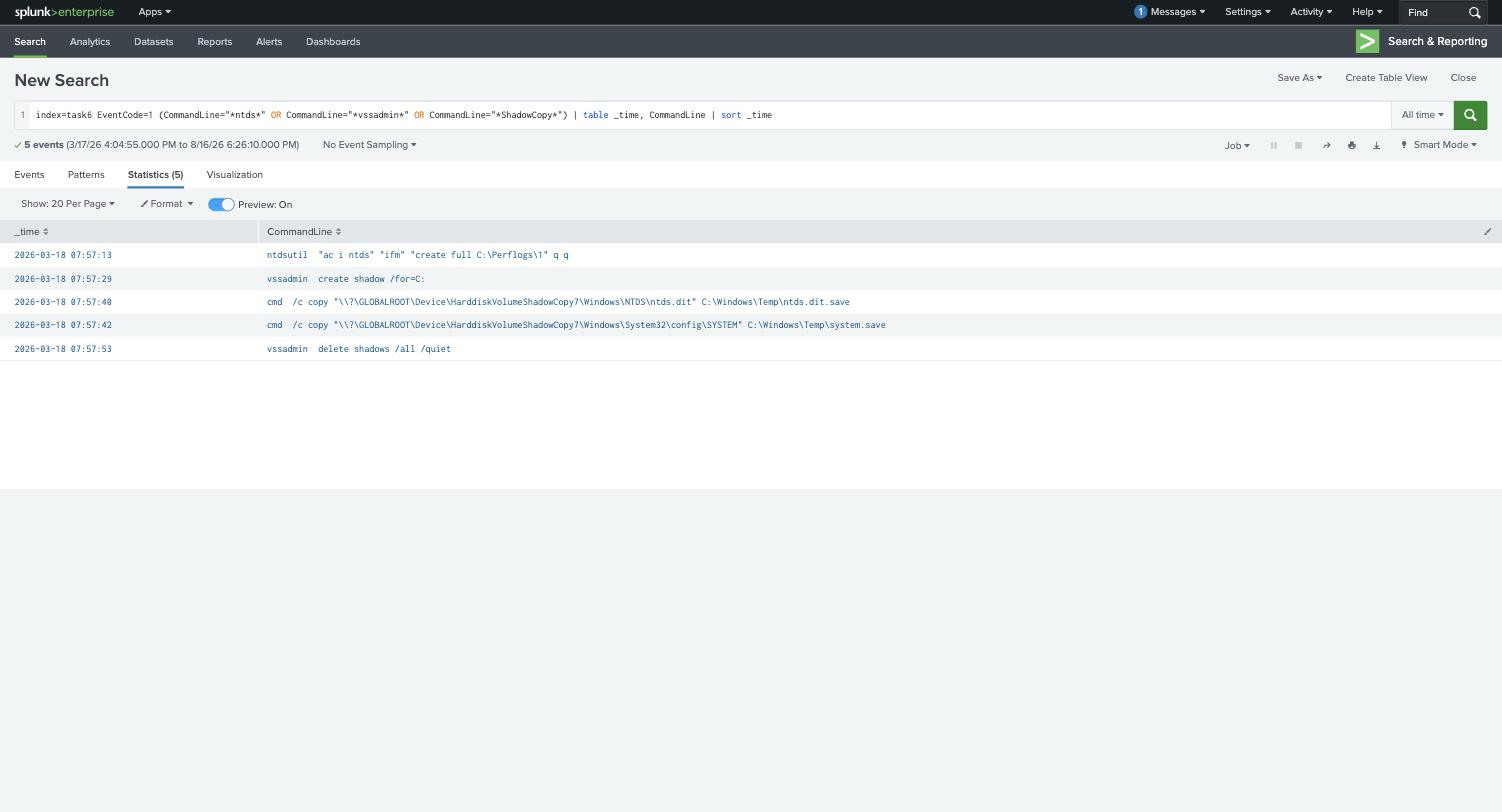
Five commands, forty seconds:
| Time | Command |
|---|---|
| 07:57:13 | ntdsutil "ac i ntds" "ifm" "create full C:\Perflogs\1" q q |
| 07:57:29 | vssadmin create shadow /for=C: |
| 07:57:40 | cmd /c copy "\\?\GLOBALROOT\Device\HarddiskVolumeShadowCopy7\Windows\NTDS\ntds.dit" C:\Windows\Temp\ntds.dit.save |
| 07:57:42 | cmd /c copy "\\?\GLOBALROOT\...\Windows\System32\config\SYSTEM" C:\Windows\Temp\system.save |
| 07:57:53 | vssadmin delete shadows /all /quiet |
So the extraction command is the ntdsutil IFM one-liner, the shadow copy source is \\?\GLOBALROOT\Device\HarddiskVolumeShadowCopy7\Windows\NTDS\ntds.dit, and the staging directory is C:\Windows\Temp.
Three details worth carrying away. The attacker copied SYSTEM alongside ntds.dit, the database is encrypted with the boot key stored in that hive, so ntds.dit alone is useless and the pair is what makes the theft complete. The C:\Perflogs target is a classic staging directory: it exists by default, it is writable, and nobody looks in it. And the final vssadmin delete shadows /all /quiet is anti-forensics that doubles as a ransomware precursor, the same command appears in nearly every ransomware playbook to prevent recovery.
One practical note on answering these: the room wants the command line exactly as Splunk shows it, and Sysmon renders these with a double space after the image name (ntdsutil "ac i ntds"). The underscore mask on the answer box confirms the character count, so match it literally.
Task 7: the investigation challenge
A fresh index, an unguided intrusion, and five questions that ask you to repeat all four detections without being told which is which. Every query from the earlier tasks transfers directly.
index=task7 EventCode=4768 Pre_Authentication_Type=0 | stats count by Account_Name
#   -> mia.turner

index=task7 EventCode=4769 Ticket_Encryption_Type=0x17 | stats dc(Service_Name) by Account_Name
#   -> nathan.brooks, 9 service accounts

index=task7 EventCode=10 TargetImage="*lsass.exe" | stats count by host, SourceImage, GrantedAccess
#   -> THM-DEV-WS  C:\Windows\system32\rundll32.exe  0x1FFFFF (and 0x1410)
So the AS-REP target is mia.turner and the Kerberoasting account is nathan.brooks. The LSASS answer is rundll32.exe, not procdump this time, which is the point of the challenge. The CallTrace shows comsvcs.dll followed by dbgcore.DLL, meaning this is the living-off-the-land rundll32 comsvcs.dll MiniDump technique: no attacker binary on disk at all, just two signed Microsoft DLLs. The behavioural signature is identical even though the tooling changed completely.
That produced the one genuine judgement call in the room. rundll32.exe shows two ProcessAccess events, 0x1410 and 0x1FFFFF, so which is “the LSASS dump”? The CallTrace decides it: only the 0x1FFFFF event contains dbgcore.DLL in its stack. The 0x1410 handle is the preceding open; the 0x1FFFFF one is where MiniDumpWriteDump actually ran. 0x1FFFFF is the answer.
For DCSync, the naive query misleads. Both adm-luke.sullivan and nathan.brooks generate 4662 events, and nathan.brooks has 17 of them. But filtering on Properties separates them: nathan.brooks’s are all Read Property against user objects (bf967aba), which is ordinary LDAP enumeration, while adm-luke.sullivan has 105 Control Access events against the domain object. adm-luke.sullivan performed the DCSync.
Worth flagging for anyone building this detection: I first tried filtering on the replication extended-right GUIDs (1131f6aa-…, 1131f6ad-…) since that is the canonical DCSync rule, and it returned zero results, this dataset carries the friendly Control Access string in Properties rather than the raw GUIDs. Write the rule against what your logs actually contain, not against what the blog posts say they should.
Task 8: what ties it together
The through-line is that each of these five techniques has a signature that does not depend on the tool. RC4 in a 4769 does not care whether the attacker ran Rubeus or Impacket. Pre_Authentication_Type=0 is a property of the account, not the exploit. A user account issuing Control Access against the domain object is DCSync regardless of whether it was mimikatz or secretsdump. And dbgcore.dll in a CallTrace means a minidump was written whether the caller was procdump64.exe or rundll32.exe, which the challenge demonstrates by swapping exactly that.
The other lesson is about false positives, and the room teaches it by including them rather than describing them. svchost.exe touching LSASS a hundred times, domain controllers replicating with each other, users reading directory properties, all present, all benign, all indistinguishable from the attack if you alert on the event ID alone. The discriminator is never the event; it is the field. Encryption type, preauth type, access mask, principal class, Properties value.
Room solved 100%: eight tasks, eighteen answers, 40 points.