Intro to Threat Emulation
This is the opening room of the SOC Level 2 Threat Emulation module, and it sets the vocabulary and process for the hands-on Atomic Red Team and CALDERA rooms that follow. It is mostly conceptual, but it finishes with a genuinely fun pair of interactive exercises where you step into a red teamer’s shoes and emulate two real threat groups.
Task 2: what threat emulation actually is
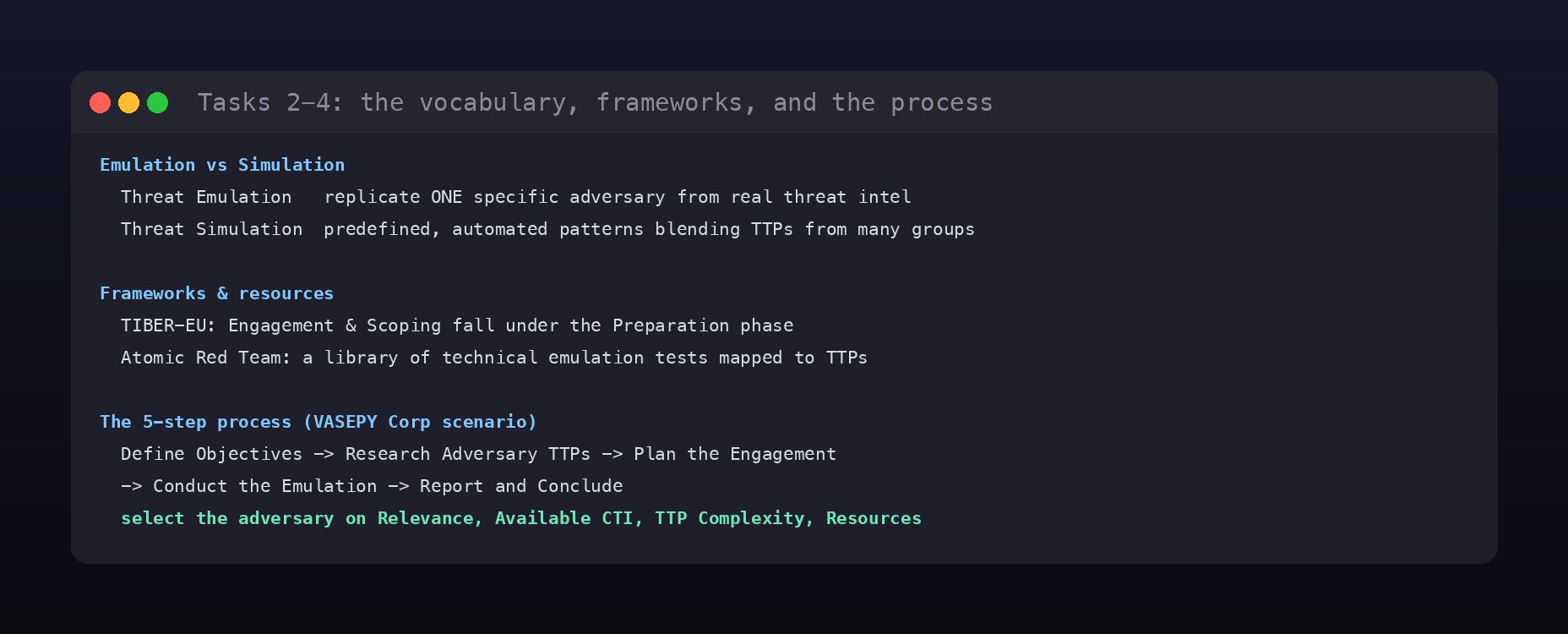
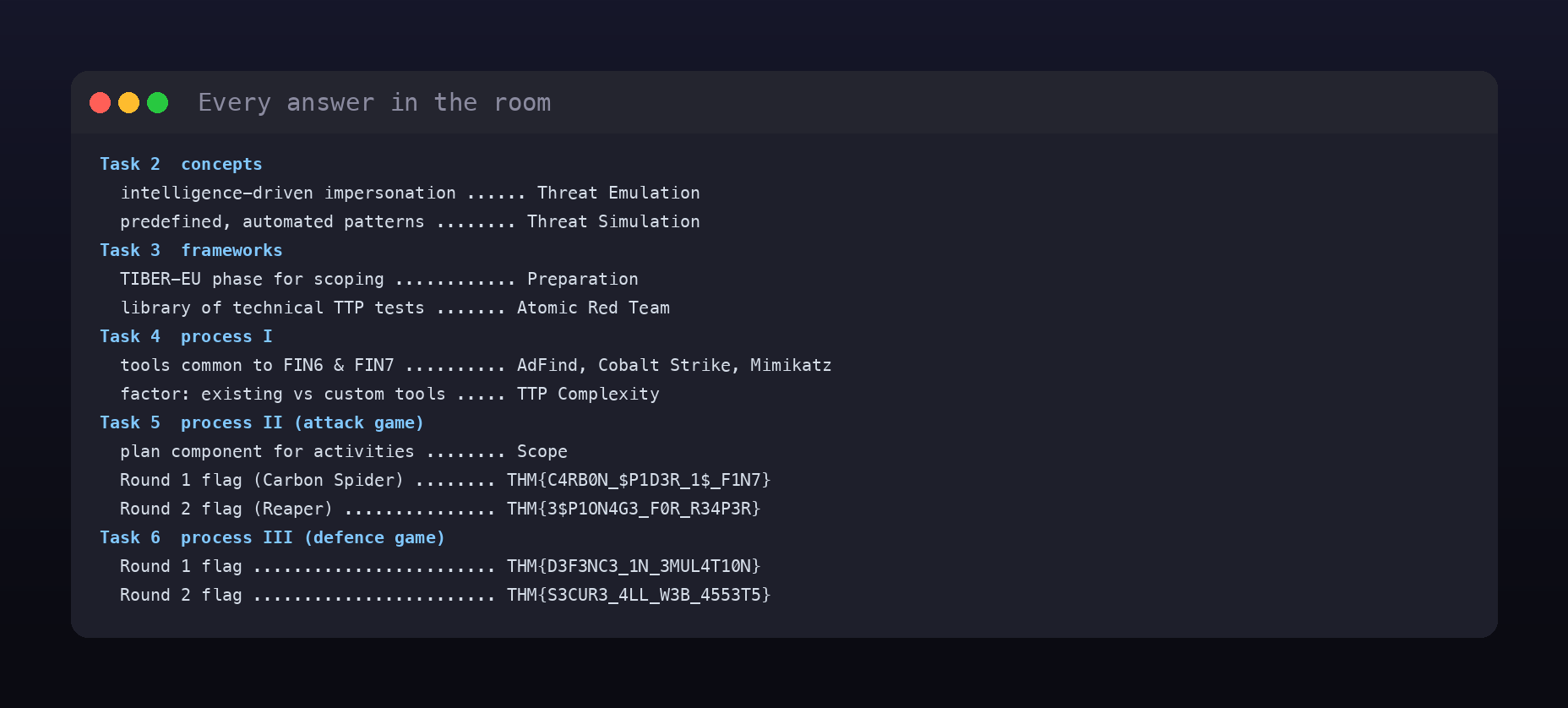
The core definition is the room’s first answer: Threat Emulation is an intelligence-driven impersonation of real-world attack scenarios and TTPs in a controlled environment, done to test and improve an organisation’s defences with evidence instead of assumptions. The room is careful to separate it from a term people use interchangeably: Threat Simulation represents adversary behaviour through predefined and automated attack patterns that blend TTPs from several groups without imitating one specific adversary. Emulation replicates one real actor; simulation is the automated, blended version.
Task 3: frameworks and resources
Structured programmes exist for this. TIBER-EU (Threat Intelligence-Based Ethical Red Teaming) organises an engagement into phases, and the phase under which Engagement and Scoping falls is Preparation. On the tooling side, the room points at Atomic Red Team, a library of small, technical emulation tests mapped directly to ATT&CK TTPs, which becomes the subject of the next room.
Task 4: the process, part one
The room frames a scenario, VASEPY Corp hiring you as a Threat Emulation Engineer, and lays out a five-step process: Define Objectives, Research Adversary TTPs, Plan the Engagement, Conduct the Emulation, and Report and Conclude. Researching the adversary starts on ATT&CK, where financially motivated retail-targeting groups FIN6, FIN7 and FIN8 surface as candidates. Cross-referencing the ATT&CK software pages, the three tools used by both FIN6 & FIN7 are AdFind, Cobalt Strike, and Mimikatz. Narrowing the shortlist uses four factors, and the one that asks whether existing tooling can handle the job or custom tools are required is TTP Complexity.
Tasks 5 and 6: emulate the adversary
This is where the room gets hands-on. Task 5 covers planning, where the plan component that defines which activities are permitted (and where) is the Scope, and then launches an interactive attack game. You play the attacker across two rounds of three questions each, plus a floating Special Ability bonus, draining the defender’s health with each correct ATT&CK choice.
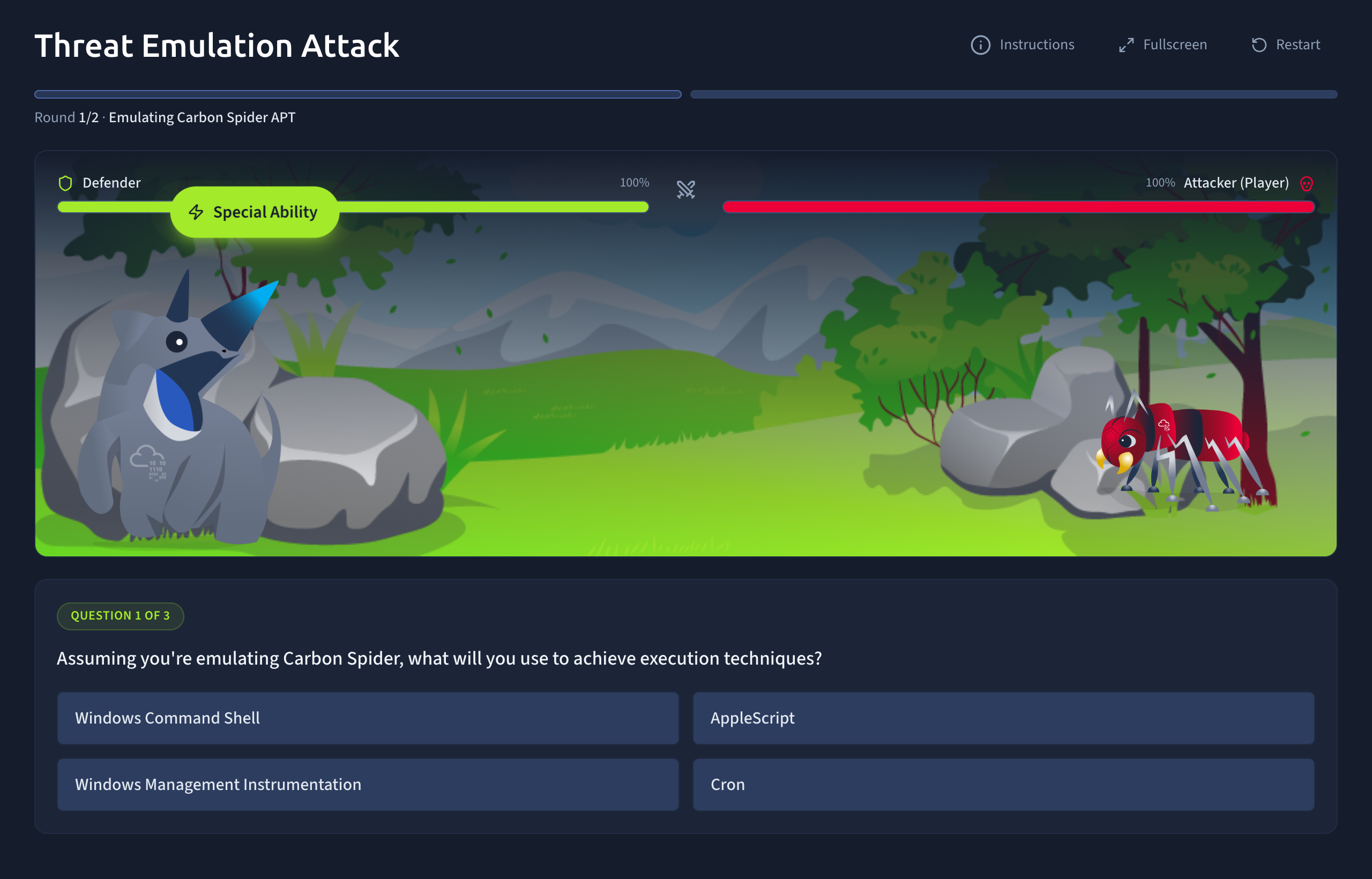
Round 1 has you emulate Carbon Spider (FIN7) and Round 2 Reaper (APT37), and clearing both captures the flags THM{C4RB0N_$P1D3R_1$_F1N7} and THM{3$P1ON4G3_F0R_R34P3R}. Task 6 mirrors the format from the defender’s chair, and completing its two rounds yields THM{D3F3NC3_1N_3MUL4T10N} and THM{S3CUR3_4LL_W3B_4553T5}.
Room summary
| Room | Intro to Threat Emulation (SOC Level 2, Threat Emulation) |
| Category | Threat Emulation, Easy |
| Task 2 | Threat Emulation; Threat Simulation |
| Task 3 | Preparation; Atomic Red Team |
| Task 4 | AdFind, Cobalt Strike, Mimikatz; TTP Complexity |
| Task 5 | Scope; THM{C4RB0N_$P1D3R_1$_F1N7}; THM{3$P1ON4G3_F0R_R34P3R} |
| Task 6 | THM{D3F3NC3_1N_3MUL4T10N}; THM{S3CUR3_4LL_W3B_4553T5} |
Wrap-up
For an intro room, this one does its job well: it fixes the emulation-versus-simulation distinction that trips people up, points at the frameworks and tooling (TIBER-EU for structure, Atomic Red Team for the tests), and walks the five-step process against a concrete adversary selection. The interactive games are the highlight, because turning “emulate FIN7” into a series of ATT&CK technique choices is exactly the mental model the rest of the module builds on: pick a real adversary, learn their TTPs, and reproduce them deliberately. Next up in the module are the tools that automate this, Atomic Red Team and CALDERA.