The Silent Transfer
Room 6 of 6 and the capstone of the Advanced Traffic Analysis module on SOC Level 2. No teaching, no worked examples, a case briefing, a forensic workstation, and eleven questions that only get answered by pivoting. New client too: Helios Software Group rather than the Nexus Financial scenario that ran through Network Monitoring with Zeek and Advanced Packet Analysis, though the attacker tradecraft is recognisably the same family.
Evidence sits in /home/ubuntu/capstone/: snort_alerts.log, a zeek_logs/ directory with the usual six, investigation.pcap, fortigate_traffic.log, and a references/ folder with local threat intel. The entire chain below came out of Zeek logs and one strings pass, Wireshark and Zui are on the desktop but never became necessary.
Starting point: one alert
The brief says “review the detection evidence around 03:47 UTC”, so start there:
cd ~/capstone
grep -E "03:4[5-9]" snort_alerts.log

# 11/14-03:47:22.543210 [**] [1:2023476:4] ET TROJAN Possible Cobalt Strike Beacon CnC Activity
#   - GET Checkin [**] [Priority: 1] {TCP} 10.14.30.88:51088 -> 194.165.16.56:443
One line gives the compromised workstation, 10.14.30.88, the C2 at 194.165.16.56, and the fact that we are looking at Cobalt Strike. Everything else is worked backwards and forwards from here.
Working backwards: how it got in
The C2 traffic is the middle of the story. The delivery came earlier, and files.log holds both ends of the intrusion in two rows:
zeek-cut ts tx_hosts rx_hosts filename mime_type total_bytes sha256 < zeek_logs/files.log

1763081220  194.165.16.78  10.14.30.88      winservice-patch-4891.exe   x-dosexec  1887232
            sha256 7f3b2e1a9c8d4f5e6b7c8d9e0f1a2b3c4d5e6f7a8b9c0d1e2f3a4b5c6d7e8f90
1763091720  10.14.0.12     185.213.154.201  Q4-Finance-Backup-2025.zip  zip        312447821
            sha256 a3f8e2c1d4b7a9e0f2c3d5e6f7a8b9c0d1e2f3a4b5c6d7e8f9a0b1c2d3e4f5a6
The dropper is winservice-patch-4891.exe, hash 7f3b2e1a…6d7e8f90. The thing that eventually left is a 312 MB archive named Q4-Finance-Backup-2025.zip, hash a3f8e2c1…d3e4f5a6, and note it leaves from 10.14.0.12, not from the workstation that was originally compromised. That gap is the whole investigation.
The dropper’s delivery domain is not in http.log where you would expect it. That request’s host field is empty, so zeek-cut host returns a blank column and the row’s other fields shift left, which looks at a glance like the request has no hostname at all. DNS has it:
zeek-cut query answers < zeek_logs/dns.log | grep 194.165.16.78
# cdn-updates.microsoftservice.net   194.165.16.78
cdn-updates.microsoftservice.net, a domain built to read as Microsoft infrastructure at a glance while being registered under microsoftservice.net, which Microsoft does not own.
The C2 channel
Two questions concern the beacon itself. The first connection’s source port comes from sorting the C2 sessions ascending rather than trusting whichever port the Snort alert happened to catch:
zeek-cut ts id.orig_h id.orig_p id.resp_h id.resp_p service < zeek_logs/conn.log \
  | awk -F'\t' '$2=="10.14.30.88" && $4=="194.165.16.56"' | sort -k1 -n | head -3

# 1763083380.000000  10.14.30.88  51000  194.165.16.56  443  ssl
# 1763083442.385990  10.14.30.88  51001  194.165.16.56  443  ssl
# 1763083498.766728  10.14.30.88  51002  194.165.16.56  443  ssl
51000, incrementing by one per beacon. The Snort alert fired on 51088, which is the 89th connection, not the first, the alert is where detection started, not where the activity did.
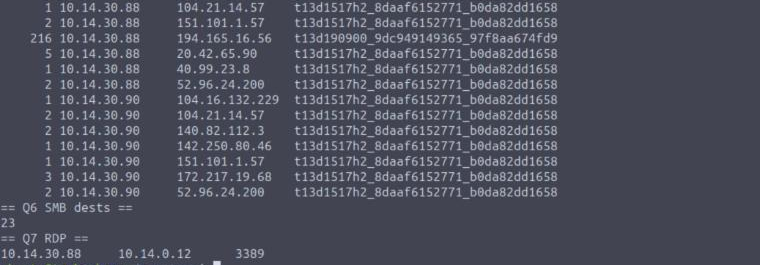
The JA4 answer is the one that makes the whole log worth reading:
zeek-cut id.orig_h id.resp_h ja4 < zeek_logs/ssl.log | sort | uniq -c
# ...
#   1 10.14.30.88  104.21.14.57     t13d1517h2_8daaf6152771_b0da82dd1658
# 216 10.14.30.88  194.165.16.56    t13d190900_9dc949149365_97f8aa674fd9
#   5 10.14.30.88  20.42.65.90      t13d1517h2_8daaf6152771_b0da82dd1658
Every other TLS session on the entire network, every host, every destination, carries t13d1517h2_8daaf6152771_b0da82dd1658, the browser. The 216 sessions to the C2 carry t13d190900_9dc949149365_97f8aa674fd9, and nothing else does. Sorting the whole ssl.log by JA4 would have found the implant without knowing the C2 address at all: one fingerprint appearing once in a network of browsers is the anomaly.
The tasking is in the beacon’s application layer:
strings investigation.pcap | grep -oE '"cmd"[^}]{0,120}' | sort -u
# "cmd":"","interval":60
# "cmd":"d2hvYW1p","interval":60

echo d2hvYW1p | base64 -d
# whoami
whoami, most check-ins return an empty cmd and one carries the operator’s command.
Forwards: what it did next
# SMB discovery
zeek-cut id.orig_h id.resp_h id.resp_p < zeek_logs/conn.log \
  | awk -F'\t' '$1=="10.14.30.88" && $3=="445"' | cut -f2 | sort -u | wc -l
# 23

# RDP
zeek-cut id.orig_h id.resp_h id.resp_p < zeek_logs/conn.log \
  | awk -F'\t' '$3=="3389"' | sort -u
# 10.14.30.88  10.14.0.12  3389
23 unique internal hosts swept on SMB, then a single RDP session to 10.14.0.12, the discovery narrowing to one target, which is exactly the shape you hope to catch before the next step.
The transfer that names the room
10.14.0.12 is a server, so its DNS is mostly package repositories and Microsoft endpoints. One query does not belong:
zeek-cut ts id.orig_h id.resp_h id.resp_p orig_bytes < zeek_logs/conn.log \
  | awk -F'\t' '$2=="10.14.0.12" && $5>100000'
# 1763091720  10.14.0.12  185.213.154.201  443  312447821

zeek-cut ts id.orig_h query answers < zeek_logs/dns.log \
  | awk -F'\t' '$2=="10.14.0.12" && $1<1763091720' | sort -k1 -n | tail -5
# 1763089918  update.ubuntu.com          91.189.91.83
# 1763090193  docker.io                  104.21.14.57
# 1763090355  cdn.jsdelivr.net           104.16.132.229
# 1763090454  update.ubuntu.com          91.189.91.83
# 1763091660  backup.corpfiles-sync.com  185.213.154.201

backup.corpfiles-sync.com resolved at 1763091660, and the 312 MB upload to the address it returned begins at 1763091720, exactly 60 seconds later. Against a baseline of Ubuntu mirrors and jsDelivr, one query to a “backup sync” domain nobody provisioned, immediately followed by a third of a gigabyte leaving, is the entire case in two log lines.
That 60-second gap is worth noting for its own sake: it is short enough that a detection firing on the DNS resolution would still have had time to block the transfer.
Every answer
| # | Question | Answer |
|---|---|---|
| 1 | Internal IP originating the C2 traffic | 10.14.30.88 |
| 2 | Delivery domain for the dropper | cdn-updates.microsoftservice.net |
| 3 | SHA256 of the downloaded file | 7f3b2e1a9c8d4f5e6b7c8d9e0f1a2b3c4d5e6f7a8b9c0d1e2f3a4b5c6d7e8f90 |
| 4 | Source port of the first C2 connection | 51000 |
| 5 | JA4 fingerprint of the C2 client | t13d190900_9dc949149365_97f8aa674fd9 |
| 6 | Unique internal IPs in the SMB sweep | 23 |
| 7 | RDP destination | 10.14.0.12 |
| 8 | Domain resolved before the large transfer | backup.corpfiles-sync.com |
| 9 | SHA256 of the exfiltrated archive | a3f8e2c1d4b7a9e0f2c3d5e6f7a8b9c0d1e2f3a4b5c6d7e8f9a0b1c2d3e4f5a6 |
| 10 | Command the attacker issued | whoami |
Attack chain
03:07  cdn-updates.microsoftservice.net -> winservice-patch-4891.exe  (10.14.30.88)
03:43  first C2 beacon, sport 51000 -> 194.165.16.56:443, JA4 t13d190900_...
03:47  Snort fires, 89 beacons in, sport 51088
  ~    whoami tasking returned in the beacon body
  ~    SMB sweep, 23 internal hosts
  ~    RDP 10.14.30.88 -> 10.14.0.12
06:21  10.14.0.12 resolves backup.corpfiles-sync.com
06:22  312 MB Q4-Finance-Backup-2025.zip -> 185.213.154.201:443
Wrap-up
Two things worth keeping.
The alert is a coordinate, not a starting time. Snort fired at 03:47 on source port 51088, the 89th beacon. The first connection was at 51000, roughly 40 minutes earlier, and the dropper landed nearly 40 minutes before that. Every question in this room was answered by treating the alert as one point on a timeline and walking outward in both directions. An investigation that begins and ends at the alert timestamp finds a beacon; one that walks backwards finds how it got in, and forwards finds the 312 MB that left.
JA4 was the only indicator that did not need prior knowledge. The IPs, the domains and the file hashes all had to be discovered by following the chain. The JA4 fingerprint was visible by sorting one column: 216 sessions carrying t13d190900_9dc949149365_97f8aa674fd9 in a network where literally every other TLS session was the same browser hash. That is a hunt you can run with no alert at all, count JA4 values per network, look at the ones with a count of one, and it is the technique from this module most likely to catch the next intrusion rather than explain the last one.
Room solved 100%: 2 tasks, 11 answers, 300 points.