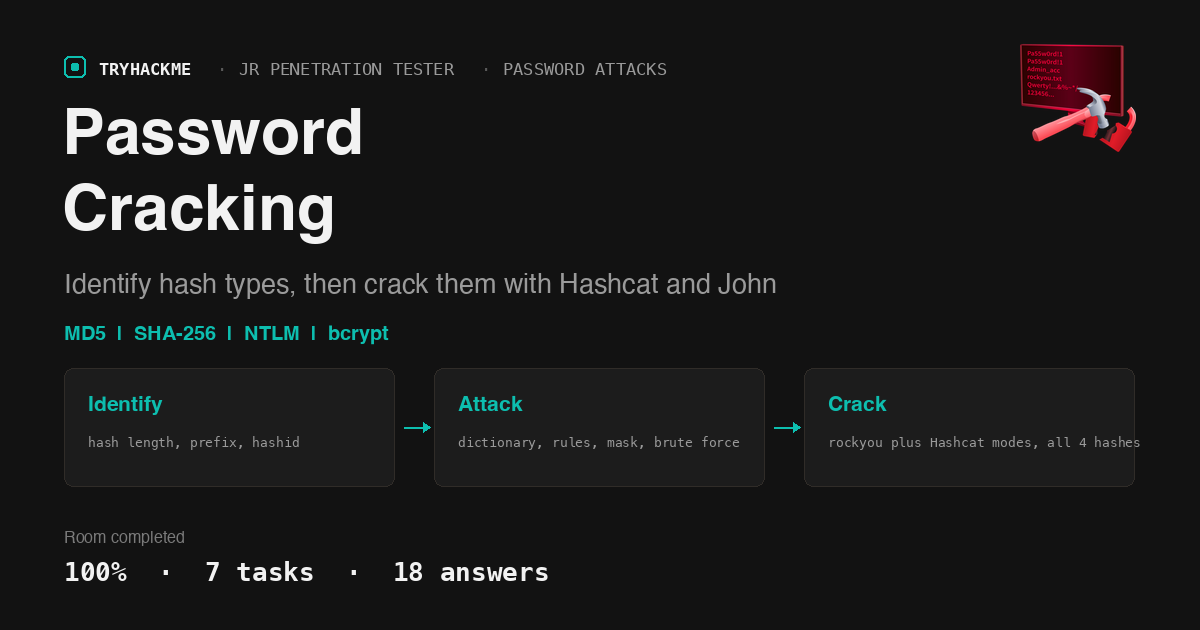
Building a wordlist is only half the job. The other half is turning a hash back into the password that made it, and that starts with knowing which algorithm you are looking at. TryHackMe’s Password Cracking room is the next step in the Password Attacks module of the Jr Penetration Tester path, and it lists the Introduction to Wordlists room as a direct prerequisite: that room built the lists, this one uses them against real hashes. It also pairs naturally with the module’s Phishing Basics room, which harvests the credentials in the first place.
This is a hands-on room. Four tasks of theory set up the last one, the Practical, where you identify and crack four hashes. I solved it from my Mac with hashcat (which handles every mode the room covers) and rockyou.txt, downloading the task files directly rather than booting the AttackBox.
Task 1: Introduction
The opener frames password cracking as recovering plaintext from a leaked database, a captured handshake, or a hash pulled off a compromised machine. There is nothing to submit, so the answer is the built-in No answer needed for the readiness prompt.
Task 2: How Passwords Are Stored
Passwords are not stored in plaintext; they are stored as hashes. This task covers the three properties that make that work, and asks about each.
A hash function is one-way: there is no way to reverse a hash back to the original input, which is why cracking means guessing candidates and hashing them until one matches. A salt is the unique random string added to a password before hashing, so two identical passwords produce different hashes and precomputed rainbow tables become useless. And bcrypt is the algorithm designed specifically for passwords and deliberately made slow, so that each guess costs an attacker real time. The Aptoide breach example in the task drives the point home: SHA-1 without salt let a single GPU test over 10 billion candidates per second.
Task 3: Identifying Hash Types
Supplying the wrong mode to a cracking tool produces no results no matter how long it runs, so identification comes first. The fastest tell is length and format. An SHA-256 hash is 64 hex characters. The task’s reference table pairs each algorithm with its cracking parameters, and the John the Ripper format for an SHA-256 hash is raw-sha256.
For unknown hashes the room introduces hashid, which lists candidate algorithms for a given string. A 32-character hex string is ambiguous (it could be MD5, NTLM, and others), so you cross-reference with context and try the likely candidates in order.
Task 4: Wordlists and Attack Strategies
Choosing the wrong strategy wastes time without results. The task walks through four:
- Dictionary attack: test a pre-built list one entry at a time. It is the fastest first step and should always be the starting point. The standard list is
rockyou.txt, pre-installed on the AttackBox at /usr/share/wordlists/rockyou.txt. - Brute force: generate every combination up to a length. Guaranteed to work eventually, but the search space explodes past 6 to 7 characters.
- Rule-based attack: apply transformations such as capitalisation and number suffixes to an existing wordlist. That is the answer to the transformation question: a rule-based attack, driven by rule files like
best64.rule. - Mask attack: a structured brute force against a known pattern. For a policy requiring a capital letter, six lowercase letters, and two digits, the best-suited attack is a mask attack, because the exact structure is known.
Task 5: Cracking with John the Ripper and Hashcat
This task compares the two tools. For a large set of SHA-256 hashes that need to fall as quickly as possible, Hashcat is the better choice because it uses the GPU. Hashcat’s attack modes are numbered, and the mask attack mode is 3 (-a 3). John the Ripper is easier for quick jobs and odd formats; its –show flag displays previously cracked passwords straight from the potfile without re-running the attack.
Task 6: Practical
Time to crack. The four hash files are pre-loaded on the AttackBox at /root/Rooms/PasswordCracking/, or downloadable as a zip. I pulled the zip and worked locally. Identifying each by length and prefix:
# the four hashes and their algorithms
hash1.txt  e10adc3949ba59abbe56e057f20f883e                                  MD5      (32 hex)
hash2.txt  5e884898da28047151d0e56f8dc6292773603d0d6aabbdd62a11ef721d1542d8  SHA-256  (64 hex)
hash3.txt  8846f7eaee8fb117ad06bdd830b7586c                                  NTLM     (32 hex)
hash4.txt  $2b$05$9I7YCSrgm6aLO7J5YPC9x.Kp08LQ7cSJTmkALhFTgm5UMFAwBr5.e       bcrypt

hash3 is worth a note: it is 32 hex characters like MD5, but it is the exact NTLM example from the Task 3 table. The algorithm produced by hash1 is therefore MD5, and the Hashcat mode for the SHA-256 hash in hash2 is 1400.
Now the dictionary attack. MD5, SHA-256, and NTLM are fast, so all three fall against rockyou almost instantly:
hashcat -m 0    -a 0 hash1.txt rockyou.txt   # MD5
hashcat -m 1400 -a 0 hash2.txt rockyou.txt   # SHA-256
hashcat -m 1000 -a 0 hash3.txt rockyou.txt   # NTLM

The plaintext for hash1 is 123456. hash2 (SHA-256) and hash3 (NTLM) crack to the same word despite being different algorithms, which is the lesson the room is making: the outputs look nothing alike, but the plaintext is identical. That shared plaintext is password.
Hash 4 is bcrypt, and bcrypt is deliberately expensive, so it takes longer even for a common password. Mode 3200 with rockyou still finds it in seconds on modern hardware:
hashcat -m 3200 -a 0 hash4.txt rockyou.txt # bcrypt

The plaintext for hash4 is hayden07. All four cracked, using nothing but the right mode and rockyou.
Task 7: Conclusion
The final task recaps the workflow: identify the algorithm from its characteristics, pick the matching Hashcat mode or John format, and run a dictionary attack first, escalating to rules or masks only if it fails. It is a No answer needed acknowledgement, and it closes the room.
Two takeaways
Identification is the whole game. hash2 and hash3 share the plaintext “password”, but one is SHA-256 (mode 1400) and the other NTLM (mode 1000). Point the wrong mode at either and it will never crack, no matter how good your wordlist is. Length and prefix get you most of the way (64 hex is SHA-256, $2b$ is bcrypt), and hashid resolves the ambiguous 32-hex cases.
Slow-by-design hashing is doing its job even when it loses. bcrypt still cracked to a common rockyou password, but it took real seconds where MD5 and NTLM took milliseconds. Scale that cost factor across a whole leaked database and a weak-but-slow-hashed password buys defenders time that a fast unsalted hash never would. The algorithm matters as much as the password.
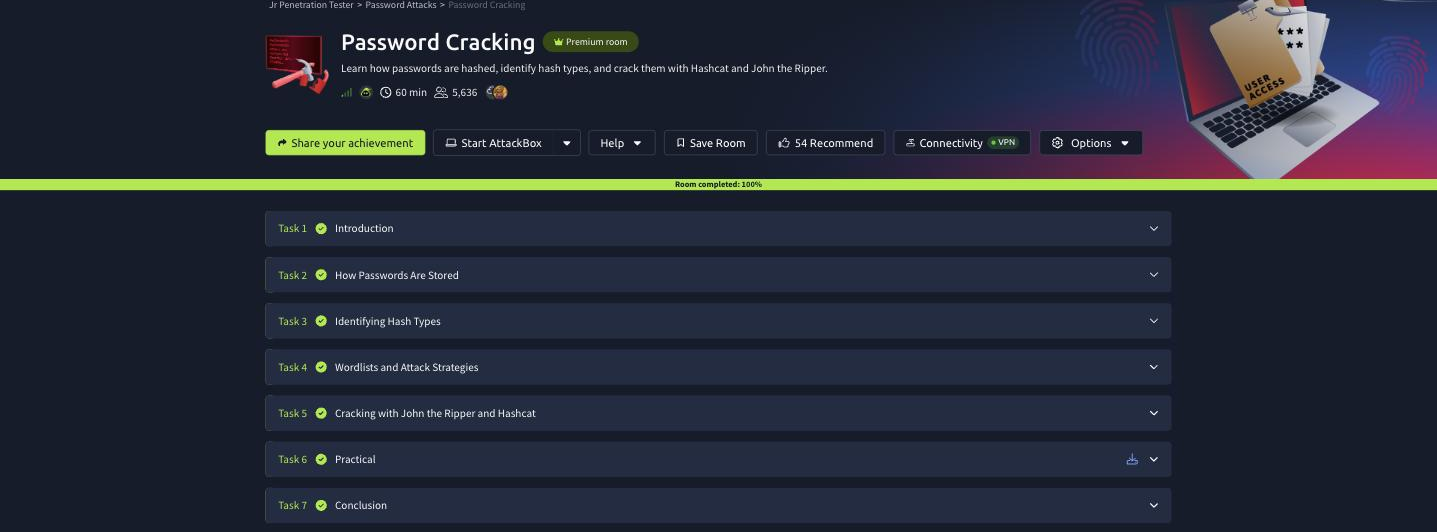
Room solved 100%: 7 tasks, 18 answers.