Support is the capstone challenge for the Web Application Vulnerabilities II module of the Jr Penetration Tester path, the box you get after the teaching rooms. It sits directly after API Pentesting and Broken Authentication, and it is essentially both of those rooms stacked: a login you have to guess, an authorization decision stored where the client can edit it, an object id with no ownership check, a file read with a broken jail, and a command filter that only looks at the first four characters. Five separate weak trust boundaries, each one useless alone, and chained they hand you a shell.
Two flags: one on the admin dashboard, one in /home/ubuntu/user.txt. No hints, no guided steps.
Getting a route to the box
The lab machine is a normal deployable VM, and this Mac had no route to it: the only tunnel up was a
corporate VPN carrying 10.160/16, which is not the THM range. route -n get <target> pointed at
en0 and every port came back closed. Connecting the TryHackMe OpenVPN profile in Tunnelblick fixed
it in one click, and after that everything ran locally with nmap, curl and ffuf. Worth checking
the route before blaming the box.
Recon: two ports and a very small application
A full TCP scan finds exactly two open ports.
# nmap -sT -p- --min-rate 2500 10.49.134.232

SSH is publickey only, so it is not an entry point. That leaves Apache. Directory brute forcing
turns up a small PHP application:
  # gobuster dir -u http://10.49.134.232/ -w raft-medium-files.txt -x php
index.php        200
dashboard.php    302  -> index.php
api.php          302  -> index.php
config.php       200  (0 bytes)
footer.php       200
logout.php       302  -> index.php
info.php         200  (73 KB, phpinfo)
includes/        301   header.php, skin.php
skins/           301   default.php, red.php, green.php, blue.php
That info.php is a leftover phpinfo() page, and it is genuinely useful later: PHP 8.3.6,
disable_functions empty, open_basedir unset, allow_url_include Off, post_max_size 8M. Note
those last two, they close off two obvious attacks and one of them cost me an hour.
Everything except the login redirects to index.php, so the login is the only door.
Step 1: a login with no rate limiting
The form takes a corporate email and a password, and the placeholder helpfully names a real account:
[email protected]. There is no SQL injection here (quotes, OR 1=1, time-based payloads and PHP
type juggling all return the same 2678-byte “Invalid credentials” page), no user enumeration, and no
lockout. What there is, is nothing stopping you guessing.
  # ffuf -u http://TARGET/index.php -X POST \
  #      -d '[email protected]&password=FUZZ' \
  #      -w 10k-most-common.txt -mc 302

The password is snoopy, entry 129 in the standard 10k list. A successful login answers with a
302 to dashboard.php and, more interestingly, a second cookie.
Step 2: an authorization decision handed to the client
Set-Cookie: isITUser=68934a3e9455fa72420237eb05902327; Max-Age=3600; path=/
That value is md5("false"). It is one of the most recognisable hashes there is, and if you do not
recognise it, hashing the obvious candidates takes five seconds. md5("true") is
b326b5062b2f0e69046810717534cb09.
Swap the cookie and the dashboard grows an IT Admin Panel with a link to api.php. Hashing a boolean
is not encryption, it is not a signature, and it does not stop anything: there are only two possible
values and both are public knowledge. The server is asking the browser whether the browser is
allowed to do something.
Step 3: IDOR on the internal API
api.php presents itself as a self-service endpoint, telling you that as a helpdesk user you may
query your own profile at /user/3. The id is a plain integer in the query string with no ownership
check behind it.

Three accounts exist:
| id | admin | |
|---|---|---|
| 1 | [email protected] | true |
| 2 | [email protected] | false |
| 3 | [email protected] | false |
The API strips password from every response, so this is disclosure, not credentials. But it names
the account that matters. Everything from here is about becoming user 1.
Step 4: the theme selector is a source disclosure
The footer carries a theme dropdown linking to ?skin=default, ?skin=red and so on. That parameter
goes straight into a file read. ?skin=../skins/red still renders the red stylesheet, which proves
the path is concatenated rather than matched against a list, so ?skin=../config climbs out of
skins/ and lands on config.php.
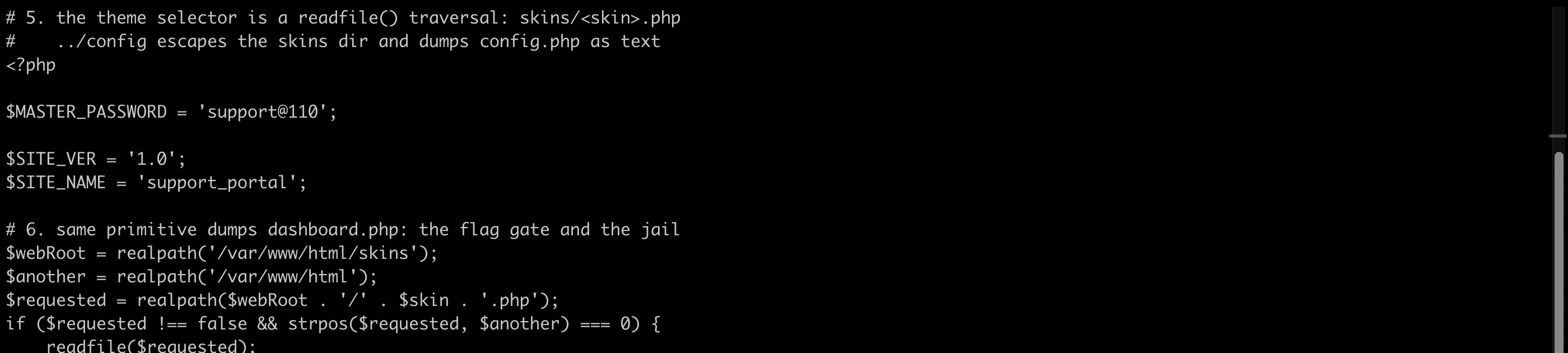
The important detail is that this is readfile(), not include(). The PHP is never executed, it is
printed, so the primitive is source disclosure for any .php file under the web root. That is
better than an LFI here, because it hands you the application logic:
  // dashboard.php
$webRoot   = realpath('/var/www/html/skins');
$another   = realpath('/var/www/html');
$requested = realpath($webRoot . '/' . $skin . '.php');

if ($requested !== false && strpos($requested, $another) === 0) {
    readfile($requested);
}
The jail is actually sound. realpath() resolves the traversal before the prefix check, so
../../db resolves to /var/www/db.php, fails strpos, and reads nothing. The user table lives in
/var/www/db.php, one directory above the web root, and it stays out of reach for the whole room.
Worth confirming that early rather than grinding on it.
Reading the rest of the source gives the two things that matter. dashboard.php gates the first flag
on a session value:
  // dashboard.php
if (isset($_SESSION['admin']) && $_SESSION['admin'] === true):
    echo htmlspecialchars(trim(file_get_contents('/var/www/web.txt')));
And footer.php, which dashboard.php includes, holds the RCE:
  // footer.php
$isAdmin = $_SESSION['admin'];

if ($isAdmin && $_SERVER['REQUEST_METHOD'] === 'POST' && isset($_POST['sys'])) {
    $sys = $_POST['sys'];
    if (strpos($sys, 'date') === 0) {
        $output = shell_exec($sys);
    } else {
        $error = 'Only date command is allowed.';
    }
}
$_SESSION['admin'] is written only by a successful login in index.php, and only from the user
record. So both remaining objectives collapse into one problem: log in as specialadmin.
Step 5: the master password, and the trap in it
config.php gives up $MASTER_PASSWORD = 'support@110'. That is obviously the intended credential,
and it does not work. Neither does it work for the other two accounts, nor as an md5, sha1, sha256 or
base64 of itself.
This is where I lost the most time, and it is worth being honest about how. I assumed the master
password was a decoy and went looking for other ways to forge $_SESSION['admin']: header and cookie
trust bypasses, parameter pollution, a 100,000-word brute force against specialadmin, and a PHP
session upload-progress injection (session.serialize_handler is php and
session.upload_progress.enabled is On, which is the classic setup for injecting | into a session
key). The session attack was the interesting failure. My first attempt used a 12 MB body, which
post_max_size = 8M rejects outright so no progress was ever written; once I dropped under the limit
the upload demonstrably clobbered a live logged-in session, proving the write happened, but the
injected loggedin|b:1;admin|b:1; never parsed back. PHP 8.3 does not let | survive into a session
key any more. Dead end, correctly identified only after building the whole thing.
The actual answer was much dumber. The password is support110. The @ in support@110 is
decoration, and a short custom wordlist built from the application’s own vocabulary (support@110,
Support@110, support110, support_portal, specialadmin, and so on) found it in about twenty
requests. Twenty requests I could have sent an hour earlier. When a leaked secret nearly works, mutate
it before concluding it is a decoy.
Step 6: admin, and then a shell
Logging in as [email protected] / support110 sets $_SESSION['admin'] = true, and the
dashboard renders the first flag.
The command filter is strpos($sys, 'date') === 0, which asks only that the string begins with
date. It says nothing about what follows, so a semicolon and a second command run happily.
  # POST /dashboard.php   sys=date;id
Sun Sep  6 13:39:17 UTC 2026
uid=33(www-data) gid=33(www-data) groups=33(www-data)

The dashboard flag is THM{I_AM_ADMIN999} and sys=date;cat /home/ubuntu/user.txt returns
THM{GOT_THE_FLAG001}.
Note that date is a real allow-list entry that the developer presumably tested and watched work.
The filter is not absent, it is just anchored to the wrong thing: it validates a prefix instead of
validating the whole string, and a prefix check on a value that gets handed to a shell is not a check
at all.
Two things worth keeping
A prefix check is not an allow-list. strpos($sys, 'date') === 0 looks like an allow-list to
whoever wrote it, and it passes every test built from the dropdown that feeds it. It fails because it
constrains the beginning of a string that a shell will read to the end. The same shape shows up in
open-redirect filters that check a URL starts with your domain and path checks that confirm a prefix
before appending user input. If the consumer reads the whole value, validate the whole value, or
better, never pass the value through at all and map the dropdown to a fixed command server-side.
Recognise your own guessing and time-box it. The chain up to config.php was ordinary
methodology and took under an hour. The step after it took several times that, because I decided the
master password was a decoy and started building increasingly clever attacks against the session
handler instead of spending two minutes on the boring hypothesis that the secret was almost right.
The signal I ignored is a useful one: when a room hands you a credential-shaped string at exactly the
point you need a credential, the room means it. Exhaust trivial mutations of a leaked secret before
you write any exploit code.
One process note for the honest record: an early 10,000-word brute force at 25 threads exhausted Apache’s worker pool and took port 80 down entirely, which cost a machine redeploy. Later runs used five to ten threads with a small delay and the box stayed up. Concurrency that a real target would shrug off will flatten a 1 vCPU lab VM.
Room solved 100%: 1 task, 2 answers.