Tactical Detection
Buying a detection product and forgetting about it is not a strategy. This SOC Level 2 room in the Detection Engineering path is about the opposite: cheap, immediate, high-impact detections that you build yourself and that are tailored to your own environment. It walks through three tactics, each layering a little more visibility on top of whatever you already run: turning unique threat intel into rules, adopting public IOCs, and planting tripwires. The guiding idea is stated plainly in the room: an attacker has to beat every one of your defenses, but you only need them to trip a single layer to know they are there.
Task 2: unique threat intel becomes a Sigma rule
The first tactic uses intel you already own. After an incident, responders log indicators of compromise in a spreadsheet, and those unique IOCs are gold: they are the fingerprints of an adversary that has already been in your environment. The room hands you exactly such a spreadsheet.
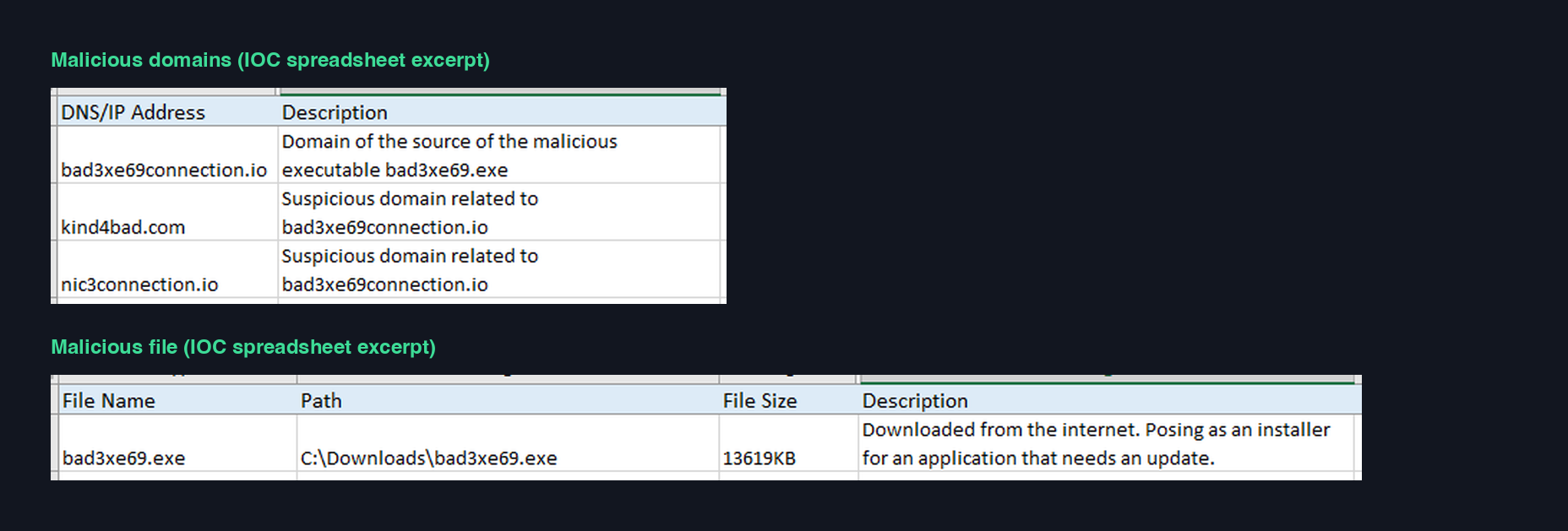
Reading the spreadsheet answers the first questions directly. The original indicator the authors found is the domain bad3xe69connection.io, from which they pivoted to two associated domains (kind4bad.com, nic3connection.io). The full path of the malicious file downloaded from the internet is C:\Downloads\bad3xe69.exe, a fake application updater weighing in at 13,619 KB.
To make these IOCs useful everywhere regardless of which SIEM you run, the room transforms them with Sigma, an open-source, vendor-agnostic signature language. The example rule, baddomains.yml, watches a proxy log for executable downloads from any of the three domains.
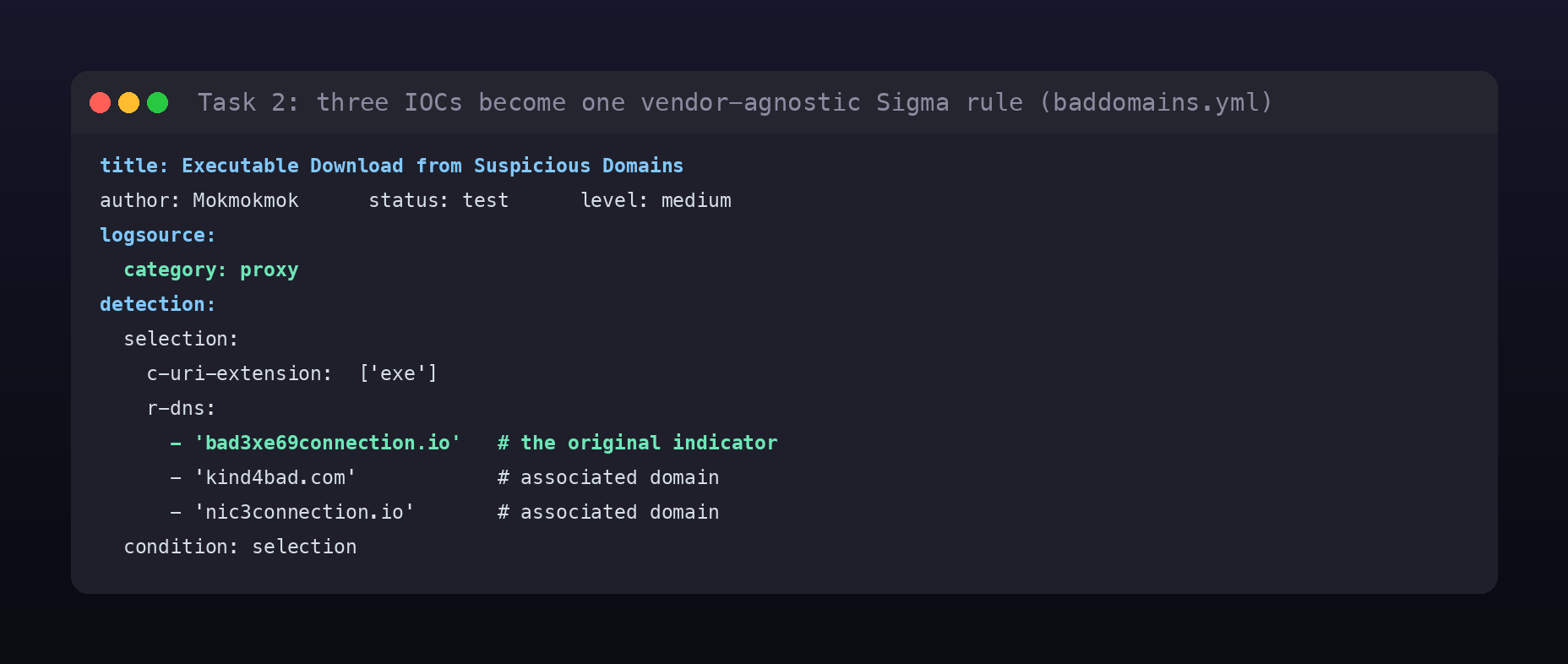
Two answers fall out of the rule itself: the tool used to write vendor-agnostic detections is Sigma, and the logsource category the author chose is proxy.
Task 3: public IOCs, translated to any SIEM
You do not have to be breached to learn from a threat. When a new 0-day drops, the community releases public IOCs and Sigma rules, and you can adopt them immediately. The catch is that everyone runs a different SIEM, so the room uses Uncoder to translate a public Sigma rule into whatever query language you actually deploy. It works through two well-known rules: Huntress’s Follina/MSDT rule and a Log4j “suspicious shells spawned by Java” rule.
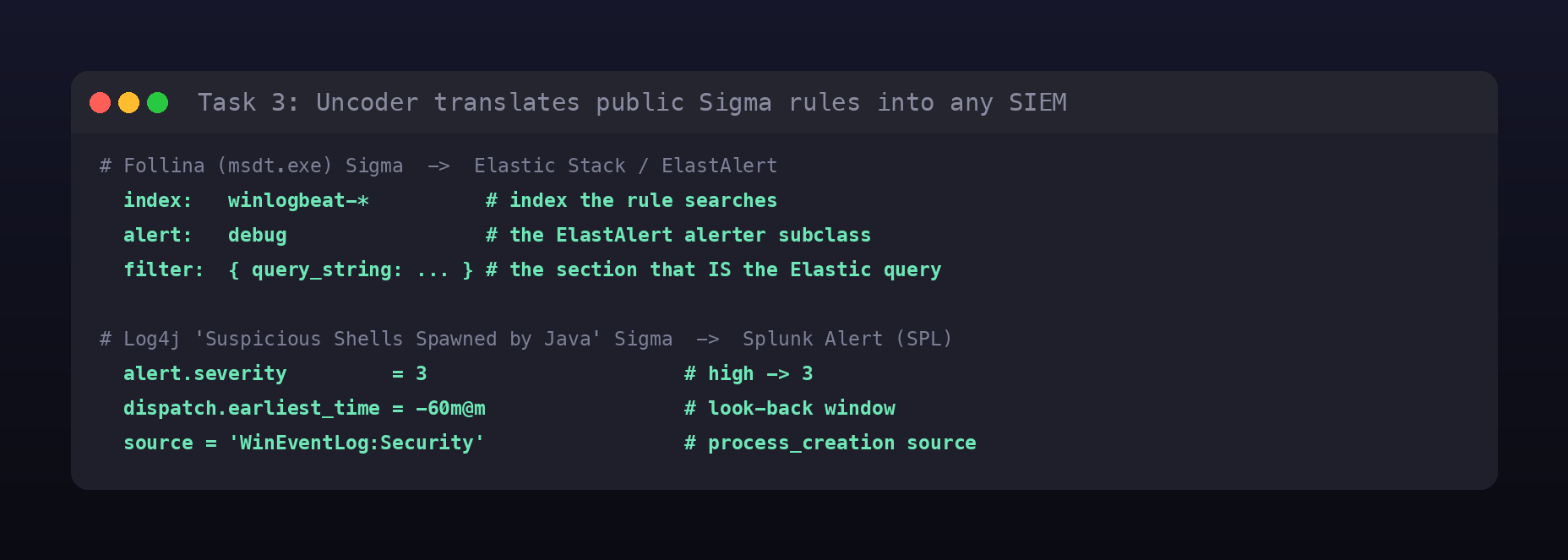
Translating the Follina rule to Elastic/ElastAlert, the output searches the winlogbeat-* index, its alerter subclass is debug, and the part of the ElastAlert output that looks exactly like the Elastic query is the filter block. Translating the Log4j rule to a Splunk alert, the mapped alert.severity for a high-level rule is 3, the dispatch.earliest_time look-back window is -60m@m, and the source the query targets is WinEventLog:Security. (Note that the free Uncoder.io translator has since moved behind SOC Prime’s enterprise Prime Architect, so the exact field values above are the ones the room’s original conversions produced.)
Task 4: tripwires with Windows object-access auditing
The third tactic leans on “knowing your environment.” Some data has no legitimate reason to be touched, so any access to it is instantly suspicious. That is the essence of a tripwire, a honeypot file or folder that exists only to be an alarm. The room sets one up on Windows: enable Audit object access in the Local Security Policy, create a “Secret Document,” and add an auditing entry for Everyone on it. From then on, every access is recorded in the Security log under Event ID 4663.
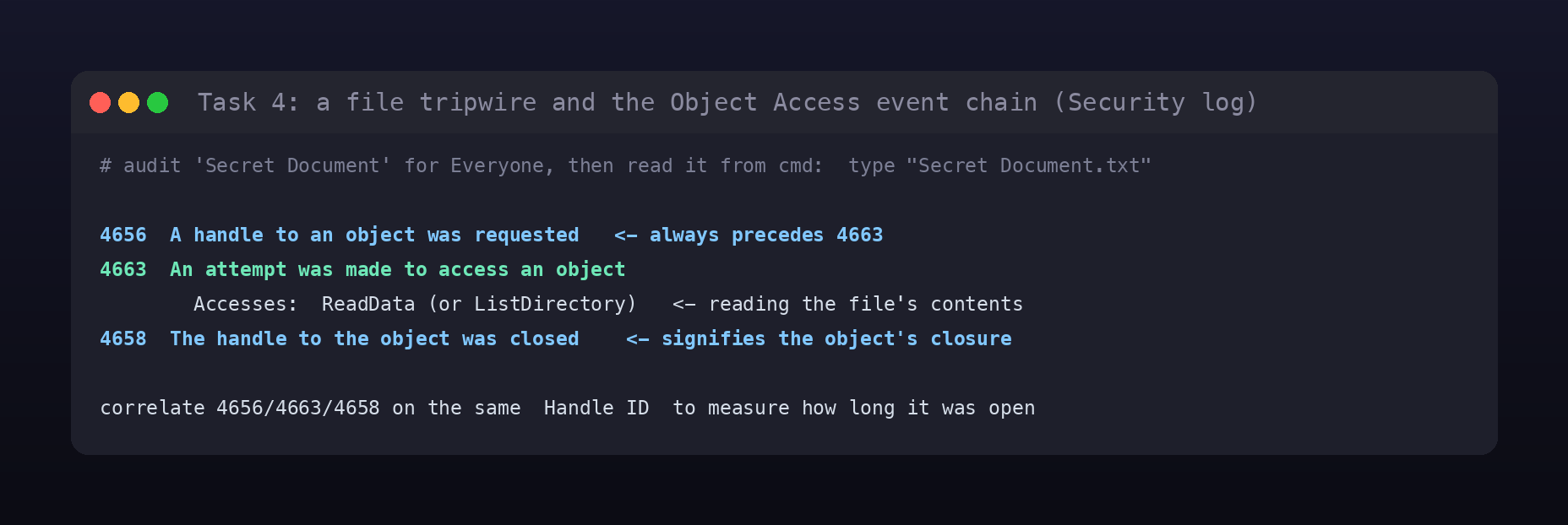
Reading a monitored file’s contents from cmd produces a 4663 whose Accesses value is ReadData (or ListDirectory). The object-access events form a chain worth memorising: 4663 is always preceded by 4656 (a handle to the object was requested), and the closure of an object is signalled by 4658 (the handle was closed). Because 4658 tells you when a handle closed, you can measure how long an object was open by correlating events that share the same Handle ID, the description field that ties a single open-access-close sequence together.
Task 5: purple teaming
The room closes on the cheapest force-multiplier of all: simulate the attack yourself and watch what your detections do. If you want to know how your defenses fare, run the technique, then check the logs for what you caught and what slipped through. The Tempest and Follina rooms are cited as examples of leveraging purple team tactics, and the Follina MSDT room specifically covers CVE-2022-30190.
Room summary
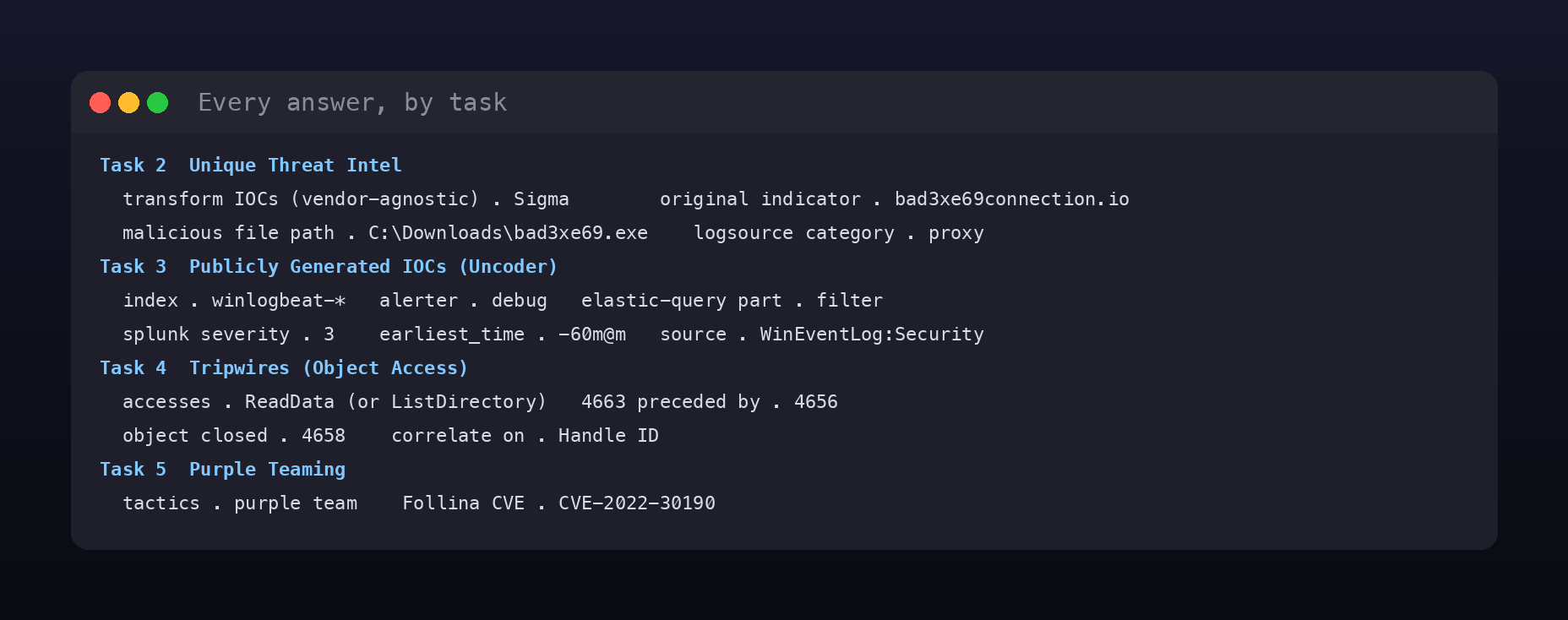
| Room | Tactical Detection (SOC Level 2, Detection Engineering) |
| Category | Detection Engineering, Medium |
| Task 2 | Sigma; bad3xe69connection.io; C:\Downloads\bad3xe69.exe; proxy |
| Task 3 | winlogbeat-*; debug; filter; 3; -60m@m; WinEventLog:Security |
| Task 4 | ReadData (or ListDirectory); 4656; 4658; Handle ID |
| Task 5 | purple team; CVE-2022-30190 |
Wrap-up
The theme running through Tactical Detection is leverage. None of these tactics require a new product or a big budget; they take intel you already have, research the community already published, and telemetry your operating system already emits, and turn each into an actionable alert. Unique IOCs become Sigma rules that spot a returning adversary. Public Sigma rules become SIEM queries with one Uncoder translation. A single audit policy turns an ordinary file into a tripwire that screams the moment anything unauthorised touches it. And purple teaming ties it together by proving, rather than assuming, which of those layers actually fires. Depth beats any single perfect control, because the attacker has to clear every layer while you only need one to catch them.