Threat Intelligence for SOC
Threat intelligence is only useful if it changes what your security operations actually do. This SOC Level 2 room in the Detection Engineering path takes a set of technical, IOC-based intelligence and pushes it through the whole pipeline: hunt the indicators in your logs, prevent the confirmed-bad ones with a DNS sinkhole, and detect anything that slips past by turning the blocklist into an alert. The entire investigation runs against an Elastic Stack loaded with Zeek logs, driven from Kibana’s Discover view with the credentials elastic:elastic.
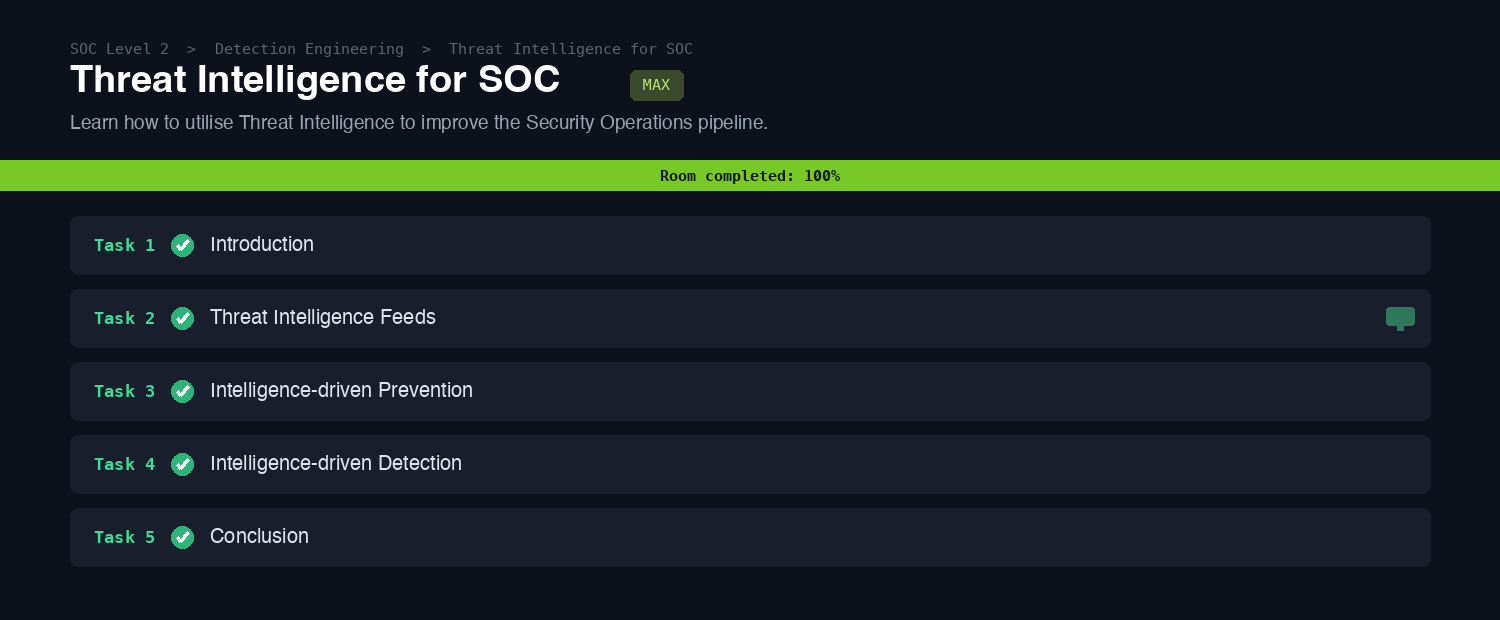
Task 2: hunting the IOC feed
The first job is to take an IOC feed (a list of malicious IPs) and check whether any of them show up in the environment. The room uses Uncoder.io to convert the raw IOC list into a ready-to-run SIEM query, so you do not have to hand-write the syntax for whatever platform you happen to run.
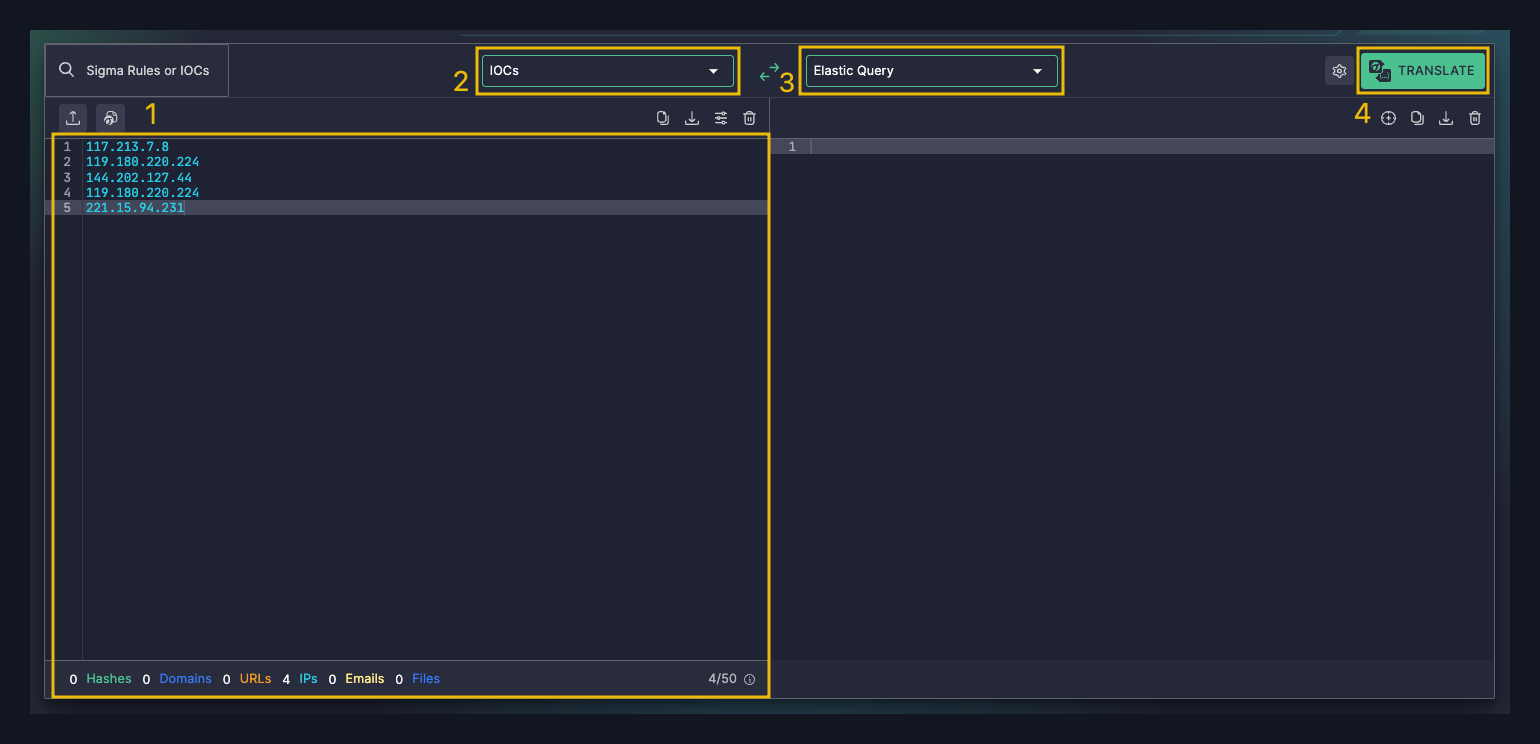
The generated query goes straight into Kibana’s Discover, filtered to the filebeat-* index and the incident’s timeframe of Feb 14 to 16, 2023.

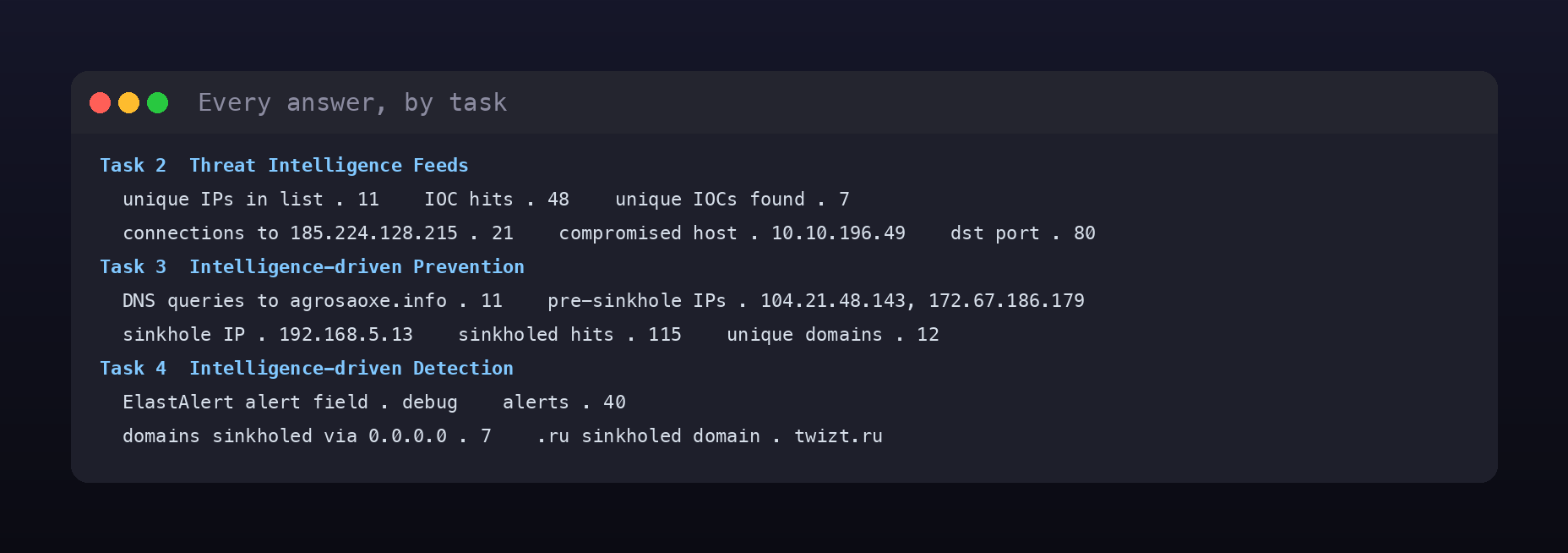
The investigation IOC list holds 11 unique IP addresses (after removing defanging and duplicates). Querying destination.ip against all eleven returns 48 hits, but the interesting detail is that only 7 of the eleven IOCs actually appear in the logs. The other four are near-duplicates of real indicators (185.224.126.215 next to 185.224.128.215, and so on), a deliberate reminder that IOC feeds contain typos and decoys, and that verification matters.
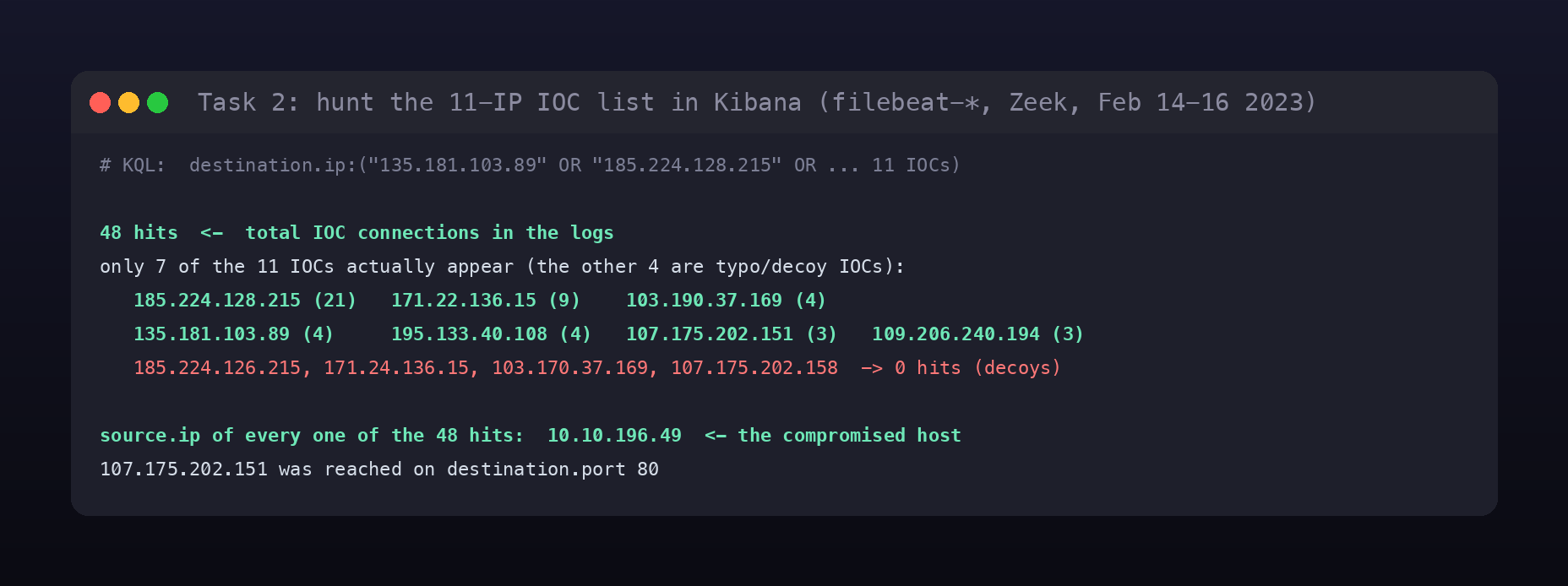
Every one of those 48 connections originates from a single internal address, so the compromised host is 10.10.196.49. Pivoting on individual indicators fills in the rest: the host made 21 connections to 185.224.128.215, and its connections to 107.175.202.151 all went to destination port 80.
Task 3: prevention with a DNS sinkhole
Knowing which domains are malicious lets you stop the traffic before it leaves, and the classic tool is a DNS sinkhole: point the bad domains at an address you control so the malware never reaches its real infrastructure. The logs capture the exact moment this was deployed. The domain agrosaoxe.info was queried 11 times, and its answers tell the story.
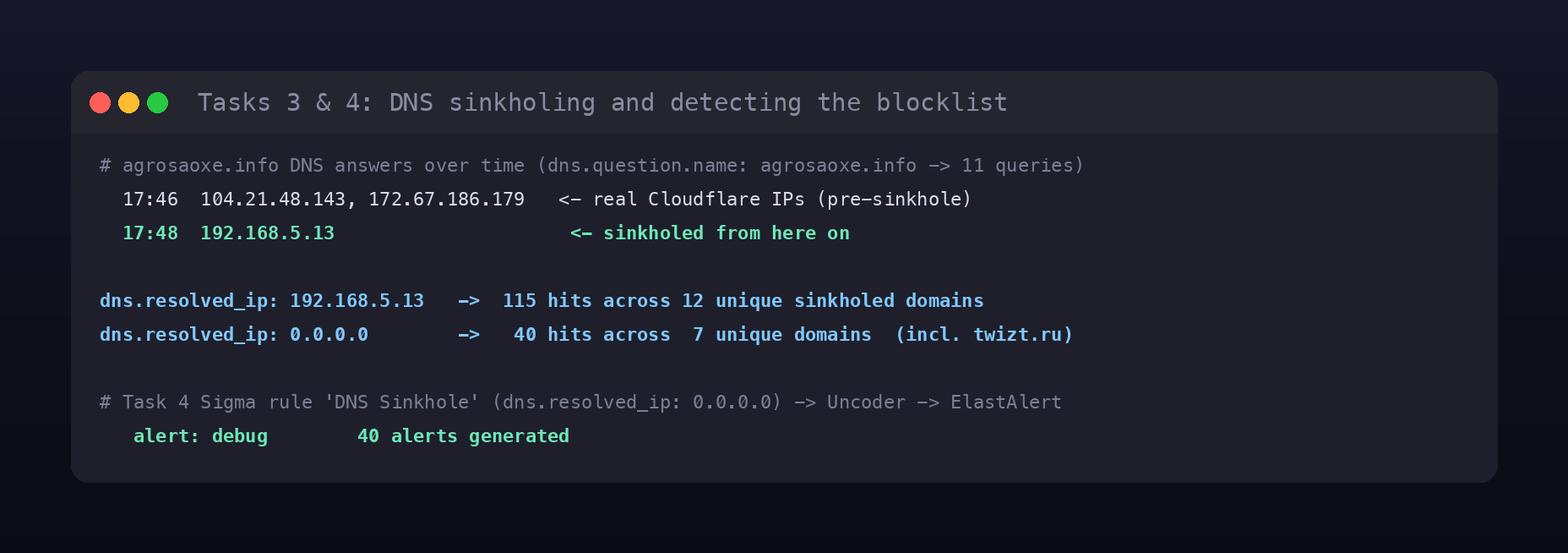
Before the sinkhole was configured, agrosaoxe.info resolved to its genuine IPv4 addresses 104.21.48.143 and 172.67.186.179 (Cloudflare). After deployment, every query for it returns 192.168.5.13, the DNS sinkhole IP. Filtering dns.resolved_ip on that sinkhole address shows 115 hits spread across 12 unique domains, the full set that was redirected away from their real servers.
Task 4: detecting the blocklist
Prevention and detection work best together: once the sinkhole is in place, a resolution pointing at the sink is itself a high-fidelity signal that something on the network is trying to reach a known-bad domain. The room writes a small Sigma rule for exactly that, matching dns.resolved_ip: '0.0.0.0' (a null-route sink), and converts it to an ElastAlert rule with Uncoder. The converted rule’s alert field is debug, and running it generates 40 alerts. Those alerts cover 7 unique domains sinkholed via 0.0.0.0, one of which, twizt.ru, carries a .ru TLD.
Room summary
| Room | Threat Intelligence for SOC (SOC Level 2, Detection Engineering) |
| Category | Detection Engineering, Medium |
| Task 2 | 11; 48; 7; 21; host 10.10.196.49; port 80 |
| Task 3 | 11 queries; pre-sink 104.21.48.143, 172.67.186.179; sink 192.168.5.13; 115; 12 |
| Task 4 | debug; 40; 7; twizt.ru |
| Tools | Kibana / Discover, Uncoder.io, ElastAlert, Zeek logs |
Wrap-up
The room is a compact tour of how threat intelligence earns its keep in a SOC. The same IOC list drives all three stages: hunting it in the logs proves a host was compromised and reveals which indicators are real versus noise, sinkholing the confirmed domains prevents the next callback, and alerting on sinkhole resolutions turns the prevention control into a detection one for free. The recurring lesson is verification. Eleven IOCs were provided but only seven were genuine, so blindly trusting a feed would have wasted effort on four decoys. Intelligence is a starting point for investigation, not a verdict, and the value comes from running it through your own environment and watching what it actually lights up.