Web Server Attacks I
Another premium room in the Web Application Security Fundamentals module on the Jr Penetration Tester path, sitting alongside Modern Web Stacks and after Content Discovery. Where Modern Web Stacks was about CVEs, this one is about the far more common finding: nothing is unpatched, everything is default, and the defaults are talkative.
One host runs four servers:
| Port | Server | What was left open |
|---|---|---|
| 80 | Apache 2.4.58 | mod_status and a listable /files/ |
| 3000 | Node.js Express | route-listing and process.env debug endpoints |
| 8000 | Python http.server | the whole working directory, dotfiles included |
| 8080 | nginx 1.24.0 | stub_status and autoindex on |
All four answered directly from my Mac over the THM tunnel, so no AttackBox: everything below is curl from a local shell. There is no exploit in this room, which is the point. Every flag comes from reading something the server was configured to hand out.
Task 2: four servers, four fingerprints
One HEAD request each is the entire reconnaissance phase:
$ curl -sI http://MACHINE_IP:80/   | grep -i '^server:'
Server: Apache/2.4.58 (Ubuntu)
$ curl -sI http://MACHINE_IP:8000/ | grep -i '^server:'
Server: SimpleHTTP/0.6 Python/3.12.3
$ curl -sI http://MACHINE_IP:8080/ | grep -i '^server:'
Server: nginx/1.24.0 (Ubuntu)
The Python answer is SimpleHTTP/0.6 Python/3.12.3, and port 8080 is nginx.
Express is the odd one out: it sends no Server header at all, so the framework has to be read from X-Powered-By, which Express sets automatically unless the developer disables it.
$ curl -sI http://MACHINE_IP:3000/ | grep -i '^x-powered-by:'
X-Powered-By: Express

Ubuntu ships Apache with ServerTokens OS, which is why the version and the distro both appear. A hardened deployment shows bare Apache or nothing.
Task 3: Python http.server, which serves the directory it was started in
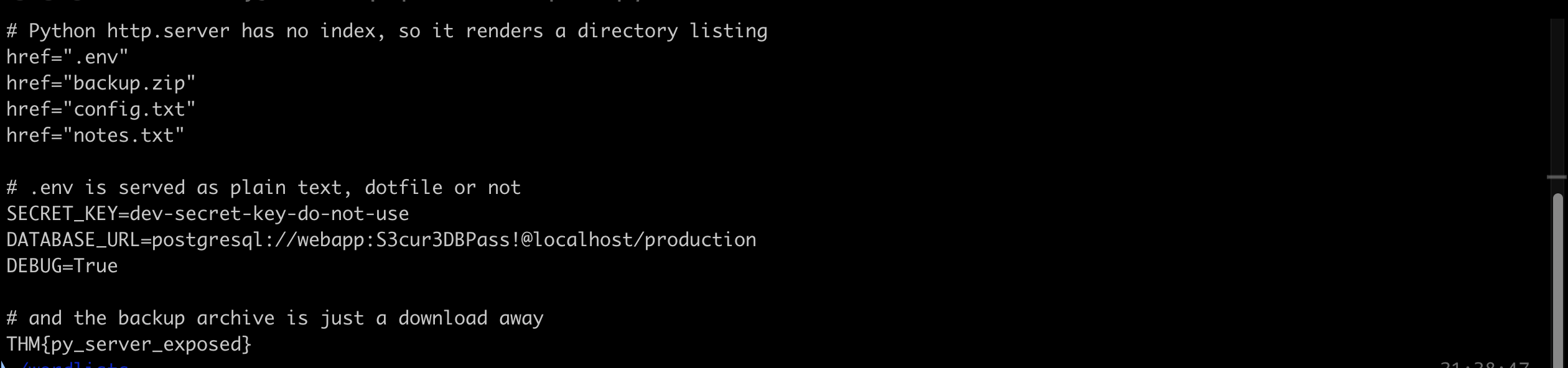
python3 -m http.server has one behaviour worth internalising: with no index.html, it renders a directory listing of the current working directory, and it serves dotfiles like any other file. Whatever directory the developer was standing in when they ran it is now public.
$ curl -s http://MACHINE_IP:8000/ | grep -oE 'href="[^"]*"'
href=".env"
href="backup.zip"
href="config.txt"
href="notes.txt"

$ curl -s http://MACHINE_IP:8000/.env
SECRET_KEY=dev-secret-key-do-not-use
DATABASE_URL=postgresql://webapp:S3cur3DBPass!@localhost/production
DEBUG=True
The database password in the .env file is S3cur3DBPass!. Note it is in the production DATABASE_URL, not the config.txt sitting next to it, which holds a different db_password=OldP@ssw0rd99 for staging. Two plausible-looking passwords, and the question asks specifically about the .env one.
The archive is a plain download:
$ curl -sO http://MACHINE_IP:8000/backup.zip && unzip -q backup.zip -d bk
$ grep -ahoE 'THM\{[^}]*\}' bk/*
THM{py_server_exposed}
THM{py_server_exposed}.
notes.txt in the same listing also gives up Admin creds: admin / admin123 and an internal host. Nothing in the room asks for those, but on a real engagement that file is the finding.
Task 4: Apache, mod_status and Options +Indexes
mod_status is enabled by default on Ubuntu’s Apache package, and it ships restricted to localhost via Require local in conf-available/security.conf. The trap is that a single Require all granted anywhere in a virtual host silently overrides that, without anyone touching the module config. So the module answer is mod_status, and it is always worth requesting even on a server that looks stock.
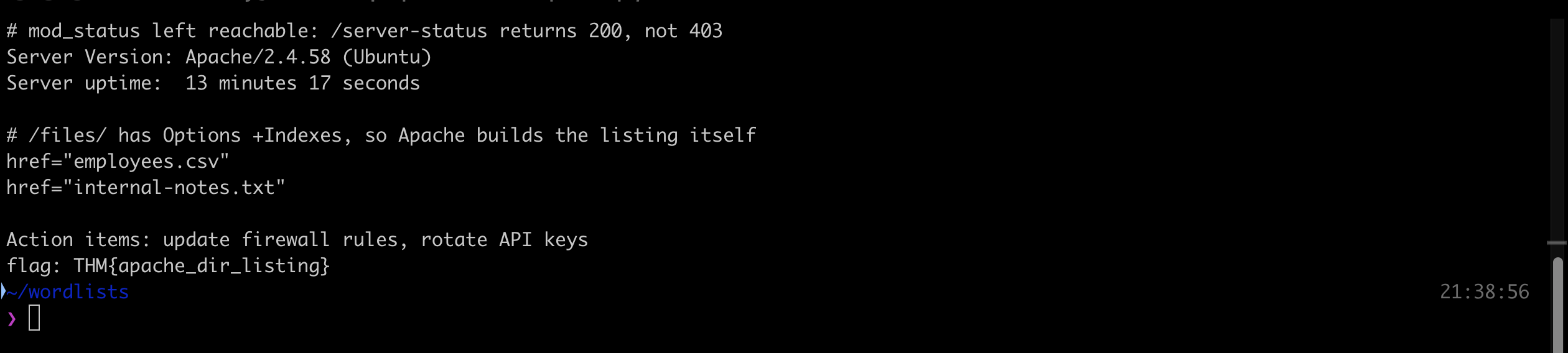
$ curl -s http://MACHINE_IP/server-status | grep -oE 'Server Version[^<]*|Server uptime[^<]*'
Server Version: Apache/2.4.58 (Ubuntu)
Server uptime:  13 minutes 17 seconds
A 200 there, not a 403, is the finding. It exposes the version, the uptime, and every URL currently being requested by other clients.
The second misconfiguration is Options +Indexes on a path with no index file:
$ curl -s http://MACHINE_IP/files/ | grep -oE 'href="[a-z][^"]*"'
href="employees.csv"
href="internal-notes.txt"

$ curl -s http://MACHINE_IP/files/internal-notes.txt | tail -2
Action items: update firewall rules, rotate API keys
flag: THM{apache_dir_listing}
THM{apache_dir_listing}, alongside a CSV of employee names and email addresses.
Task 5: Express, where the app enumerates itself for you
The root path returns a JSON status blob with an application version, which is normal. The problem is the debug endpoints left in place. Guessing at /debug, /status, /health and /env returned 404 across the board; the actual paths came from the room’s own material, and the first one makes the rest unnecessary:
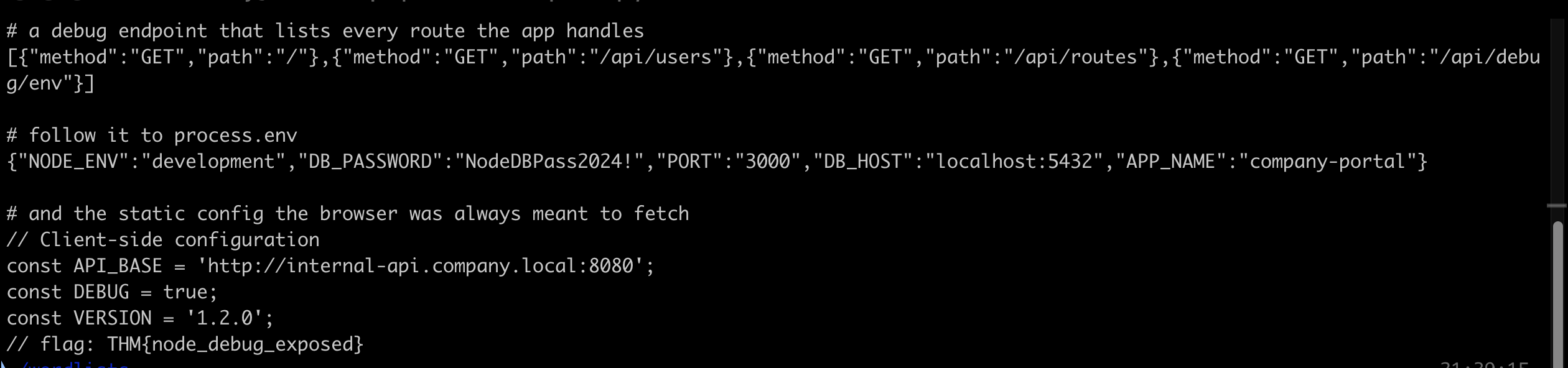
$ curl -s http://MACHINE_IP:3000/api/routes
[{"method":"GET","path":"/"},{"method":"GET","path":"/api/users"},
 {"method":"GET","path":"/api/routes"},{"method":"GET","path":"/api/debug/env"}]
That endpoint reads Express’s internal app._router.stack to list every registered route. It removes the need for Gobuster entirely. Following it to the env dump:
$ curl -s http://MACHINE_IP:3000/api/debug/env
{"NODE_ENV":"development","DB_PASSWORD":"NodeDBPass2024!","PORT":"3000",
 "DB_HOST":"localhost:5432","APP_NAME":"company-portal"}
NODE_ENV is development, which on a reachable server is itself the finding: it means Express’s own error handler will pass stack traces through to clients.
The static middleware is the last piece. express.static() serves a whole directory, and client-side config files are “meant to be public” in a way that does not survive contact with what people actually put in them:
$ curl -s http://MACHINE_IP:3000/static/config.js
// Client-side configuration
const API_BASE = 'http://internal-api.company.local:8080';
const DEBUG = true;
const VERSION = '1.2.0';
// flag: THM{node_debug_exposed}
THM{node_debug_exposed}, plus an internal hostname the outside world was not supposed to learn.
Task 6: nginx, autoindex and stub_status
nginx does not list directories by default. It has to be turned on, and the directive is autoindex on inside a location block. Someone did:
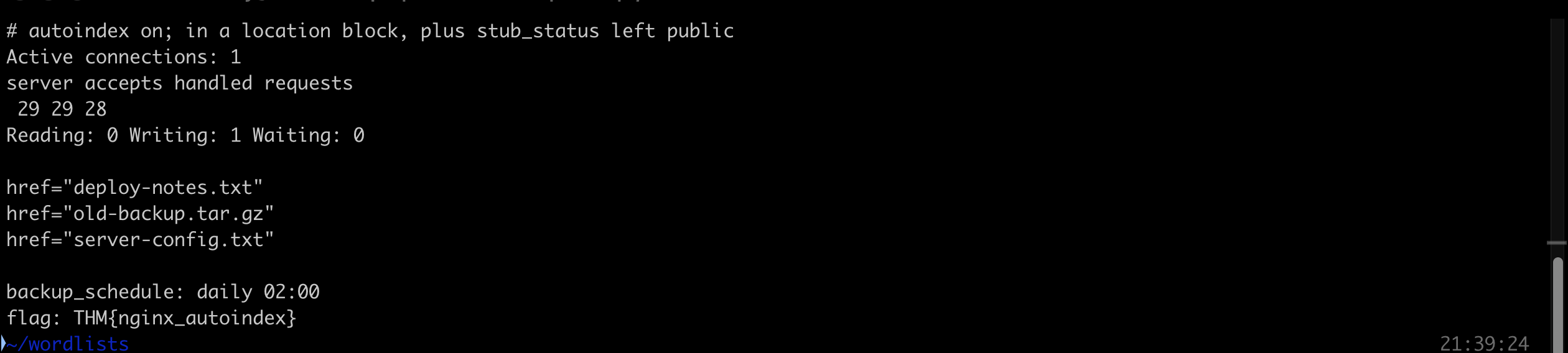
$ curl -s http://MACHINE_IP:8080/nginx_status
Active connections: 1
server accepts handled requests
 29 29 28
Reading: 0 Writing: 1 Waiting: 0

$ curl -s http://MACHINE_IP:8080/files/ | grep -oE 'href="[a-z][^"]*"'
href="deploy-notes.txt"
href="old-backup.tar.gz"
href="server-config.txt"

$ curl -s http://MACHINE_IP:8080/files/server-config.txt | tail -2
backup_schedule: daily 02:00
flag: THM{nginx_autoindex}
The connection statistics path is /nginx_status (the stub_status module, conventionally mounted there), and the flag is THM{nginx_autoindex}. /status, /stub_status and /basic_status all returned 404, so the conventional name is the one that mattered.
deploy-notes.txt in that same listing hands over an SSH key path and a sudo password. Nothing asks for them, but that is the file that ends the engagement.
Task 7: the cross-cutting misconfigurations
The security header that prevents a page being framed on another origin is X-Frame-Options, and its absence is what enables clickjacking. None of the four servers here send it.
For the scanner question, I installed Nikto and ran it rather than guessing the wording:
$ nikto -h http://MACHINE_IP:80 -maxtime 240
+ Server: Apache/2.4.58 (Ubuntu)
+ [750500] /files/: Directory indexing found. See: CWE-548
The finding text is Directory indexing found.

One honest note on that run. My first pass used -maxtime 90 and finished before Nikto reached the /files/ probe, reporting only missing permissions-policy and content-security-policy headers. That looked like the tool disagreeing with what I had already found by hand. It was not: the scan had simply been cut short. Raising the budget to 240 seconds produced the finding at the four-minute mark. A scanner that stops early does not report “incomplete”, it just reports less.
Two things worth keeping
Every flag here came from a default, not a vulnerability. Nothing on this host was unpatched. Apache’s mod_status ships enabled, Python’s http.server ships serving the working directory, Express’s X-Powered-By ships on, and the only deliberate change anyone made was autoindex on. The finding in a report like this is not “you are running vulnerable software”, it is “you deployed the defaults into a place they were never meant to reach”. That distinction changes the remediation from patch to configure.
Time-box your scanner, then check what it did not reach. The 90-second Nikto run missed the exact finding the room asked about and produced a plausible-looking result set anyway. When a scanner’s output disagrees with what manual enumeration already proved, the first question is whether it actually got there, not whether the manual finding was wrong. Manual reconnaissance is what tells you when the tool came up short.
Room solved 100%: 8 tasks, 16 answers.