| Follow @anir0y | |
|---|---|
| Whats Your Name? |  |
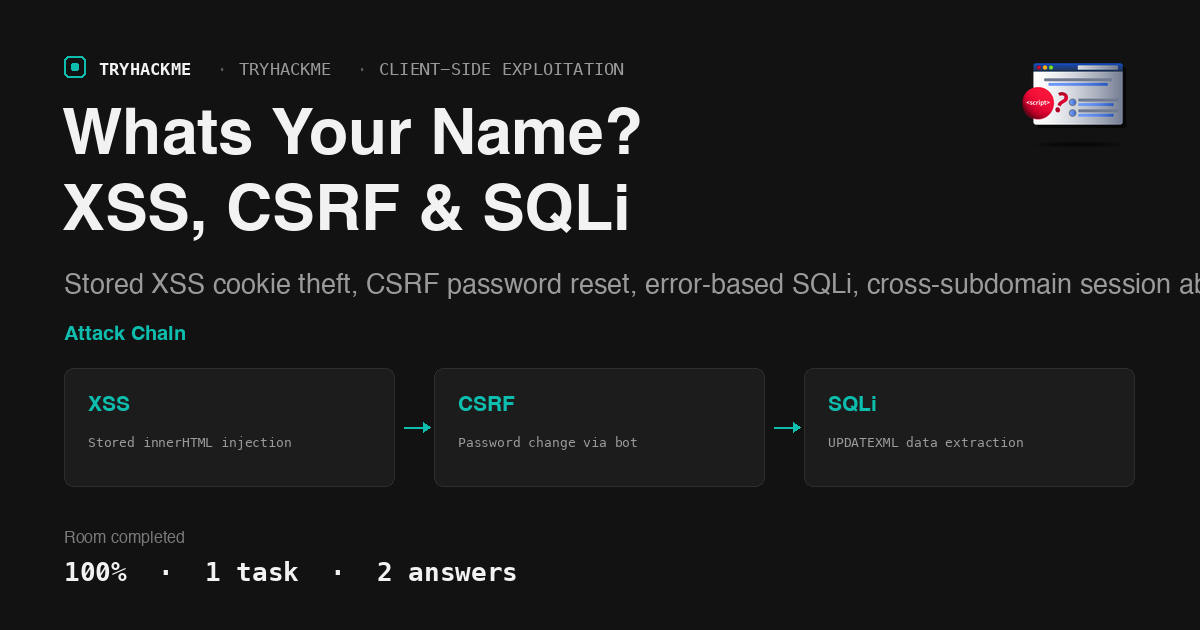
This medium-difficulty room tests client-side exploitation from end to end: inspecting JavaScript to find innerHTML sinks, stealing cookies via stored XSS, forging cross-site requests through a chat bot, and chaining SQL injection to extract credentials. Two web applications share a session cookie across subdomains, and that shared trust is the pivot for both flags.
Task 1: Challenge
The lab deploys two interconnected applications on the same server:
- worldwap.thm: a posting platform with registration, a dashboard, and a moderator panel
- login.worldwap.thm: a chat application with an admin bot that visits
chat.phpevery five seconds
Both share a single PHPSESSID cookie scoped to .worldwap.thm. A session created on one subdomain works on the other.
Reconnaissance
A port scan showed only HTTP (80) open. The first step was mapping every endpoint and reading the client-side JavaScript.
dashboard.js renders posts with innerHTML, making every field an XSS sink:
postDiv.innerHTML = `<h3>${post.title}</h3><p>${post.content}</p><p>- ${post.username}</p><hr>`;
chat.php on login.worldwap.thm also renders messages with innerHTML:
messageDiv.innerHTML = msg.message;
register.js leaks an API key required for registration:
X-THM-API-Key: e8d25b4208b80008a9e15c8698640e85
login.js reveals role-based routing: moderators go to admin.php, everyone else to dashboard.php.
Finding SQL injection
The edit_post.php and delete_post.php endpoints accept user-controlled id and title fields in a raw SQL query. Injecting into the id field of an UPDATE statement triggers XPATH errors via UPDATEXML, leaking query results character by character:
id: 4 AND UPDATEXML(1,CONCAT(0x7e,(SELECT version()),0x7e),1)
# XPATH syntax error: '~8.0.36-0ubuntu0.22.04.1~'
This confirmed error-based blind SQL injection. Stacked queries were blocked (the application uses mysqli_query, not mysqli_multi_query), so writes to other tables were off the table.
Database enumeration
Using the UPDATEXML injection, I mapped both databases:
- postman (worldwap.thm):
users(id, username, password as bcrypt, email, name, role, status) andposts(id, title, content, username with FK to users) - chatapp (login.worldwap.thm):
users(username, password in plain text, role) andmessages
The chatapp stored passwords in plain text, a critical weakness.
Flag 2: admin panel (CSRF via chat XSS)
The admin bot on login.worldwap.thm clicks the first unclicked <a> tag in the latest chat message using window.open(). The change_password.php endpoint accepts a POST with just new_password, no CSRF token and no old-password check.
Attack chain:
- Sent a chat message containing
<a href="...">pointing to a page that submits a CSRF form tochange_password.php - The admin bot clicked the link, changing its own chatapp password
- Logged in to the chatapp as admin with the new password
- Accessed
profile.phpon login.worldwap.thm
The profile page displayed: Flag value: AdM!nP@wnEd
The admin bot’s stolen session also worked on worldwap.thm (cross-subdomain sharing), giving admin-level access to the post management API, which enabled the SQL injection enumeration above.
Flag 1: moderator account (password reuse via SQLi extraction)
The moderator account on worldwap.thm had role=moderator and a bcrypt password hash. The admin.php and mod.php pages required exactly role=moderator (the admin role returned 403).
Approaches that failed:
- Stacked queries to UPDATE the moderator’s password: blocked by
mysqli_query - Multi-table UPDATE from the injection point: the SET-clause injection could not introduce a JOIN
- INTO OUTFILE: restricted by
secure_file_priv=/var/lib/mysql-files/ - Session injection via registration: the register API blocked
|,;, and", the exact characters needed for PHP session deserialization
The breakthrough came from extracting the moderator’s bcrypt hash in segments using UPDATEXML:
  # Part 1: ~$2y$10$pqarkndVEh8k9rLKOY88Lu9~
  # Part 2: ~9oFkfJOzRZuEDLHj8Q.Y~
  # Part 3: ~uNX8NTvLBGS~
I already knew the chatapp admin’s original plain-text password (Un6u3$$4Bl3!!) from the CSRF attack. Testing it against the moderator’s bcrypt hash:
bcrypt.checkpw(b'Un6u3$$4Bl3!!', moderator_hash)
  # True
Password reuse. The moderator on worldwap.thm and the chatapp admin shared the same password.
Logged in to worldwap.thm as moderator, then accessed profile.php on login.worldwap.thm with that session.
The profile page displayed: Flag value: ModP@wnEd
Answers
- Q1: What is the flag value after accessing the moderator account? ModP@wnEd
- Q2: What is the flag value after accessing the admin panel? AdM!nP@wnEd
Takeaways
Shared session cookies across subdomains multiply the impact of every vulnerability. A CSRF on the chatapp changed the admin’s password, but the same session token gave admin access to the posting platform, unlocking SQL injection that would otherwise have been unreachable. Every trust boundary a cookie crosses is an attack surface.
Error-based SQL injection is a full read primitive even without stacked queries. The UPDATEXML technique extracted user tables, password hashes, and database metadata one fragment at a time. When the moderator’s hash matched a password already looted from the chatapp, the entire chain closed without ever needing a write primitive.
Room solved 100%: 1 task, 2 answers.